Microsoft says it hit a key climate milestone. Does the math add up?
Published in Business News
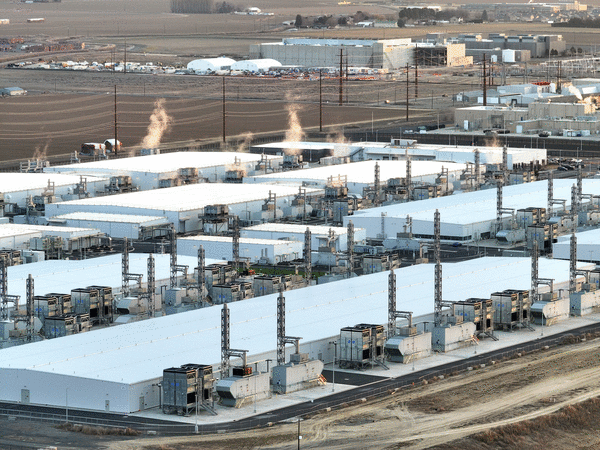
Microsoft announced Wednesday it has matched 100% of its electricity consumption with renewable energy, meeting a goal it set in 2020. The company’s electricity demand is projected to surge due to the expansion of data centers in a global artificial intelligence race, but the tech giant said for now, it had met a major milestone toward its “moonshot commitment” to become carbon negative by 2030.
Clean energy accounting experts say Microsoft’s announcement reflects meaningful progress toward addressing climate change, while some argue that “matching” electricity consumption with renewable energy is a wrong approach, one that compares apples to oranges.
Microsoft’s announcement does not mean its data centers or corporate offices are running solely on renewable energy. Most of the company's facilities are plugged into local utility grids that use a mix of fossil fuels and renewable energy, the exact ratio varying by location. But the tech giant says it has contracted enough new renewable energy in those markets to match more than 90% of its annual electricity use. Microsoft says the rest is matched by utilities’ renewable energy use.
What are these power contracts?
Since 2013, Microsoft has signed contracts for 40 gigawatts of renewable energy supply in 26 countries, enough to power 10 million American homes. About half of that power is online, the company says, and the other half will be added over the next five years.
These contracts, or “power purchase agreements,” are often signed before a renewable energy project like a solar farm or a wind farm is built. A company like Microsoft promises to buy the power for a set price for a period of time, often 10 to 20 years. Microsoft doesn’t actually take that electricity directly for itself. The wind or solar farm sells the power into the grid, and Microsoft pays or receives the difference between market price and the price agreed to in the contract.
That kind of deal provides guaranteed revenue for the project that can reduce risk and help the developer secure bank financing. The benefit to renewable energy supply, experts say, is that the contracts can make projects feasible to build in cases it would have been impossible without their financial backing. But it’s difficult to say how often.
“Sometimes, these projects might have been built anyway. They just happen to go to one buyer rather than another,” said Danny Cullenward, a climate policy researcher at the University of Pennsylvania.
Microsoft says its contracts are generally for new projects where its financial involvement is critical for their success.
Does Microsoft’s approach make a meaningful difference?
A notable part of the company’s announcement is that Microsoft is not using renewable energy credits to get to its 100% matching claim. Renewable energy credits can be purchased from projects that are already operational. For example, a wind farm can sell credits to companies separately from the actual power it generates.
Michael Gillenwater, executive director at Greenhouse Gas Management Institute, a nonprofit that works on improving climate accounting, said research has shown those credits have had little impact on additional renewable energy being built.
“Historically, (renewable energy credits) haven't done anything,” Gillenwater said. “That was really, for the most part, greenwashing. And so that's why they're shifting to these (power purchase agreements), because our expectation is they have more credibility.”
Conversations around revisions to the Greenhouse Gas Protocol — the global standard that companies like Microsoft use to measure and report greenhouse gas emissions — are increasingly focused on whether companies should more closely match their electricity use with renewable energy produced in the same places and at the same times they consume it.
But Gillenwater says the framework matching electricity use with renewable energy produced, measured in megawatt-hours, obscures the real issue.
“All this matching stuff, it’s just creating a lot of complexity and confusion and not actually telling us what we actually care about, which is: Is what the company's doing actually displacing emissions?” Gillenwater said.
What’s next?
A more meaningful analysis may look at whether renewable energy was built because of a company’s contribution, whether that displaced power was produced by coal or gas, and how many tons of carbon emissions were avoided because of that, Gillenwater said.
Still, other experts say Microsoft is setting a high standard by adding renewable energy in the same places it’s using power and by using long-term contracts which are capital intensive.
“It's a big deal,” said David Victor, an expert on corporate clean energy accounting at the University of California, San Diego. “I think they're making a plausible claim for climate neutrality.”
Moving forward, Microsoft says meeting climate and growth goals will require more than just wind and solar. The company advocates for an “all-of-the-above” decarbonization strategy that includes nuclear energy, next-generation grid infrastructure and carbon capture. And it said it would engage in conversations around strengthened measurement frameworks to ensure that its clean energy procurement resulted in real-world emissions reductions.
“Our carbon negative commitment remains a call to action — for Microsoft, our customers and the broader technology sector — to invest in an affordable, reliable and sustainable power system. As we look toward 2030, that call to action has never been clearer,” wrote Melanie Nakagawa, chief sustainability officer, and Noelle Walsh, president of cloud operations and innovation.
©2026 The Seattle Times. Visit seattletimes.com. Distributed by Tribune Content Agency, LLC.










Comments