Trump wants Powell out, but what happens if Warsh isn't confirmed in time?
Published in Business News
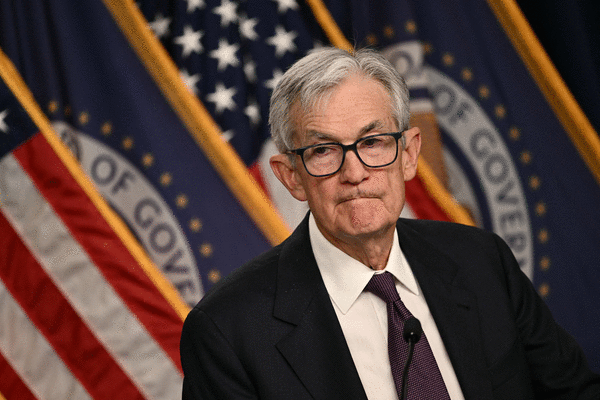
The ongoing legal standoff between the Trump administration and Federal Reserve is increasing the likelihood that the next Fed chief won’t be confirmed by the Senate before Chair Jerome Powell’s term ends in May.
Powell last week addressed speculation about what will happen in that instance: He declared he intends to remain in charge, citing both the law and historical precedent.
“If my successor is not confirmed by the end of my term as chair, I would serve as chair pro tem until he is confirmed,” Powell said during a March 18 press conference, referring to pro tempore, the Latin term used to denote a temporary title. “That is what the law calls for. That’s what we’ve done on several occasions — including involving me — and it’s what we’re going to do in this situation.”
The law, however, doesn’t directly address the approaching scenario. And historical precedent doesn’t fit neatly with current circumstances, because President Donald Trump has made clear he wants Powell out.
The Federal Reserve Act, the statute that created the central bank and governs its operations, does spell out that the Fed’s vice chair should preside over meetings of the Board of Governors if the chair is absent. But it doesn’t say explicitly what happens when the chair’s term expires and no replacement has been confirmed. Trump has nominated former Fed Governor Kevin Warsh to succeed Powell, but his path is currently blocked in the Senate over objections to a Justice Department probe into Powell.
The Legal Argument
The Fed’s former general counsel, Scott Alvarez, said Powell’s position can draw on two portions of the law for support.
First, the law’s Section 10 states that when a Fed governor’s term expires, the governor “shall continue to serve until their successors are appointed and have qualified.”
Governor Stephen Miran is just the most recent example. His term expired in January, and Warsh has been nominated to take his seat. But with Warsh yet to be confirmed, Miran is continuing to serve. In the case of a chair’s term expiring, the Fed could argue that the same rule applies, Alvarez said.
“So the existing chair holds over and fills the job until a new chair is confirmed,” Alvarez said.
Alvarez also pointed to Section 11, which gives the Fed’s board authority to delegate any of its functions – except those related to rulemaking or monetary and credit policies — to any member of the Board.
By choosing Powell as chair pro tempore, the Board would essentially be delegating to him the authority to continue carrying out the functions of chair, such as reviewing budgets and serving as the Fed’s chief spokesperson, according to Alvarez.
“All the things we think about that the chair does really are delegated from the board,” he said. “The board will vote to give him all those duties.”
Precedent
Kathryn Judge, a law professor at Columbia University who studies the Fed, said the Federal Reserve Act isn’t clear on what should happen come May 15 if Warsh is still waiting.
Still, she said Powell can also draw on how the central bank has handled previous gaps between two chair terms.
“When the underlying language is not clear, adhering to established precedent is the safest and most prudent course for the Fed,” she said.
As Powell alluded to, he’s used the pro tempore title before. In 2022, after he was nominated by former President Joe Biden for a second chair term and was awaiting confirmation, Powell served as chair pro tempore for about three months. Alan Greenspan did did the same for more than three months between terms in 1996 under President Bill Clinton.
But there’s one key difference this time. In those past instances, the president had tapped the previous chair for another four years on the job. This time, President Donald Trump has shown clear antipathy toward Powell and has repeatedly said he wants the Fed chief out of the job.
Some Fed watchers also point to a 1978 memorandum from the Department of Justice’s Office of Legal Counsel. In the event the chair became vacant, it advised that the president had the authority to appoint an “acting chair” from among the governors on the Fed’s board. That, some believe, provides at least an opening for Trump to argue he can name his own temporary pick.
“The selection of a chairman pro tempore has not been contested previously because, in contrast to today, the White House wanted the incumbent Fed chair to stay,” Michael McLean, senior research analyst on U.S. public policy at Barclays, wrote in a note to clients.
“We anticipate the administration could challenge Powell’s selection as chair pro tempore,” McLean wrote. “That scenario could prompt competing claims over Fed leadership, creating legal and institutional uncertainty and potential market volatility.”
Alvarez, the former Fed general counsel, however, said the 1978 memo was issued before a key change in the Federal Reserve Act went into effect. That change required that chair nominees be confirmed by the Senate specifically for that position, limiting its applicability today, he said.
The White House, for its part, reacted to Powell’s remarks by repeating its endorsement of Warsh and saying it’s working closely with members of Congress to get him confirmed.
Treasury Secretary Scott Bessent said it would go against historical norms for Powell to remain at the Fed after his term as chair ends, but didn’t address Powell’s right to serve as chair pro tempore in that instance.
DOJ Probe
The irony of the current situation is that it’s the Trump administration’s own pressure campaign on the Fed that is delaying Warsh’s confirmation and prompting Powell to consider remaining at the central bank.
Warsh’s path is blocked by Republican Senator Thom Tillis, who has vowed to hold up the nomination until the resolution of an investigation by the DOJ into Powell and the Fed over a $2.5 billion renovation of the central bank’s headquarters. Tillis views the probe as politically motivated.
A federal judge earlier this month quashed subpoenas the DOJ issued in the matter, but U.S. Attorney Jeanine Pirro has vowed to appeal that decision, meaning the situation could drag on for months.
Powell has said he won’t leave the central bank until the probe is over “with transparency and finality.” Apart from his chair term, Powell has a seat as a Fed governor that allows him to stay at the central bank until early 2028.
____
—With assistance from Stefani Reynolds and Enda Curran.
©2026 Bloomberg L.P. Visit bloomberg.com. Distributed by Tribune Content Agency, LLC.




Comments