Vendors, gig workers, and therapists push back on Philadelphia's 'very unfriendly' business tax
Published in Business News
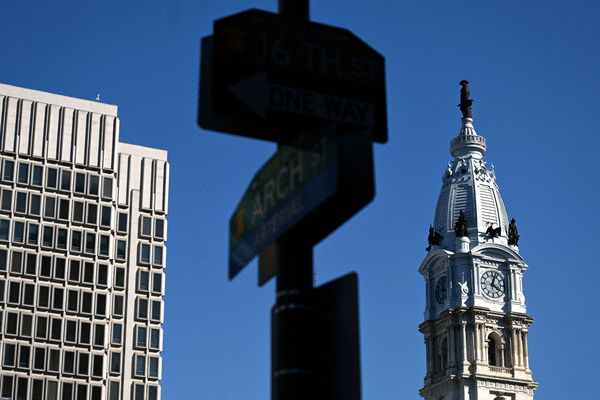
Philadelphia officials have made no secret that as of this year’s Tax Day, they are applying the city’s Business Income and Receipts Tax — $1.41 per $1,000 of sales and $57.10 per $1,000 of profits — even when sales are under $100,000. That income used to be tax-exempt.
The city estimates 75,000 small-business owners may owe the tax for the first time.
But the realization that payment of this portion of the Business Income & Receipts (BIRT) tax — plus next year’s tax, which businesses are required to pay in advance in quarterly installments — is due on top of other city, state, and local taxes, has left busy sole proprietors and other small-business owners feeling unprepared, even resentful.
The prospect of paying thousands they hadn’t expected has driven vendors, drivers, self-employed healthcare professionals and others to lobby for a bill drafted last year by Councilmember Mike Driscoll that could exempt sole proprietorships from the tax.
“This is a complete assault on the very people who support the City of Philadelphia. It exorbitantly affects my business,” said Jeanine Stewart, a self-employed therapist, who is part of a Facebook group Clinicians for BIRT Reform. “It is unreasonable. It is negligent of small-business owners’ time and energy to ask them to make such a sudden shift in income level.”
The Asian Pacific Islander Political Alliance is spreading the word about the tax among food-cart owners and gig workers, including second-generation business owners.
“They are graphic media designers and social media influencers who are young and progressive. Some of their parents are restaurant and nail-salon owners,“ said Erica Maria Cheung, APIPA spokeswoman.
Philadelphia native Jigar Mehta, a former Deloitte consultant turned self-employed systems analyst who now lives in Bucks County, started a website LiftPhilly.org, reached out to tax specialists at some of Center City’s largest corporate law firms, and set up an ad hoc committee to help small-business owners strategize.
The group helped persuade Driscoll, who represents parts of Northeast Philadelphia, to introduce a bill last fall that would exempt sole proprietorships, covering most small businesses. While city finance officials worried that big real estate developers might use it as a loophole, city staff testified in a March budget hearing that a legal review found the exemption, unlike the income limit, would likely survive a legal challenge.
“We understand what’s at stake for Philadelphia’s smallest businesses, the mom-and-pop shops, sole proprietors, and neighborhood storefronts that keep our corridors thriving,” Driscoll said in a statement to The Inquirer. ”This bill gives sole proprietors and single-member LLCs some breathing room, helps level the playing field," and would, if passed, send " a clear message that Philadelphia supports the people who drive our local economy."
City officials have said the sub-$100,000 businesses pay less than 5% of the $700 million collected by BIRT from all businesses.
Now supporters are trying to win Mayor Cherelle L. Parker’s support and get City Council to schedule a hearing.
Caught by surprise
In 2024, Stewart, the therapist, grossed just over $100,000 and owed minimal BIRT. For this year, she owes more than $5,700 — and also will be required to pay quarterly installments toward next year’s tax.
City officials decided not to fight a legal challenge to the BIRT exemption over the summer, Stewart noted. “How can it apply to all of 2025?” she asked. “And I got the official notice in December — far too late to begin saving for all of last year.”
She said she may have to move her business out of the city to continue to afford her apartment.
“It is incredibly disappointing and disheartening to see how much I will owe in taxes to the City of Philadelphia through the BIRT,” said Kyra Sjarif, a therapist who counsels trauma survivors, queer and transgender patients, patients who are Black, Indigenous and people of color, and neurodivergent clients.
Sjarif said she bills a quarter of her caseload on a sliding scale between $40 and $80, in addition to taking insurance, to make her practice more accessible. Paying the BIRT “places a significant financial burden on me.”
She said she was disappointed at “the mayor’s lack of willingness to imagine other possibilities and explore avenues to support small business owners.”
Ruth Conviser, another self-employed clinician who took three months’ unpaid leave for the birth of her second child last year, heard about the tax expansion over the summer, “but I felt surely it won’t be implemented for that whole year. Even therapists have denial. And then in October, we got this very dense letter explaining the change.”
Conviser started a Facebook group called Clinicians for BIRT Reform on March 10. In five weeks, 188 had joined, and members other self-employed professional groups reached out.
She also e-mailed the office of her City Council representative, Jamie Gauthier, but was disappointed that staffers at that time were unfamiliar with the issue and instead sent her material about property taxes.
Conviser learned about Driscoll’s bill and reached out to Mehta and to more public officials. Her group is scheduled to with representatives of the mayor’s office and the revenue department on Tax Day, April 15.
She also researched alternatives. Conviser learned she could reorganize her business into a corporation not subject to the tax — or “move out of the city.”
She doesn’t want to leave, believing “the city should be a refuge” at a time when the federal government is cutting many aid programs.
“I get that it’s not easy for city officials,” she said. “They may need the state [to change a law]. But I wish they‘d join us. We need a champion.”
So many taxes
The city has held informational workshops over the past six months, said Sarey Thach, owner of Philly Nail Co. in South Philadelphia and consultant to small businesses at the Southeast Asian Market at FDR Park.
“Their business tax prep program helps figure out how much we owe. But it’s tricky,” Thach said. “The BIRT ultimately forces us to pay estimated tax in the future. We are just getting by, and now we’re on another tax.”
Longtime vendors who for years fermented specialty foods and sold only to other immigrants from their home communities have applied for business licenses and begun paying business taxes in recent years, thanks to the Southeastern Asian Market’s increasing popularity with other city populations.
They formed a nonprofit Vendors’ Association of FDR Park, which now has more than 60 members, Thach said.
“And they are now learning it’s really expensive to run a small business in the city,” Thach said. “We have sales tax, payroll tax, occupancy tax, and now the BIRT tax, that we were not aware was a thing. There are permits and licenses and inspections. It becomes very expensive.”
“What is the point of starting a business and creating this small-business ecosystem if it is too expensive to stay in business?” Thach said.
Last winter, Angela Le, who was laid off from Urban Outfitters’ fashion division after nine years, started Tailor Your Closet, a “one-stop shop for clothing customization” that converts customers’ cherished old fabrics into new garments, such as wedding and bridesmaid dresses.
“My budget was already pretty tight — tariffs have increased the cost of fabric — and I’m a new business owner. There’s a lot of uncertainty and pressure, and now there’s this extra cut that I didn’t allocate for,” Le said.
“I’m a firm believer that small businesses make our community thrive,” Le said. “It’s an inherently risky, nontraditional career path. These are people we should support.”
©2026 The Philadelphia Inquirer, LLC. Visit at inquirer.com. Distributed by Tribune Content Agency, LLC.






Comments