Data centers use lots of electricity. Should we be worried? Here are 5 key issues
Published in Business News
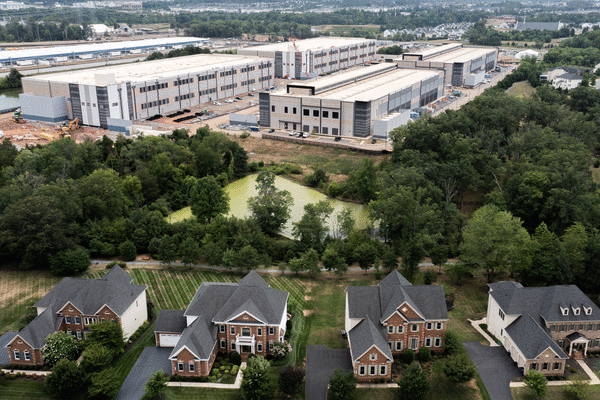
Data center proposals across the country are stoking wide-ranging questions and concerns tied to their consumption of electric power.
The facilities store racks of computing equipment, in row after row, powering main features of modern technology, especially artificial intelligence.
Keeping that machinery humming can consume as much electricity as entire cities — adding up to potentially spark one of the biggest transformations to U.S. power demand since the rise of widespread air conditioning.
We previously looked at the water consumption of data centers. Now, here are key issues related to electricity:
How much energy do they use?
Data centers can use a power grid-altering amount of electricity. Some facilities can guzzle as much energy as 100,000 homes, said Lauren Withycombe Keeler, a professor at Arizona State University’s School for the Future of Innovation in Society.
In places like northern Indiana, a data center campus for Amazon and Anthropic, the AI developer, is estimated to require as much electricity as 1 million-plus homes, according to multiple reports. That project is part of a data center push in Indiana that, by 2030, could see a handful of sites use more power than all 6.8 million households in the state, says an overview from Indiana University.
Collectively, data centers already consume a substantial — and growing — slice of the nation’s electricity. A report from Lawrence Berkeley National Laboratory found that by 2023, data centers accounted for about 4.4% of total U.S. electricity consumption — more than doubling the 1.9% the facilities used in 2018.
By 2028, the report estimated, data centers could use 6.7% to 12% of all U.S. electricity.
Much of that energy consumption comes from the nature of AI, which doesn’t work in the same way as traditional computing. The computations for AI are remarkably hard, requiring trillions of inputs and outputs. The resulting output is essentially grown, not retrieved like something from an ordinary database. And the information is summoned based on the given prompt and range of possible answers.
“AI is just a fundamentally hard computation. You have to do lots of math,” said Alex Newkirk, a researcher with the Lawrence Berkeley National Laboratory. “That’s why they need dedicated hardware.”
The hardware requirements explain the need for more large data centers. And that creates the need for lots of electricity for power but also to cool all the machinery.
The expected large use from data centers is helping drive national energy trends, alongside other forces, like electric vehicles and heating systems. Forecasts for overall electricity demand call for a significant increase in coming years after a decades-long plateau that leaps in technology and efficiency made possible.
For instance, national electricity use is expected to grow by 1% this year and 3% in 2027, according to the U.S. Energy Information Administration. Should that pan out, it would mark the first time since 2007 that demand has risen in four consecutive years.
Relatively few power plants were built over the nation's prolonged period of flat demand. But the appetite for more of the “baseload” power they provide has been reawakened amid the push for data centers. That has delayed some plant retirements and caused Missouri and other states to dust off ambitions to build new nuclear plants for the first time in decades.
For example, at a statewide nuclear summit last year that attracted political, energy and business leaders, Missouri Gov. Mike Kehoe expressed urgent support for the energy source, saying "nuclear technology can be a critical piece" in powering the state's future. And Ameren, the St. Louis-based power utility, has cited "large-load customers" like data centers as a chief catalyst for reshuffling its long-term plans; it now aims to get 40% of its energy from nuclear power, 30% from gas and 30% from renewables by the 2040s.
“The era of flat load growth is over for a variety of reasons,” said Newkirk. “But AI is a big one.”
Where do they get the power?
How data centers get power varies by facility, depending on their location and the regional electric grid. And some data center operators are exploring ways to run their own power sources.
Data center developers say that figuring out how to power the facilities is the tallest hurdle they face.
“Power is the single biggest constraint on data center development in the United States, and has been for years,” Bob Clark, the executive chairman of Clayco — whose affiliate, CRG, is a major developer of the facilities — said in an email to the Post-Dispatch.
Project developers and electric grid operators don’t just face questions about how to procure the power but also how to move it to where it’s needed.
“The challenge is both generation and transmission,” said Clark, who mentioned that transmission capacity is at the top of the list of topics discussed often with Ameren. “Decades of flat electricity demand led to underinvesting in the grid, and the infrastructure is now catching up.”
Often, data center projects gravitate to where they can get a steady supply of cheap power. For example, the abundance of hydropower has helped make the middle of Washington state a hotbed for data centers. And major ones in northwest Indiana could stand to take advantage of Illinois’ nation-leading output of nuclear power, plus the lower taxes offered in the Hoosier State.
The proposed projects around St. Louis are typically focused on sites near large transmission lines and substations, poised to draw from the region’s broader power grid that is heavily reliant on coal.
For instance, in Montgomery County, Missouri — where data centers for both Google and Amazon are proposed — a local economic development group has touted access to the largest electrical substation in the state. And in Festus, Missouri, a suburb of St. Louis where CRG aims to build a large data center project, Clark points to a sizable transmission line as a key draw.
What are the environmental concerns?
Top environmental concerns hinge on the climate implications and greenhouse gas emissions that would accompany buildouts of fossil-fuel power generation, whether from new gas plants or the extended use of coal plants.
But design strategies and technological innovations also stand to trim the energy requirements for data centers.
Cooling, as a dominant use of energy at the facilities, is a main target for those efficiencies. The most efficient forms of cooling typically use water to whisk heat away from the equipment; the water is often circulated in looped systems that run through chillers.
Nvidia — the dominant producer of the chips for AI — recently announced that its newest generation of chips could be cooled with water as hot as 113 degrees.
At that temperature, "no water chillers are necessary for data centers,” said Jensen Huang, Nvidia’s CEO, when he described the new chips at a January event. “We’re basically cooling this supercomputer with hot water. It is so incredibly efficient."
Still, experts caution that the scale and proliferation of the facilities could diminish those gains.
But in a best-case scenario, they say, the moment can be harnessed into much-needed upgrades to the grid and to accelerate clean technologies — all or mostly paid by data center operators.
“If these guys can foot the bill ... that’s a great outcome for everybody,” said Jackson Morris, a director with the Natural Resources Defense Council.
On that note, Clark, of Clayco, pointed to commitments for clean energy from data center companies, as well as investments in renewable energy from Ameren. The utility, while still leaning into new natural gas plants, plans to also ramp up its renewable power in coming years.
“Anyone who wants clean energy investment in Missouri should welcome" data centers, Clark said.
What are the transparency complaints?
In multiple communities around St. Louis, local residents have voiced frustration about the lack of transparency in data center proposals. Nondisclosure agreements can block key details, including the identity of operators and the anticipated water and power requirements.
Nationally, the opacity has often extended to the whereabouts of major AI data centers. For example, there’s no comprehensive dataset about who owns what facilities, and where they’re located. Some groups have resorted to studying satellite imagery to assess development of facilities that look like advanced data centers — gleaning clues like counting the number of industrial chillers on rooftops.
Others insist that more data is needed about the facilities’ energy usage as well as other key metrics like water consumption.
“It all gets back to transparency,” said Eric Masanet, an engineering professor at the University of California, Santa Barbara who studies data centers. “You can’t manage what you don’t measure.”
Do electric bills go up?
The short answer is maybe.
Big power users like data centers could help push prices higher in different ways. One key factor is increased power demand. That can be influenced by the types of power generation that are serving that demand.
Forecasts from the U.S. Energy Information Administration say that if power demand grows faster than expected in the near future, it would result in higher wholesale electricity prices, which stand to be passed on to consumers, especially in areas relying on gas and coal plants.
Jumps in electricity prices would vary from place to place. The hikes could be steeper in places like Texas, which has limited connections to power grids in other regions.
The prospect of higher prices has helped give rise to a slogan — coined BeYONCE, like the singer — encouraging data center developers to “Bring Your Own New Clean Energy” to the table. The goal is to coax new, low-cost generation onto the grid, from sources like wind and solar, to reduce electricity prices for customers. Locally, attorney and developer Jim Onder is proposing a $2 billion project in Ferguson, Missouri, to build a clean energy data center on the former Emerson campus.
Another factor that can affect customers' bills are infrastructure costs — the price of building out the electric grid. Many places have yet to establish rules about such costs and who pays for them.
In Columbus, Ohio, for example, local officials have pointed to data center construction as a key reason for residential bills increasing about $20 monthly, as customers absorb hikes in both base rates and transmission rates.
Missouri has recently formed rules for how to handle costs tied to “large-load” customers of its biggest utilities, like Ameren, and to shield customers from negative impacts — especially if a major power user were to suddenly move or go out of business after significant investments were made.
To avoid having customers shoulder costs in such a scenario, Missouri officials have adopted certain rates for big customers, along with conditions to ensure that they cannot easily or quickly abandon their deals with electric utilities.
The prevailing agreement for Ameren’s territory won support from many parties, including Google, Amazon, the Sierra Club and the utility itself. There was a notable holdout, however, as the Office of Public Counsel — a state office that argues on behalf of ratepayers — did not sign the agreement.
Prospective developers of local data center projects have pointed to those rules while aiming to allay concerns about costs.
"Under Missouri law, data centers must pay for the infrastructure they require," Clark, the Clayco chief, told the Post-Dispatch. "New transformers, substations, and transmission upgrades get built without shifting costs to residential customers."
©2026 STLtoday.com. Distributed by Tribune Content Agency, LLC.










Comments