Inflation resurgence squeezes US voters as gas, food prices rise
Published in Business News
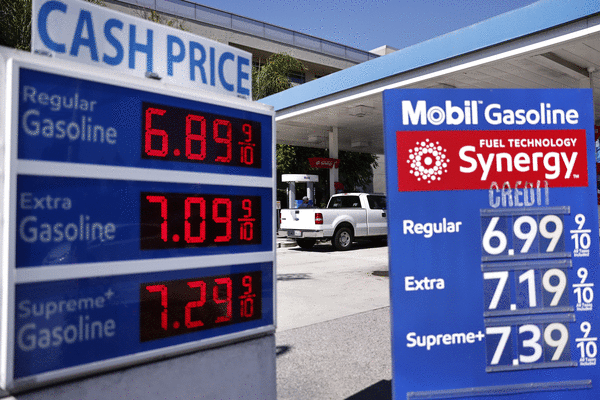
The worst U.S. inflation in years is once again eating away at Americans’ paychecks, as rising gasoline and grocery prices threaten to undermine household spending.
Fresh government data out Tuesday underscored how the Iran war is reigniting inflation, straining consumers who were already frustrated by the high cost of living. After accounting for rising prices, wages declined in April from a year earlier — the first such drop since 2023.
President Donald Trump this week unveiled new proposals to lower prices as Republicans and Democrats scramble ahead of the U.S. midterm elections to convince voters they can make their daily lives more affordable. But the renewed squeeze on household budgets suggests Americans’ sour mood on the economy is unlikely to ebb anytime soon.
“We need to fill up the car to get to work, to get the kids to school. We need to eat. These aren’t purchases that households can avoid or put off,” said Sarah House, senior economist at Wells Fargo & Co. “This really is putting the squeeze on a lot of U.S. households.”
The consumer price index rose 3.8% from a year ago, the most since 2023, data out Tuesday showed. Gasoline prices are up some 50% since the war began, according to data from the American Automobile Association, and the latest Bureau of Labor Statistics report pointed to rising prices for airfares, housing, clothing and food, too.
Grocery prices jumped in April by the most since 2022, when overall inflation rose to multi-decade highs. Ground beef prices topped $7 a pound for the first time, as the nation’s cattle herd remains at its smallest in 75 years, and coffee prices hit another all-time high. Prices for fresh fruits and vegetables, milk and bread also climbed.
Trump was elected in part due to Americans’ frustrations with high prices, but has largely focused his attention on foreign wars and White House renovations. Democrats are now campaigning aggressively on affordability, arguing that Trump has not delivered on those 2024 campaign pledges.
Some of Trump’s recent proposals include floating a temporary pause on the federal gas tax. He also had been expected to sign executive orders intended to reduce beef prices that have since been delayed and urged Congress to pass housing legislation that “would ensure that homes are for people, not Corporations.”
Republican strategist Alex Conant said it was important for the White House to show they are focused on the issue, arguing that the “cost of living is the number one issue for voters, it better be the number one issue for Trump.”
Still, just how quickly any of these moves could be realized — or just what actual benefits would flow to Americans — was not clear. Democratic pollster Jeff Horwitt, of Hart Research, said this push may not shift voters’ views greatly.
“Even a gas tax holiday makes the point that you’ve made things worse,” he said. “It doesn’t change the bigger problem.”
Pressed about the impact of the war on American consumers, Trump said Tuesday, “I don’t think about Americans’ financial situation. I don’t think about anybody. I think about one thing: We cannot let Iran have a nuclear weapon.”
Record low sentiment
Americans are saving less and borrowing more to keep up with the cost of living. Tax refunds have helped blunt the blow of higher prices, but company executives say lower-income customers are already beginning to cut back. Consumer sentiment is at a record low, and even among Republicans, the University of Michigan’s gauge has dropped to the lowest level of Trump’s second term.
Even if the current ceasefire holds and the Strait of Hormuz reopens soon, economists anticipate higher costs are likely to persist in the months ahead as oil output normalizes and shipping flows recover. Rising prices for fertilizer are expected to result in higher grocery bills, and elevated oil prices could also make other goods and services more expensive as companies seek to pass rising transport costs on to consumers.
That keeps the pressure on people like Liam Chavez, a 28-year-old program operations manager at the University of California, Berkeley’s School of Public Health who is seeking ways to balance rising prices while continuing to pay down his debt.
Chavez is skimping on fresh produce, taking public transportation more, and — when he does drive — planning his trips carefully to conserve gas. In California, where gas prices are over $6 a gallon on average, that also means sometimes only partially filling up his tank or visiting a food bank to make it to his next paycheck.
“I’m making the most money I’ve ever had in my life and yet I’m still struggling so much,” Chavez said.
So far, overall consumer spending has remained resilient, according to Bank of America Institute data. Total card spending per household rose 4.8% in April from a year earlier, the strongest pace in the last three years, and was still up 4% excluding gas.
Those figures, however, are not adjusted for inflation and differ based on income group. Though higher-income Americans are faring well, there are signs of “lower- and middle-income households easing back on discretionary spending,” the analysts wrote.
A separate report released Tuesday by the Federal Reserve Bank of New York on household debt, however, showed many households remained stretched in the first quarter. The share of auto debt that was at least 90 days past due reached a record high, while the share of credit card debt similarly delinquent climbed to the highest since 2011.
Arietta Venizelos, a 70-year-old retired federal worker in Miami, said she’s had to tap her retirement accounts to pay for the rising prices of essentials like groceries and gas.
“Every time I go out and buy something, especially groceries, you’re like, ‘What did I just buy for $160?’” Venizelos said. “If you don’t have money in the stock market or in a retirement fund, I don’t know how you would make it.”
(With assistance from Jonnelle Marte, Ilena Peng and Augusta Saraiva.)
©2026 Bloomberg L.P. Visit bloomberg.com. Distributed by Tribune Content Agency, LLC.










Comments