Raises for Chicago tipped wage workers frozen by City Council vote
Published in Business News
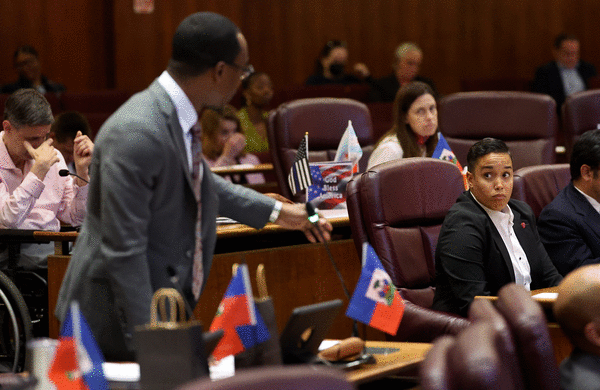
Aldermen voted to freeze Chicago’s “One Fair Wage” ordinance Wednesday, halting required raises for tipped workers like waiters who now get paid below the city minimum.
The City Council’s move stops the increases for at least two years. The veto-proof majority — just one alderman voted against the change — hardly marks an end to the fight, instead foreshadowing likely future pushes by the restaurant lobby to fully end the raises. Wednesday’s outcome is also a major blow to a key win for Mayor Brandon Johnson and his working-class agenda.
Aldermen voted in March to indefinitely stop One Fair Wage, but Johnson vetoed that move, arguing then that the subminimum wage “has its vestiges tied to slavery.”
Wednesday’s compromise package, which delays the annual pay bumps for tipped workers for two years at large restaurants and four years at smaller ones, has enough council support to overcome a Johnson veto, however. Faced with that reality, both the One Fair Wage national campaign that backed the original measure and the Illinois Restaurant Association that sought to defeat it have begrudgingly accepted the deal.
Ald. Walter “Red” Burnett, the freeze’s chief architect, argued it was necessary to save jobs at restaurants that might otherwise close.
“Every one of us understands the importance of this moment to compromise to protect workers,” Burnett said. “Today is an opportunity to meet the needs of both the workers and the restauranteurs who are trying to employ people in communities.”
The freeze was badly needed by restaurants already beset by rising food costs and high taxes, Ald. Gilbert Villegas, 36th, argued.
“It’s okay to say, ‘Hey, you know what? We tried this, it didn’t work. Let’s pause for a second, and let’s fix this and allow the economics to play out here,'” he said.
Ald. Jessie Fuentes, the chief City Council proponent of the measure, said she was “heartbroken,” even as she voted for the freeze.
“When compromise is reached, people don’t leave happy,” she said. “The alternative is that we keep a tipped credit and the conditions that we are fighting against continue to exist.”
She added a plea to aldermen who might try to block the raises from going into effect after the delay: “Allow this to be the last time that we litigate this.”
“Let us take the pause. Let businesses have the beat,” she said. “And then let’s give our workers the raises that they deserve.”
But despite Fuentes’ tepid support, Ald. Jason Ervin, Johnson’s floor leader, blasted the delay as “an economic betrayal and moral failure.” The stalled pay raises will harm Black Chicagoans most, all for an economic reason that “just doesn’t add up,” he said.
“There’s a difference between compromise and caving in. This is a cave-in on the people in the South and West sides,” he said. “What we’re telling people is to let them eat cake.”
The freeze was passed in a voice vote, with Ervin the only aldermen who asked to be recorded as a “no.”
The original One Fair Wage ordinance, passed by a 36-10 vote in 2023, has already raised subminimum wages from $9.48 an hour to $12.62. It was set to raise wages again on July 1 and completely eliminate the subminimum wage in 2028.
But the measure that passed Wednesday changed that timeline. Instead, the subminimum wage will be frozen in restaurants with more than 20 workers until 2028 and in smaller restaurants until 2030.
After the freeze, the ordinance is slated to continue to be gradually implemented. But if the fight in recent months by the Illinois Restaurant Association is any indicator, restaurant-backed lobbyists and aldermen will likely again try to prevent the raises from going into effect.
Illinois Restaurant Association President Sam Toia on Wednesday did not rule out future efforts to prevent the delayed raises, and reiterated that his organization still backs keeping the subminimum wage.
“We do not think tipped credit should be eliminated,” he said. “We shall see where things are in two years, but we will always support keeping the tip credit.”
During the negotiations in recent weeks — which several sources said Johnson’s administration did not take part in — Toia proposed keeping subminimum wages, but requiring restaurants that use it to pay tipped workers 124% of the city’s minimum wage, counting both tips and wages.
Restaurant owners are currently required to make up the difference between the lower rate and the city’s minimum wage when tips do not bridge that gap. Supporters of eliminating the tipped wage say owners routinely do not do so, and the city system to hold them accountable operates far too slowly to protect workers.
Wednesday’s meeting started with a surprise mea culpa from GOP gubernatorial candidate Darren Bailey, who infamously called the city a “hellhole” during his unsuccessful 2022 campaign for governor.
“To this city, I owe you something: I owe you an apology,” Bailey said during public comment. “I said some things about Chicago that were wrong. What I meant was that the political class is failing us, and I should have been more clear, and I wasn’t, so I apologize.”
The two-time Republican nominee, who lacks the big dollars to run TV ads and is forced to convey his message on social media, then focused his splash-seeking speech on dinging Gov. JB Pritzker, mostly for education policy.
Aldermen also on Wednesday passed in a 42-to-8 vote an ordinance honoring civil rights icon Rev. Jesse Jackson with several measures aimed at protecting voting rights. The ordinance creates new requirements on landlords to provide secure mailboxes, rules against trying to harm government workers by sharing their personal information and an advisory council tasked with advocating for voting access.
Opponents of the measure argued in a heated debate it was a rushed effort redundant to the powers of the Chicago Board of Elections. But proponents countered it is needed amid federal attacks on voting rights and a critical protection for Black Chicagoans.
“I’m absolutely disappointed in my colleagues today,” Ald. Lamont Robinson said. “I hope that we can take a moment, pull it together, and listen to one another when we say that our communities that we represent are hurting, and the laws are trying to be reversed, and our history is trying to be whitewashed and taken away.”
The City Council also approved a settlement with disability advocacy group Access Living over a lawsuit that alleged Chicago has long discriminated against disabled people by failing to make enough units accessible to them. The settlement includes a $2.25 million payment and a pledge by the city to build nearly 3,000 housing units earmarked for people with limited mobility, hearing and sight.
Aldermen also approved the appointments of William Cheaks as Department of Transportation Commissioner, David Glockner as Inspector General police reform activist Anjanette Young as a member of the Community Commission for Public Safety and Accountability.
(Chicago Tribune reporter Alice Yin contributed.)
©2026 Chicago Tribune. Visit at chicagotribune.com. Distributed by Tribune Content Agency, LLC.






Comments