Aaron Brown: The paradox of today's media
Published in Business News
In 1992, Bruce Springsteen performed a song called “57 Channels (And Nothin’ On)” as a guest on Saturday Night Live. I remember this not just because of the Boss’ mellow lamentation of media oversaturation, but because I was watching on a rural Minnesota television set that only received four channels.
Fifty-seven channels? Must be nice.
It made more sense after I experienced cable and satellite television in subsequent years, learning that one really can suffer from ennui while watching rich strangers choose kitchen tile. In fact, the 21st century ushered in so many channels, and online channels of channels, that 57 ended up being a small number.
Today, the notion of a “channel” is quaint. Americans got used to paying a cable or satellite TV bill, which opened the door for streaming services. To watch all the cool shows, you might end up paying just as much as for cable.
This brings us to one of the lessons of modern life. If people become willing to pay a monthly bill for something, companies will sell the cash flow to bigger companies. It joins the central problem of our times: The rich get richer while everyone else pays more to keep up.
Despite an explosion of new content from “people like us,” media companies are rapidly consolidating. Sure, you’re free to declare your independence on your preferred social network, but be warned: The person who controls that network relies on favorable government contracts and regulations.
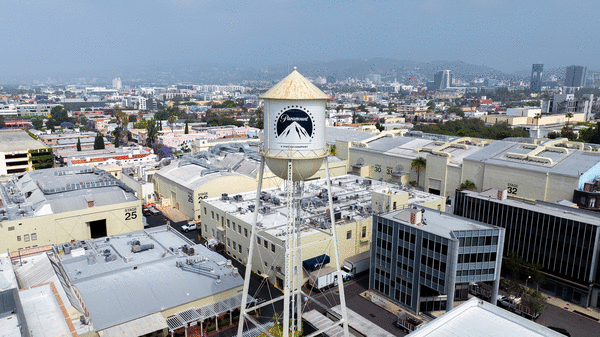
On June 12, the U.S. Justice Department signaled its approval for Paramount’s bid to acquire Warner Brothers. Though this enormous merger is not yet finished, it now appears likely. This would put CNN under the same corporate umbrella as CBS News. Paramount’s operation of CBS has already drawn criticism for its pro-administration political spin on straight news franchises like “60 Minutes” and “CBS Evening News.”
Meantime, on June 15, Fox announced plans to acquire Roku for $22 billion. This is another intriguing turn in the media landscape. Roku makes television software. According to the company, more than half of all American households use Roku products to watch TV. Mine is one of them.
In fact, Roku’s assortment of free channels has allowed me to watch more Mystery Science Theater 3000 in the last year than I did when I was 15, which is saying something. The irony of my modern 65-inch flat-screen TV is that the only “free” shows I watch are the same ones I saw on my old four-channel cathode-ray-tube monster box. Reruns cost less to offer to viewers, but the illusion of cheaper entertainment is really just an opportunity to increase the advertising and subscription costs.
In the past, content creators sought a channel because a channel provided access to the audience. In 1988, Minnesota comedian and MST3K creator Joel Hodgson found a channel in KTMA, a small independent station in St. Paul. His show became an unlikely underground hit, finding its way to Comedy Network and the Sci-Fi Channel.
Today everyone has a channel, including the audience. I know more people who have podcasts than my phone can hold podcasts. We all tell each other that we’re listening to each other’s podcasts. We’re all lying.
The rise of Netflix, Amazon and YouTube as content producers, along with these rolling mergers, now exposes the paradox of our supposedly “democratized” media industry. Perhaps content-generation is more democratic, but the attention span of the American public, and the distribution of media, is thoroughly fascist. A small number of companies hold power, and power is everything.
Yes, new creators can break out. We saw great examples recently in two hit movies from breakout Gen-Z directors. Kane Parsons’ “Backrooms” turned an internet meme and a $10 million budget into more than $250 million in global box office revenue so far. Curry Barker’s “Obsession” will soon cross the $300 million milestone despite an astonishing budget of less than $1 million.
These movies caught something in the zeitgeist, to be sure, but this past weekend brought the Disney Pixar juggernaut “Toy Story 5,” which knocked those movies out of the small rural theaters near me. Andy, the boy from the original “Toy Story,” would now be 37. I am older than Andy, with gray hair, but the movie’s lead actors, Tom Hanks and Tim Allen, are older than my dad. Franchise power is absolute, and at least partly generational — because that’s where the money is.
Nothing lasts forever. Perhaps the widespread ability to generate original material will serve us well in the future. Right now, an increasingly consolidated distribution system serves an increasingly limited public attention span. There are 57 million channels, and we watch reruns because the world terrifies us.
For the cost of a television set, a radio and a $.50 a day newspaper subscription, we once had all the media we thought we needed. Today, once-mighty legacy media struggle to adapt to a system that is increasingly expensive for the audience. Consumers pay more for the illusion of freedom and choice, while the quality of what’s being offered shrinks like the food containers at the grocery store.
I remember carefully hauling my 32-inch tube TV up the stairs of my college dorm. With the narrow exception of my car, it was both the heaviest and most expensive thing I owned. Today, TVs are bigger, better and cheaper than ever. They show amazing products for sale. We are those products.
©2026 The Minnesota Star Tribune. Visit at startribune.com. Distributed by Tribune Content Agency, LLC.




Comments