Could a split-rate property tax reshape Baltimore? City Council weighs option
Published in Business News
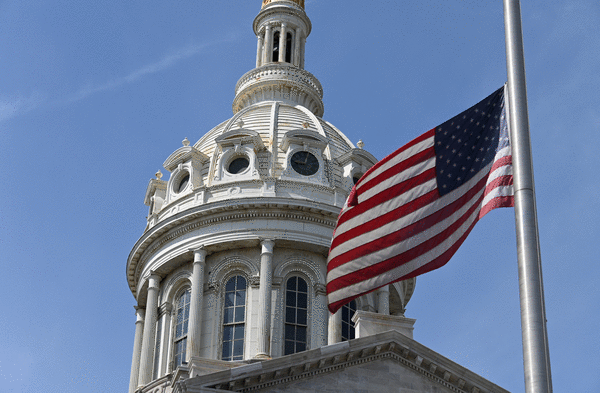
Baltimore City leaders are set to begin what could become one of the most significant tax debates in decades: whether Maryland’s largest city should pursue the state’s first split-rate property tax system in an effort to combat vacant properties, discourage speculation and spur investment.
A bill introduced Monday by City Councilman Zac Blanchard calls for a hearing involving the Department of Housing and Community Development, Department of Finance, Department of Planning and the Mayor’s Office of Small and Minority Business Advocacy and Development to examine what a split-rate property tax system could mean for Baltimore.
The measure would also invite participation from organizations including Live Baltimore, the Baltimore Development Corporation, the Maryland Department of Assessments and Taxation and other stakeholders to discuss the proposed change.
What is a split-rate property tax system?
The proposal would not create a new tax system. Instead, it would begin a public discussion over whether Baltimore should pursue a structure that taxes land and buildings at different rates — a model supporters argue rewards investment while penalizing vacant and underused property.
The hearing would specifically examine the impact of such a system on absentee property ownership and speculation, vacant residential and commercial properties, owner-occupied homeowners’ tax bills and housing production.
“We have a very real challenge with absentee owners in too many of our neighborhoods. We have a very real challenge with speculators, who own property that they hope that their neighbors in their neighborhood will make their neighborhoods better and then they can sell it without having done any work on their own,” Blanchard said.
Under a traditional property tax system, land and the buildings sitting on it are taxed at the same rate. Under a split-rate system, vacant land is taxed more heavily while improvements such as homes, apartment buildings and commercial developments are taxed at a lower rate.
Supporters argue that the approach makes it more expensive to sit on vacant lots or abandoned buildings while making it less costly to renovate a rowhouse, build apartments, or redevelop an underused commercial site.
“We could meaningfully address all of these challenges without reducing the revenue that the city collects from this each year,” Blanchard said during Monday night’s council meeting. “I do think this is something that a couple years down the road could be a really big win for the city.”
State approval is required
Even if Baltimore ultimately embraced the concept, city officials could not implement it on their own.
“The state would have to approve this change as well,” said Donald Tobin, a professor at the University of Maryland Francis King Carey School of Law.
The Maryland Constitution gives taxing authority to the state, Tobin said. While local governments can set tax rates, they generally require authorization from Annapolis to create new tax structures.
“It would be kinda strange for them to do it first,” Tobin said. “The general way is legislature first and city second. Counties and cities can set the rate but they can’t put forward a property tax.”
That legal obstacle may be easing.
The General Assembly this year considered similar legislation authorizing Baltimore City and Maryland counties to establish separate tax subclasses for land and improvements and apply different tax rates to each. The law would have taken effect for tax years beginning after June 30, 2027, but it died in committee.
A city shaped by vacancy
The proposal arrives as Baltimore continues to wrestle with a heavy concentration of vacant housing.
As of July, Baltimore had 11,617 vacant properties, according to the city’s Department of Housing and Community Development, down from roughly 16,000 in 2020.
The city owns more than 900 vacant buildings and has continued acquiring additional properties for redevelopment efforts.
The neighborhoods with the largest numbers of vacant properties are Carrollton Ridge with 756, Broadway East with 720, Sandtown-Winchester with 595, Harlem Park with 451 and Midtown-Edmondson with 336.
Vacant properties have become a defining challenge for Baltimore after decades of population loss. The city lost roughly 37% of its population between 1970 and 2022, according to the Federal Reserve Bank of Richmond, leaving entire blocks of abandoned rowhouses in some neighborhoods.
Supporters of split-rate taxation argue the current system unintentionally rewards inactivity by allowing owners to hold vacant land or buildings for years while waiting for surrounding investment to increase property values.
Pennsylvania became America’s testing ground
If Baltimore eventually moves forward, it would be entering largely uncharted territory outside Pennsylvania.
Pennsylvania has served as the nation’s primary experiment in split-rate taxation since the state authorized municipalities to tax land and buildings at different rates more than a century ago.
Communities including Harrisburg, Scranton, Allentown, Aliquippa, Clairton, DuBois, New Castle and Coatesville have used versions of the system over the years.
Harrisburg became the best-known example.
The city gradually increased taxes on land while lowering taxes on buildings, eventually taxing land at roughly six times the rate applied to structures.
Supporters credited the policy with helping encourage redevelopment and reducing the number of vacant structures from roughly 4,200 in the early 1980s to fewer than 500 by the early 2000s, although researchers caution that downtown redevelopment subsidies, state government expansion and other economic development efforts also played major roles.
The strongest recent academic analysis came in a 2022 Public Finance Review study by economists Zhou Yang and Zackary Hawley, who examined Pennsylvania municipalities that adopted split-rate taxation.
The researchers found municipalities using split-rate systems experienced statistically significant increases in aggregate real estate values and that commercial properties appeared to benefit more than residential or industrial properties. They also found lower land values, suggesting the system may reduce speculative premiums without significantly harming the overall tax base.
The study stopped short of concluding that split-rate taxation alone revitalizes struggling cities.
Instead, it suggested the policy changes incentives by making it more expensive to hold land idle and less expensive to invest in improvements.
For Baltimore, that is precisely the question city leaders say they want to begin answering.
©2026 The Baltimore Sun. Visit at baltimoresun.com. Distributed by Tribune Content Agency, LLC.










Comments