Are Seattle's beloved neon signs going away?
Published in Business News

SEATTLE — A large arrow points out Marco Polo Bar & Grill, a saloon that's sat on Fourth Avenue South in Georgetown for 76 years.
It's most eye-catching after dusk. The setting sun is replaced by the luminescence of the establishment's neon sign — a tangible piece of American nostalgia. For owner Matthew Miera, it can also be a financial burden.
When you have to replace a part, it is super expensive," he said. "I think it is definitely a dying trend — probably partly because of cost and upkeep."
Many local businesses are recognized by their age-old neon signs. Though it's a point of pride for Seattleites, the steep price tags for acquisition, repairs and maintenance could alter this revered tradition for good. Many are opting for inexpensive, plastic LED alternatives over the traditional signs, which are handcrafted out of glass and use select noble gases like neon and argon.
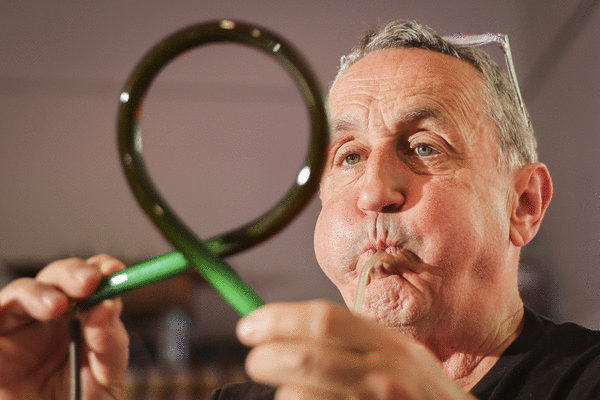
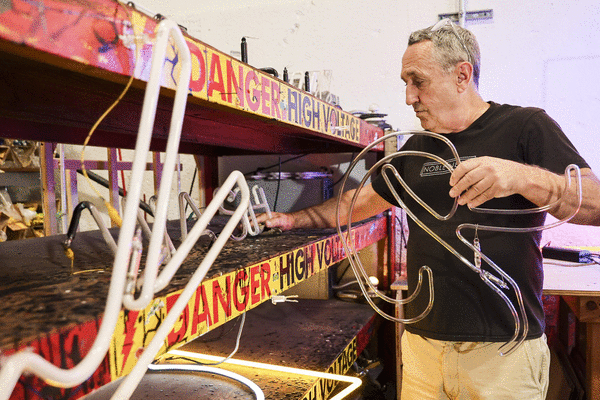
"It's hard to compete," said Kelsey Fernkopf, a tube bender, or an artisan who shapes neon tubes by hand, at Noble Neon.
'Slowly going away'
In Seattle, neon signs define many of the city's most famed businesses — Pike Place Market, the Elephant Car Wash and Dick's Drive-In among them.
The 2022 book "Seattle Neon," by Matt Hucke, features photos of more than 450 neon signs throughout the Seattle area.
But Miera, at Marco Polo Bar & Grill, said he's watching LED signs gradually overtake neon signs.
"The neons are kind of slowly going away," he said. "You just don't see it as often."
Across the U.S., neon was used in only 10% of electric signs in 2022, according to a survey by Signs of the Times Magazine, a sign-industry publication. Instead, LED reigned supreme, lighting 86%.
Neon signs can range from hundreds to tens of thousands of dollars. Retailers like Amazon sell plastic LED signs for as low as $10.
Miera, who grew up in the Seattle suburb Bellevue, took over the bar — and its shattered, external neon signage — in 2006. He operated for a year without it before moving forward with a revamp.
"It was not cheap," he said. But "if you have the money, you pay to fix it because, if you don't, then you're that guy on the street that has a sign that doesn't light up."
Seattle's rainy spells can put a damper on its functionality. According to Miera's estimates, replacing a transformer costs around $400, plus labor, and restoring a glass tube can reach about $1,000.
And "I couldn't tell you what the electricity bill is on it, but I'm sure it draws a lot," Miera said.
He believes neon brings character to a business, and he keeps other old-school signs inside the bar. However, Miera may be tempted by LED the next time a major repair is needed.
"In any small business, when something breaks, you look at it, and you're like, 'All right, is it really worth it to fix it?'" he said.
'You learn to burn'
Two small businesses that specialize in neon signs still hold true to the art form.
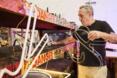
Inside Noble Neon's nondescript building in the South Park neighborhood, Fernkopf pulled out a large green lighter to set several torches aflame. Neon signs glowed blue, white, red and yellow on the walls around him.
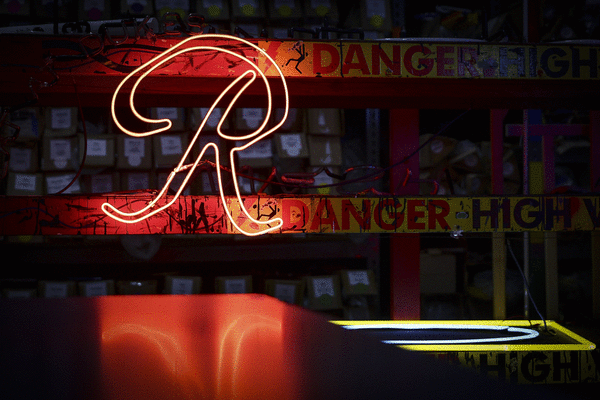
A jumbo glass "R" that belonged on a vintage Rainier Beer sign sat on the work table in front of him. Fernkopf made pencil marks on the glass before heating it in the crossfire and curving it to his preference.
The entire process — from making the "R" to installing it on the sign — takes him between six and seven hours.
All the while, he chatted casually around the open flames. In this job, "you learn to burn," he said. A younger Fernkopf's arms used to sport scorch marks.
"I've been doing this a long time," he said over the shop's ambient buzzing on a July morning. "There aren't that many people that do it."
He's carrying on the trade's legacy.
French engineer Georges Claude created the first neon sign in 1902, per the National Institute of Standards and Technology. Los Angeles welcomed the first American neon sign in 1923, kicking off decades of the trend's popularity across the country.
Fernkopf learned the craft in 1986 at a program in a small Kansas town before making his way to Seattle soon after.
"There used to be a lot of trade schools because there were a lot of neon sign companies," he said. Not so anymore.
Since Noble Neon's founding in 2012, co-owner Lia Hall has watched a number of local shops shut down throughout the Seattle metropolitan area.
"We're not doing this because we're making a ton of money," said Hall, a Seattleite.
Instead, she and co-owner Cedar Mannan, who hails from rural Pacific County, Washington, are in the industry for the love of it.
Many customers approach Noble Neon because they either want their own bespoke art or a repair of a retro sign. Hall said their clients appreciate the qualitative difference between neon and LED.
"Everything is literally custom," she said.
Neon cities
Western Neon has counted as a go-to spot for signage and public art since 1985.
Recently, Western Neon created the iconic "Sea Beacons," or neon whale tails, distributed throughout town for the FIFA Men's World Cup, according to creative director Dylan Neuwirth.
"People recognize the value in what we bring to the table," he said, "and they also recognize the value of investing in the kind of things that we make."
However, that doesn't make the manufacturer impervious to economic fluctuations.
"At the end of the day, we all know that budget's going to drive a lot of the conversation," Neuwirth said.
Sometimes, that means reimagining a project with tighter purse strings, to "be sensitive to the fact that we're all experiencing financial strain from the current America we live in," Neuwirth added.
With Seattle's dark and moody aesthetic, he's confident it will remain a longtime home to neon, along with other devotees like New York City, Tokyo and Shanghai.
"We know that there are just certain neon cities out there across the world," Neuwirth said, "and we're one of them."
'Keep that neon going'
Despite the financial pressures, several business owners remain committed to their neon investments.
In Sodo, Scott McLaughlin and Laurel Evans, owners of Siren Tavern, have never considered replacing the sign out front.
"Our sign is old and maintenance intensive," McLaughlin said, but "there are things that we consider to be imperative at the bar."
The taps need to work to pour beer, he said, and certain signs, including the one outside, need to be repaired because they're part of the bar's heritage.
Though the pair have owned the establishment since 2018, it's been around since 1963 — first as a music store before becoming a tavern. That's why the sign is in the shape of a treble clef.
"There is no, 'Oh, that thing. You know, not again. Maybe we could save some money if we did something different,'" McLaughlin said. "Keep that neon going because that's a piece of Seattle history — and Siren history."
The biggest expense is the acquisition of a neon sign, whether it's vintage or brand new, McLaughlin said. From there, maintenance typically costs between $500 to $1,000 every year or two.
"Not a small amount, but, at the same time, it's a predictable amount," McLaughlin said.
On Capitol Hill, both Linda's Tavern and Bait Shop are holding on to their neon signs.
Linda's Tavern was established in 1994, and Bait Shop opened in 2012. The former features a neon sign that reads, "Tools radio tackle," in its window. The latter hearkens passersby with a "bar" sign in red glowing letters.
Co-owner Jonah Bergman said a recent repair of a Bait Shop sign cost $1,000.
"You're kind of at the mercy of who can maintain it," he said. "It's like having an old car."
As cities modernize, neon signs can fall by the wayside, Bergman said, particularly as new technology and cheaper options emerge. But he underlined their importance to his businesses.
"I don't understand somebody taking down a cool, old neon sign and putting up a new, modern sign," he said. "It's knocking down a beautiful, old building and putting in some cookie-cutter condos that have no feel and no soul."
"I'm not OK with that, Bergman added.
©2026 The Seattle Times. Visit seattletimes.com. Distributed by Tribune Content Agency, LLC.








Comments