Paramount's David Ellison says critics don't get his politics
Published in Business News
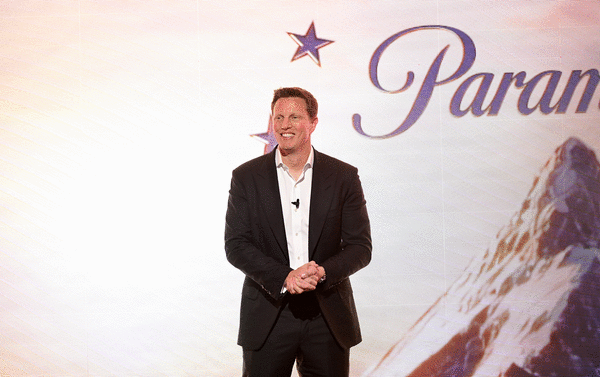
Paramount Chairman David Ellison believes the tug-of-war over his proposed $111 billion purchase of Warner Bros. Discovery comes down to a single question: Can he be trusted to control CNN?
"I believe this fight is not really about market share," Ellison wrote in a Tuesday op-ed in The New York Times, noting that regulators around the world, including the U.S. Justice Department, have approved the deal that has been temporarily blocked by an antitrust lawsuit brought by California Attorney General Rob Bonta and his coalition of Democratic state attorneys general.
"I believe a plainer worry sits beneath the briefs and the news releases," Ellison wrote. "The issue is whether I can be trusted as a steward of Warner's CNN."
The rare opinion piece serves as Ellison's acknowledgment that his family's close association with President Donald Trump has sullied his standing in Hollywood and beyond.
Shakeups at CBS News, which is part of Paramount, the departure of CBS late-night host Stephen Colbert, and a visible presidential lobbying effort — including hosting a lavish dinner for Trump in Washington in late April and attending Trump's birthday extravaganza in June with UFC fights on the White House lawn — have come with a cost.
More than 5,000 entertainment industry workers, including such high-profile stars as Jane Fonda, Ben Stiller, Bryan Cranston and Mark Ruffalo, signed an open letter early this year, calling on Bonta to try to block the merger. The group alleged the transaction would weaken Hollywood with "fewer opportunities for creators, fewer jobs across the production ecosystem, higher costs, and less choice for audiences."
Ellison's roughly 730-word essay does not mention Trump by name nor ties between the president and his father, tech billionaire Larry Ellison. Trump has endorsed the deal and bestowed praise on David Ellison, who contends the deal will make Hollywood stronger.
On Tuesday, U.S. District Judge Araceli Martínez-Olguín set a March 2 trial date for the antitrust lawsuit brought by Bonta and his coalition of 11 other state attorneys general. Paramount had been seeking a trial in November so it could wrap up the industry-reshaping deal by year's end.
Bonta and the other state attorneys general have alleged the merger of two major film studios would give Paramount-Warner Bros. more than 25% of the wide-release theatrical film market. Their lawsuit — which also sidesteps the political backdrop — contends the combined company would own too many cable TV channels — more than 50, including CNN, TBS, HGTV and Comedy Central.
Bonta, in a recent interview with the Los Angeles Times, denied the lawsuit was motivated by politics.
"This is just a straight-up meat and potatoes antitrust case," Bonta said.
Many in Hollywood fear the consolidation of two historic studios will bring thousands of layoffs and contribute to a bleaker employment picture. Ellison's Skydance Media's takeover of Paramount a year ago resulted in the loss of 2,000 jobs.
Since 2022, an estimated 57,000 Los Angeles-based entertainment jobs have been erased, according to federal labor data.
To be sure, some have opposed the Warner Bros. deal by saying one family shouldn't be allowed to control two significant news operations: CBS News and CNN, which is owned by Warner Bros. Discovery.
In his essay, David Ellison, tried to allay such concerns.
"There has been speculation about my politics, my loyalties, my intentions," Ellison wrote.
"Unfortunately, I can't give anyone a view into my heart and mind, but I can share this: I have regularly voted for candidates of both parties; I hold some views that would be called conservative and others that would be called liberal, just like most Americans," Ellison said. "And when it comes to our news operations, I do not aspire to lead these companies to bend their newsrooms to my views. I believe that news should be based on facts and truth."
Ellison pointed to opinion polls that show trust in the news media is low.
"Great news organizations like CNN and CBS News are here to tell it straight down the middle," Ellison said. "That requires newsrooms that reflect the whole world, not one side of it. And it requires independence. Our journalists will continue to answer to the facts and to all the people they serve — not to any party or cause.
"These were founding principles for both CNN and CBS News, for legends like Ted Turner and Edward R. Murrow, and it is exactly that kind of independence that has always fueled the greatness of "60 Minutes," Ellison wrote.
Fired "60 Minutes" correspondents, including Cecilia Vega, have complained that since Bari Weiss became editor in chief of CBS News last fall, journalists have been asked to tilt the presentation of controversial news events, including protests to Immigration and Customs Enforcement actions earlier this year in Minnesota, which led to the deaths of two Americans.
Since taking over Paramount, ratings at some CBS News programs have declined, although "60 Minutes" increased its regular season audience before the ouster of journalists that also included Scott Pelley and Sharyn Alfonsi and executive producer Tanya Simon, who ran the news magazine until May. Sources have said Weiss often suggests changes, but journalists have pushed back. No one has had to sprinkle in false talking points into their reports, these people said.
Still, talent has been shaken. CNN's Anderson Cooper left "60 Minutes" earlier this year, and CNN's Paula Reid is departing the network, in part due to concerns about the direction of the news organization under the prospective new owners.
Ellison's driving determination to acquire Warner Bros. grew from his love of films, he said.
"I have loved film since I was old enough to sit still for one," Ellison wrote.
In legal documents, Paramount has disputed the foundation of the plaintiff states' lawsuit, saying the states failed to factor in the rise of technology companies, including Netflix, Google's YouTube and Amazon Studios, which also attract significant swaths of viewership.
The Writers Guild of America has separately sued to block the merger, saying it would lead to fewer opportunities and lower pay for writers struggling to stay in the industry.
Martínez-Olguín, who is overseeing the high-profile case, issued a temporary restraining order to block the merger from finalizing while the two sides hashed out the evidence. Late last month, Paramount made a significant concession by agreeing to delay the close of the merger until after the antitrust trial — or until June 1, 2027, whichever date comes first.
In court documents filed Friday, Bonta and his coalition of 11 other Democratic attorneys general proposed having a two- to three-week trial to weigh the evidence. The plaintiff states include Colorado, Washington, Oregon, Nevada, New Mexico, New York and Minnesota.
"The states claim this deal will give one company too much influence over theatrical releases and cable operators, while the W.G.A. argues that our combined market power will hurt writers," Ellison said in the opinion piece. "Both suits imagine a Hollywood that no longer exists — an industry ruled by a handful of legacy studios."
_____
(Times staff writer Stephen Battaglio contributed to this report.)
_____
©2026 Los Angeles Times. Visit at latimes.com. Distributed by Tribune Content Agency, LLC.



Comments