Seattle corporate caterers caught between hybrid work, national rivals
Published in Business News


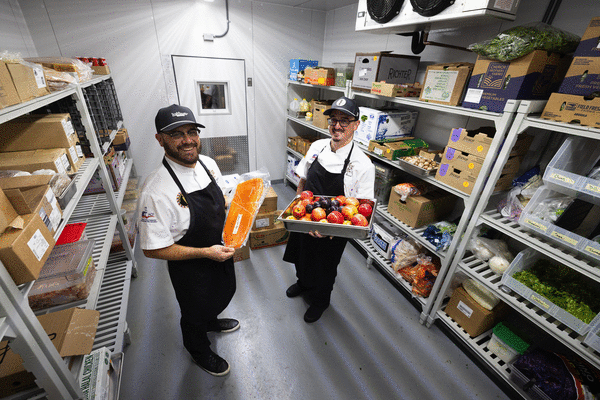


SEATTLE — By the end of the summer, Seattle-area Meta employees may notice a shift in their daily routines — a change that will take place right underneath their noses.
The tech giant with offices in Seattle, Redmond and Bellevue is swapping its food provider from locally owned Lavish Roots Catering and Hospitality to Sodexo, a global food services provider that serves hospitals, schools, government agencies and now Meta, too.
The change might be inconsequential for Meta employees, depending on one’s palate. But Lavish Roots is hit by the loss of one of its “largest and longest-standing” contracts, which was over a decade old.
“I have grown with them. I've upscaled, downscaled with them,” Carly Duke, president and co-founder of Lavish Roots, said in an interview.
Lavish Roots isn’t the only local business facing the pressure cooker of global competition. Many small caterers have seen the stakes rise as national companies like Sodexo increasingly vie for a share in Seattle’s corporate catering market.
The squeeze on local catering companies arrives amid their already prolonged recovery from the pandemic. Caterers like Lavish Roots, which depend on gatherings with mouths to feed, had their operations largely halted during the pandemic. Since then, their recovery has been slow as Seattle-area employers continue to adopt hybrid work.
But if Duke knows anything after her decade in the business and keeping afloat during the pandemic, it’s the importance of staying nimble. She and other catering business owners are already thinking about their next moves.
“Any service industry you're in, there’s a ‘If you don't adapt, you die’ kind of a mindset. So I think that caterers, fortunately, have a really big ability to do that,” she said.
‘Zero revenue’
Before everything stalled at the beginning of the COVID-19 pandemic, things were going swimmingly for Seattle-based Lish Catering. It served hundreds of different accounts, with corporations making up more than half of its clientele.
Most of Lish’s services are what it calls subscription catering, or managed meal programs for clients, ranging from once-a-week lunches to three meals a day. It serves tech offices and professional services, “a lot of names that you would recognize,” said Aakhil Fardeen, CEO of Lish Catering, but he declined to disclose specific clients.
Lish experienced substantial growth every year from 2014 until March 2020, when it dropped to “almost zero revenue in a matter of a couple of weeks,” Fardeen said. “We pretty much had to lay off the entire company, and we had a few people working 50% time.”
After scraping by for two years with the help of government loan programs, Lish resumed full-service operations when offices returned to in-person work. The growth was quick — as the company was restarting from near zero.
“I think 2024 onwards, we've settled into a good, healthy growth rate,” Fardeen said. As offices made efforts to bring employees back in person, catering contracts grew, but not as quickly as before the pandemic.
Similar to Lish Catering, part of Lavish Roots’ growth came from a return-to-office wave that included free catering as an employee perk.
“Anybody who goes out to eat or goes to the grocery store knows how much it costs, and that is a huge benefit,” Duke said. “Then that keeps their people in office and not going out to lunch or leaving early — they're more invested, they're eating food on the site.”
But now, companies aren’t pushing for the same extensive return-to-office perks as they once did.
“RTO needs were a driving factor for many clients, but I'd say that part has kind of settled in a little bit,” Fardeen said. “Most companies that have wanted to return to office have returned to office.”
‘Economy of scale’
Why are national players seeking Seattle offices? Hybrid head counts play a part.
With sweeping layoffs in May and a three-day in-person policy for most employees, Meta has to plan around fewer mouths to feed.
“As we return to the office, we’ve adjusted on-site services and amenities to better reflect the needs of our hybrid workforce,” Tracy Clayton, a Meta spokesperson, said in an email. He added that teams will be “increasingly distributed,” prompting the company to streamline its catering operations.
The transition to Sodexo is happening across Meta's offices worldwide — a plan to improve what was a “fragmented system” with “uneven quality” across sites, Clayton said.
A national-scale caterer is better suited to serve more offices with fewer people. At a scale that large, volatile attendance can mean unpredictability for a small caterer. For a global player like Sodexo, it may not have much of an impact.
Now, Meta is transitioning to a single, global caterer from the more than 30 it partnered with across its different regional offices, Clayton said.
Duke said that years ago she was able to compete more evenly with large-scale companies, but lately “it’s more competitive than it's ever been.”
“We're doing the work that other huge companies are doing, like Sodexo and Compass — we're competing on that global level,” she said. “As we saw (with) the tech boom, we needed to grow as fast or faster than they were to keep up with them, or we wouldn't be able to compete.”
Duke said she saw many local caterers raise eyebrows at the model she pursued with large tech clients, questioning its profitability. “When you first start doing it, it's not hugely profitable. It's like an economy of scale, right? So you have to just do a lot of it, and it's really hard working for tech clients.”
Despite rising competition, some small caterers are still sticking with the tech world.
Gourmondo Café and Catering has maintained a presence in Amazon’s Seattle offices since 2012 because the e-commerce giant continues to source partnerships from local and national caterers.
“I think the way Amazon has built their food program — it's an ecosystem,” said Alissa Leinonen, founder and CEO of Gourmondo. “It's not a one-stop shop. It's not a big box, but you're getting the best of all worlds.”
Leinonen said she believes the most sustainable future for local caterers lives in a model like Amazon’s, and “that’s what you will most likely see as these corporations continue to iterate their food programming on their campuses.”
Amazon spokesperson Haley Silva said the company's meal program is meant to complement local businesses. In addition to partnering with Gourmondo and local nonprofit FareStart, We encourage employees to support neighborhood restaurants and food trucks, Silva said.
At the same time, local companies that have lost their tech connections for now are looking to traditional catering opportunities.
Lavish Roots, for example, as it transitions away from Meta, plans to reintegrate into the local community through small-scale events, such as weddings, senior services and a deli partnership at Pike Place Market.
Duke is hopeful for the future, despite the loss of her largest client.
“It's a cycle, so I'll be curious to see what happens,” she said. “But I'm just going to remain nimble and creative and patient while we go through this.”
_____
©2026 The Seattle Times. Visit seattletimes.com. Distributed by Tribune Content Agency, LLC.










Comments