Boeing workers reject contract offer at crucial moment for company
Published in Business News
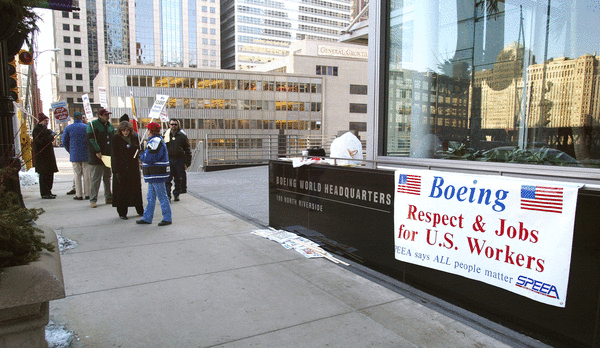
Boeing’s engineering and technicians union voted Friday to reject the company’s contract offer and authorize its negotiating team to call for a strike.
Boeing, in response, said it was moving forward with a contingency plan meant to ensure it can keep up with aircraft deliveries and other commitments to customers if its professional workforce walks off the job.
The union, the Society of Professional Engineering Employees in Aerospace, or SPEEA, said it will seek to resume negotiations with Boeing, but is prepared to call for a work stoppage after members overwhelmingly authorized a strike. If called, a strike would not begin until the current contract expires Oct. 6.
The results of the vote and discussions with members over the last few weeks show SPEEA’s rank-and-file members “deeply mistrust Boeing management,” the union’s negotiating team said in a statement Friday.
The union pointed to past decisions to move engineering work out of Washington, accusations that “quality and safety took a backseat” to speedy production and a failure to make sure wages kept up with the high rate of inflation.
“The current executive leadership is saying and doing the right things,” SPEEA said in its statement. “And the management team that met with us appeared sincere, solution-focused and genuine in their efforts to right the past errors of their predecessors. Still, the membership has made clear that the current offer falls short.”
Ben Nimmergut, vice president and functional chief engineer for production engineering for Boeing, said Friday the company is “disappointed” in the vote.
“We gave a strong contract offer to position our employees among the market leaders in pay and benefits in the Pacific Northwest,” Nimmergut said in a statement.
The company has “no choice” but to implement its contingency plan, he continued. “We have a responsibility to the rest of the workforce and our customers to build on our progress over the last two years and maintain our momentum.”
Boeing declined to share the details of its contingency plan. It has not made any changes to its delivery schedule, the company said.
Boeing and its white-collar union began contract negotiations on July 1, the first time the parties have held full negotiations in nearly 14 years.
The union represents 17,000 employees at Boeing’s facilities in Washington and nearby states.
The negotiations will result in two collective bargaining agreements representing SPEEA’s two largest units. Its professional unit represents about 13,000 engineers and scientists, and the technical unit represents about 4,000 analysts, technicians, planners and specialists.
Both units rejected the contract offer on the table, with 64% of the professional unit voting no and nearly 72% of the tech unit rejecting the deal.
Professional unit members approved strike authorization with a nearly 88% vote in favor, and tech unit members approved with a nearly 90% vote in favor.
The union said 92% of eligible members voted.
The contract included a 3% general wage increase this year, retroactive to Feb. 20, 2026, and then yearly increases to wage pools spread among the workforce. Those wage pools would increase 6% in March 2027, then 5% annually through 2030. The money in the wage pools is distributed based on inflation, capped at 3% each year, and performance-based metrics.
Boeing said Friday the contract offer would have increased the average base salary for members of the professional unit by $45,000, from $152,000 to $197,000, over the length of the four-year agreement. It would have increased the average base salary for the tech unit by $35,000, from $119,000 to $154,000, according to the company.
SPEEA’s negotiating team unanimously endorsed the contract offer, telling members it addressed their priorities and offered meaningful value. But a group of union leaders tasked with making a vote recommendation to rank-and-file members were split on how to view the deal.
A group representing the tech unit recommended members reject the deal, while a group representing the professional unit made no recommendation because it could not reach a 60% threshold on which way to recommend.
On Friday, SPEEA’s negotiating team highlighted the benefits of the deal, including the largest wage pool increase since 1983, additional vacation days, limits on mandatory overtime work and twice-annual meetings with Boeing executives to discuss future work development.
But, in an interview, two members of the negotiating team said members’ feedback on the contract offer all came back to the same message: members don’t trust that Boeing management will do what they say they’re going to do. A contract needs explicit protections, the negotiating team members said.
SPEEA is planning to survey members about what it will take to get them to approve a contract offer. Those results will shape SPEEA’s requests if the union resumes bargaining with the company.
Katheryn Durkee, a member of SPEEA’s negotiating team and an engineer at Boeing, said the union already knows it’s focused on securing a contract that supports both its professional and technical units, particularly after previous contracts that “eroded and targeted” the technical workers.
It also wants to revisit Boeing’s commitment to keeping work in the Pacific Northwest, both for current programs and the company’s next entirely new plane.
SPEEA members last went on strike in 2000 and remained off the job for 40 days. That marked the first bona-fide strike by Boeing’s white-collar workers since the union formed in 1946. Before the strike in 2000, the union had once walked out for just one day.
Contract negotiations since then have not resulted in a strike but have been contentious, particularly in 2012, when the union appeared poised to strike. Boeing began a series of engineering work transfers to other parts of the country soon afterward.
In 2016 and again in 2020, Boeing and SPEEA leadership engaged in private, often-secretive discussions about extending the current contract well before its expiration.
Heading into negotiations this time, the union knew it didn’t want another contract extension, said Kevin Boyd, a member of SPEEA’s negotiating team and a production engineering tool designer in Auburn.
Both Boeing and SPEEA said they hoped to work collaboratively during negotiations to solve problems facing the workforce. SPEEA’s negotiating team said it was focused on a contract that would reset the union’s relationship with the company after years of tension related to pay and job security, rather than seeking retribution to make up for past damage.
Boeing has faced two strikes from its other major union in recent history, including a 53-day Machinists strike in 2024 that silenced its Puget Sound area factories and a three-month strike by members of the same union at Boeing’s defense factories in St. Louis last year.
A SPEEA strike would similarly threaten Boeing’s commercial production rate in its Puget Sound factories and would risk further delaying the manufacturer’s effort to certify two new programs, the 737 Max 10 and the 777X family.
In a note to employees sent Friday, Boeing’s Nimmergut said, “I know this is a challenging time. I encourage everyone to stay focused on the job at hand.”
©2026 The Seattle Times. Visit seattletimes.com. Distributed by Tribune Content Agency, LLC.










Comments