Carney says US wants to destroy Canada firms, examines retaliation moves
Published in Business News
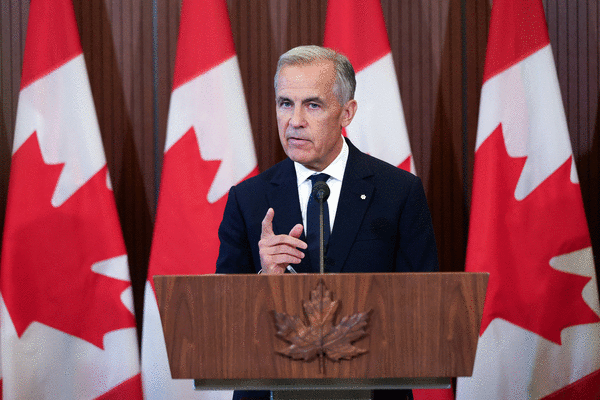
Prime Minister Mark Carney said his government is still working on options for retaliating against U.S. President Donald Trump’s new tariffs on Canadian goods, but added that he’s willing to continue trade talks if the U.S. adopts the “right attitude.”
The discussions with U.S. negotiators revealed that Trump wants to destroy Canada’s major industries — steel, aluminum and autos — with unfair terms, Carney said.
“There is a mutually beneficial deal possible here, but it has to be one that respects Canada’s sovereignty, that respects our independence, that uses our complementary strengths to build something better, not tear apart for short-term gain,” Carney told reporters Monday, speaking at a news conference in Quebec.
His comments came hours after Trump pledged to hike tariffs on Canadian autos to 50% — and to tax auto parts as well — starting on Jan. 1. The current rate is 25% but applied only to non-U.S. content in finished vehicles, while auto parts still cross the border tariff-free.
The threat marks yet another significant escalation of the trade fight, after 50% tariffs on around $20 billion of Canadian products — including furniture, plastics, plywood and electrical equipment — came into effect Saturday morning. Talks to avert those collapsed on Friday, with each side blaming the other for the breakdown.
Carney has promised to retaliate with counter-tariffs by Sept. 8, affecting American steel, dairy, appliances, agricultural equipment, electronics and pulp and paper. But the government is still working on a detailed list. He has also pledged support for industries hit by the new U.S. duties.
“An attitude at the negotiation table that Canada is a subsidiary of the United States, that Canadian industry is going to be disadvantaged relative to American industry, that we’re going to set up terms so that over time Canadian industry is going to face constant headwinds — that’s not something we’re going to accept,” the prime minister said.
Minutes after his remarks, Trump posted again on social media about Canada, calling Carney “governor” and lambasting Ontario Premier Doug Ford. “Someone should get these clowns to ‘fall in line’ or, the consequences for Canada will be far WORSE!” the president posted.
‘Range of Options’
In his remarks Monday, Carney said he prefers to first use “positive” responses to U.S. trade aggression, such as building new coast guard ships with Canadian steel, which he announced alongside Quebec’s premier.
But Carney said the government is looking at a “range of options” for retaliating against the new U.S. duties and isn’t ruling anything out when it comes to potentially using critical minerals, energy or other goods that Canada exports south of the border.
“The strategic and symbolic scope of reprisals are very important,” he said. “I think we need to do what’s intelligent and hit where there’s sensitivity.”
Carney acknowledged it’s difficult to go dollar-for-dollar in counter-tariffs against the U.S., given how much bigger the American economy is. He said Canada may have to take a more targeted route in its retaliation.
The S&P/TSX Composite Index whipsawed in early trading Monday, falling as much as 0.3%, but was flat around 2:20 p.m. in Toronto. The loonie was down sharply, falling around 0.7% against the U.S. dollar.
Carney has said talks fell apart for a number of reasons. Negotiators discussed lowering U.S. auto tariffs to 15%, but the U.S. refused to extend that relief to medium- to heavy-duty trucks, such as the kind currently going into production at Ford Motor Co.’s suburban Toronto factory.
The U.S. also pushed for limits on Canada’s trade deals with other countries and made demands on cultural and French-language issues that were unacceptable, Carney has said.
U.S. Trade Representative Jamieson Greer, meanwhile, has said Canada made 11th-hour demands that upended the draft deal. The agreement would have reduced tariffs on autos, steel, aluminum and lumber, and set up cooperation on export controls, digital trade and joint tariffs, he said.
It also would have launched formal talks to renew the U.S.-Mexico-Canada Agreement, which Trump negotiated in his first term but declined to renew this year.
Parts of Canada’s economy, including Ontario auto plants and steel mills, have already faced significant production losses and layoffs as a result of U.S. sectoral tariffs.
But many smaller manufacturers were shielded from earlier rounds of tariffs because the U.S. exempted goods shipped under USMCA. The new 50% levies — ordered under a never-before-used 1930 Tariff Act provision — ignore that trade deal.
If Trump follows through on 50% auto tariffs, the move would upend a supply chain that has tightly bound the two countries’ auto sectors for decades.
©2026 Bloomberg L.P. Visit bloomberg.com. Distributed by Tribune Content Agency, LLC.







Comments