Thomas Black: The quantum computer revolution is tantalizingly close
Published in Business News
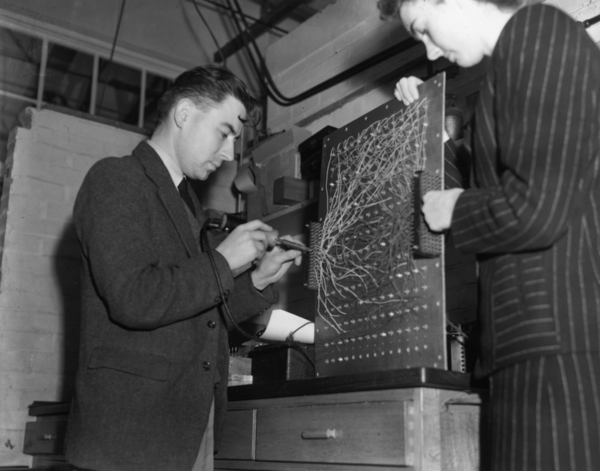
When the Electronic Numerical Integrator and Computer, or Eniac, was first built by the University of Pennsylvania for the U.S. Army in 1946, it weighed about 30 tons and had 18,000 vacuum tubes that filled an expansive room. The speed of that first programmable, general-purpose digital computer was about 5,000 hertz, which means it could perform 5,000 additions per second. It cost about $9 million to build in today’s dollars.
Now, a typical laptop can do more than 3 billion calculations per second and costs around $1,000.
The point is that technology usually starts out as clunky, slow and expensive. As it becomes more useful, the improvements accelerate. Quantum computing is still in a pre-Eniac stage, but it’s close to making a real impact. In fact, an important milestone is just around the corner, and dozens of large companies are preparing for this breakthrough.
It’s easy to overlook the progress in quantum computing amid the noise of the artificial-intelligence revolution driven by Nvidia Corp.’s powerful classical computer chips, which are adept at simulating the performance without the technical drawbacks. Quantum computers, though, hold the promise of accelerating research for drug discoveries and new materials, helping logistics companies design more efficient routes, improving financial risk management and playing a key role in encryption and cybersecurity.
But before they can do any of that, they have to overcome the error problem.
Classical computers use digital bits that process information in 1s and 0s, made possible by electric current that turns on or off tiny transistors. Quantum computing uses. well, quantum bits, or qubits. These qubits can hold the values of both 0 and 1, which is known as superposition, and scale exponentially with additional qubits. Also, classical computer bits run operations sequentially while qubits explore the different potential states simultaneously. That potential array of values is what makes quantum computing so powerful and also underpins the reason the machines will be able to do much more complex calculations than their binary cousins. The problem is that qubits are extremely delicate and can cause quantum computers to lose information.
Vibrations, heat and even cosmic rays can lead to the collapse of the quantum state — which is produced by natural or artificial particles — producing errors. To counter this, quantum computers need the error-corrected qubit, also known as the logical qubit. To arrive at a logical qubit, the information is encoded across several qubits to provide redundancy and cull out the ones with errors. In the distant future, quantum computers may have tens of thousands of error-corrected qubits. It will take time — and perhaps a few unforeseen breakthroughs, such as how the transistor radically changed computers — to learn how to scale these delicate machines while keeping errors at bay. In the meantime, the threshold for becoming a practical machine that leaves classical computers in the dust can be measured, and most agree it’s at 100 error-corrected qubits.
That bar could be reached as early as next year. Quantinuum plans to release its Sol computer in 2027 with 100 logical qubits, topping its Helios machine, which is available now and has 48 error-corrected qubits. International Business Machines Corp. announced last month that it achieved 70 logical qubits in an experiment with the University of Chicago. Infleqtion expects its latest design to provide more than 50 logical qubits next year as it scales toward 100.
Reaching 100 logical qubits “is the point at which you start to be able to solve important problems in material science and chemistry, perhaps in AI, too, that classical computers cannot solve,” Pranav Gokhale, chief technology officer and co-founder of Infleqtion, said during its earnings conference call earlier this month.
There are distinct approaches to building quantum computers, which makes tracking the industry’s progress tricky. Some designs, including those built by IBM, Google and Rigetti Computing Inc., use mechanical qubits etched and wired together on a chip. These human-made qubits can be scaled more easily than other designs but have higher error rates from initial imperfections and heat from the wires that connect them together.
Other designs are based on natural particles, such as atoms or photons. Atoms are trapped using magnetic fields and manipulated with lasers. Photonic quantum processors use beam splitters, phase shifters and other tools to control photons. Although these qubits start out as perfect, errors are introduced when they are moved around. These machines are much harder to scale. Infleqtion, for example, uses atoms with a neutral charge while Quantinuum works with charged atoms, or ions. PsiQuantum’s qubits are based on photons.
It’s too early to tell which of these pathways for building a quantum computer will be the winner, and it’s possible that there will be multiple solutions, each with their pros and cons. That’s why the Commerce Department in May selected a variety of quantum computer designs when it chose nine companies for $2 billion of funding, including IBM, Rigetti, Quantinuum, Infleqtion and PsiQuantum.
A true sign of progress is that the conversation around quantum computing has shifted to error correction and logical qubits instead of whether the technology will ever be of value. When a machine offers 100 logical qubits or more, the quantum-computing age will have finally arrived, even if it reminds some of its ungainly vacuum-tube predecessor.
____
This column reflects the personal views of the author and does not necessarily reflect the opinion of the editorial board or Bloomberg LP and its owners.
Thomas Black is a Bloomberg Opinion columnist writing about the industrial and transportation sectors. He was previously a Bloomberg News reporter covering logistics, manufacturing and private aviation.
©2026 Bloomberg L.P. Visit bloomberg.com/opinion. Distributed by Tribune Content Agency, LLC.










Comments