Ex-Belvidere Stellantis workers must wait years longer to return home
Published in Business News
Former employees of Stellantis NV's shuttered Belvidere Assembly Plant know by now not to get their hopes up.
The automaker announced earlier this month that it plans to reopen and build a new version of the Jeep Cherokee at the northern Illinois plant starting in late 2029. That's roughly two years after production of a midsize pickup originally was set to begin at the facility that closed down in early 2023.
Workers and the local union president representing the plant say the Aug. 14 announcement was in theory a positive development. Beyond pledging to bring the Jeep SUV — the first U.S. vehicle to ride on the carmaker's new STLA One platform — the company agreed to extend and increase benefits to laid-off workers. And former Belvidere workers who transferred to other far-flung plants after the closure will still get the opportunity to come home.
But when it comes to Stellantis and Belvidere, they know plans can change quickly.
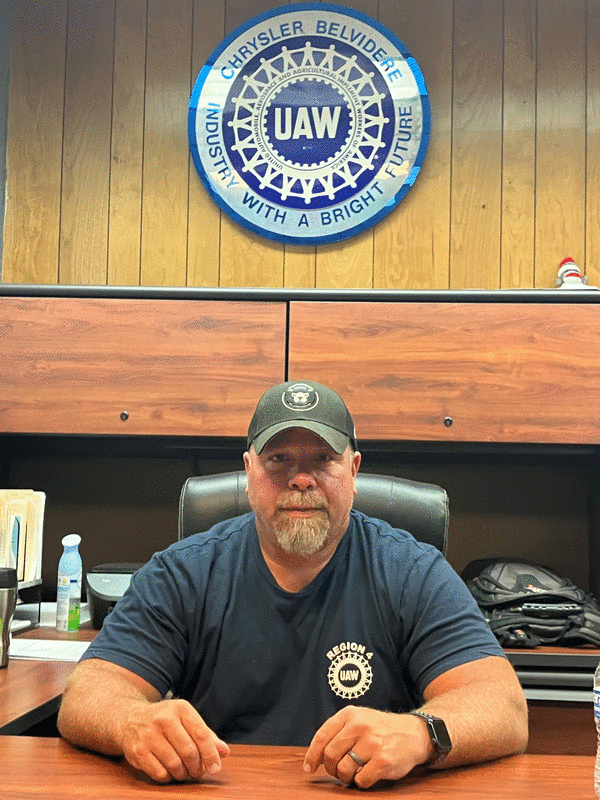
“We’ve been here before,” said Matt Frantzen, president of United Auto Workers Local 1268, which represents members in Belvidere.
Now, it's about watching for ongoing investments and upgrades inside the 5 million-square-foot plant to confirm the company is following through on its latest promise: "It's a matter of: Show us. Show us things are getting done," he said.
In the last round of contract talks between Stellantis and the UAW in 2023, the automaker agreed to produce a midsize pickup at the plant starting in 2027, set up a parts distribution hub inside the facility, and build a $3 billion electric vehicle battery plant in a field next door.
Union leaders and politicians praised the moves. A huge Midwest factory that once employed thousands and served as an economic engine for a large rural region was getting a new lease on life.
But within a year of the deal, Stellantis said it was delaying the truck launch. It appeared the carmaker might walk away from the project entirely. The battery plant and parts distribution hub never got off the ground.
The UAW fought back over the delays, holding rallies and threatening strikes at other Stellantis plants. In the ensuing months, CEO Carlos Tavares was forced out, President Donald Trump took office promising tariffs and a revitalization of American auto manufacturing — and Stellantis soon recommitted to the plant's future.
A new plan was eventually unveiled: Belvidere would still restart production in 2027, but this time build the Jeep Cherokee and Jeep Compass SUVs. The plant would get a $600 million upgrade and eventually employ 3,300 workers, the company said as it announced $13 billion in investments overall for its U.S. operations.
Now, Stellantis is shifting plans yet again. A Cherokee is still coming, but not until late 2029. The latest announcement no longer mentions the Compass, but adds the facility will still make a second vehicle on the same flexible STLA One architecture. Details will be announced "at the appropriate time," spokesperson Jodi Tinson said this week.
The announcement includes several other positive developments: $200 million in additional investments in the facility, and a commitment — pushed for by union officials — to extend supplemental unemployment benefits and increase the payments to reflect wage hikes that were included in the 2023 labor contract. Former Belvidere workers on temporary layoff receive 74% of their full pay rate under the agreement.
"We're all just praying to get home soon," said Kim Ross, who several years ago was forced to relocate, along with her two teenagers, to New Jersey so she could keep her job with Stellantis at a parts distribution facility in New York.
Ross now grapples with the distance to family and friends, the sky-high cost of living compared to Belvidere, and a two-hour commute. She's one of at least 600 former Belvidere workers scattered around the country, many of whom aim to come back when the plant reopens. Another 800 or so remain in the Belvidere area, receiving the supplemental unemployment and at times making ends meet with side jobs.
Under the new Stellantis reopening timeline, Ross hopes by late next year or early 2028 she and her kids can move back to the Belvidere area. But she knows the company's plans could change again tomorrow, in which case she'll consider seeking a transfer to a different plant, where the cost of living is lower and her family can live more comfortably.
“I’m so over it," the 57-year-old said Tuesday from her car as she drove two hours for her night shift at a Mopar parts facility. "This has been the longest four years of my entire life.”
Auston Gore is another ex-Belvidere worker forced to uproot his life to hold onto the solid pay and benefits his Stellantis job provides. He started work at the Toledo Assembly Complex three years ago — at first crashing in the basement at his aunt's house in Michigan before his girlfriend, Toshia Huble, and four children joined him and they found a place to live in Toledo.
Gore misses home, misses the plant where he had stronger ties to colleagues and became increasingly involved in the union. But the 36-year-old is also unsure whether, in another year or two, it will make sense to uproot his kids again and move the family back to Belvidere. The family has sought to acclimate to a whole new city, though "the pull of home" and family remains strong, Huble said.
“I’m mad as hell over the entire ordeal," Gore said. "Then to find out that nothing is set, or clear, that it’s always changing — there's not a set date or time (to bring workers back). Nothing is set in stone, so we have no idea how to plan.”
Gore said he loves his job as a production operator in the Toledo Jeep plant's body shop, but not the company itself. And, like Ross, he's not convinced that even this latest Stellantis plan will stick.
Belvidere is now set to reopen after the current contract between the company and UAW expires in early 2028, which Gore suspects could mean further updates to come: “It’s been very stressful, very frustrating,” he said.
The company notified the union that it forecasts producing 200,000 vehicles annually at the plant with two shifts, according to an email Frantzen sent to members in recent days. The company also still expects to receive state and federal assistance for the project, which would bring the total investment to about $2.1 billion, he wrote.
In terms of timing, Frantzen told members the plan is to start building pilots of the new Cherokee by the second quarter of 2028, with the initial shift of workers brought in by the second half of the year to train for launching the new vehicle. Production is set to begin by late 2029 for the 2030 model-year Cherokee.
In an interview, Frantzen said there have been several positive developments with the automaker lately. About 45 UAW skilled trades members have been working on equipment in the plant in recent months, and Stellantis recently agreed to add another 20 soon. The carmaker has already been pouring money into retooling the plant, he said, with $60 million spent through July, and another $60 million committed for the next several months. There's also the agreement to continue supporting laid-off workers and boost their unemployment pay.
"You don’t put that kind of an investment into members for a plant that’s not going to reopen,” Frantzen said. Still, he's wary after past promises and delays: "I'm not diving completely in, with ultimate faith that this is happening."
Stellantis just launched a redesigned Jeep Cherokee model for 2026, with assembly done at the Toluca Assembly Plant in Mexico. But Sam Fiorani, vice president of global vehicle forecasting at AutoForecast Solutions LLC, said it's not surprising that the company will turn around and redo the vehicle on a new platform in just a few years.
The current Cherokee's platform was designed primarily to be electric, which makes its current configuration as a hybrid awkward. A more adaptable platform should "make it more efficient to build," he said, and easier to sell "in this new marketplace that doesn't encourage EVs as much."
Fiorani also anticipates the smaller, next-generation Compass will still be built at Belvidere starting in 2030, even though Stellantis stopped discussing it. A future Chrysler crossover called the Airflow is also a possibility for the plant, he said.
One way or another, Ross hopes the plant is once again producing a vehicle and she can return home. Under the automaker's new timeline, she will have been living in New Jersey for six or seven years before the Belvidere plant ramps up hiring again. "We’re fed up, we’re tired, we need action, we need movement," Ross said, adding: "We just want to go home."
©2026 www.detroitnews.com. Visit at detroitnews.com. Distributed by Tribune Content Agency, LLC.










Comments