Will an early switch to winter-blend gasoline give California drivers a price break?
Published in Business News
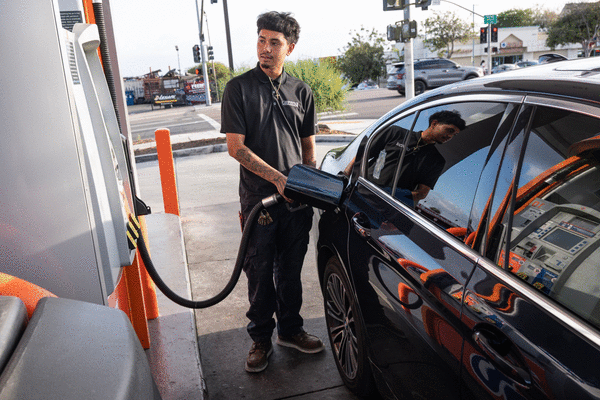
In an effort to stem the unrelenting surge in gasoline prices, Gov. Gavin Newsom has instructed state officials to switch to the lower-priced winter blend of fuel one month earlier than normal.
Fuel analysts say the winter blend is generally about 30 cents a gallon cheaper than the summer mixture.
Although it takes weeks for major price changes to ripple though the fuel system, David Hackett, president of Stillwater Associates, a transportation energy consulting company in Irvine, said the California spot market was starting to soften in reaction to the news.
“By next week, California gasoline prices will probably be at least 15 cents a gallon lower than they were this week,” Hackett said. “This is all good news for consumers.”
Newsom sent a letter to four state officials on Monday, including the chair of the California Air Resources Board, directing them to immediately allow the winter blend to be manufactured, imported, distributed and sold across the state.
Typically, summer-blended gas requirements stay in place until Oct. 31 each year.
“This is an extraordinary response to extraordinary prices driven by (President Donald Trump’s) endless war with Iran, and not a standing promise that the state will make an early transition whenever prices rise,” Newsom said in the letter.
The governor also directed the California Department of Food and Agriculture to promptly notify fuel suppliers, transporters and retailers of the adjustments to fuel-quality requirements.
“This will give suppliers greater flexibility and bring price relief to drivers ahead of the normal seasonal transition,” the letter said.
California’s unique summer blend helps reduce air pollution, but it’s more expensive than the winter blend because of the oxygenates required in the fuel.
“I do not take this step lightly,” Newsom said. “California’s summer gasoline requirements play an important role in protecting the air we breathe and the health of our communities.”
The change comes as gas prices near all-time highs.
The average price for a gallon of regular in San Diego stood at $6.40 on Tuesday, according to AAA. That’s just 4 cents shy of the previous record of $6.44, set on Oct. 5, 2022.
Local average gas prices have swollen 16 cents in the past week and 63 cents compared to one month ago.
Costs have soared as the U.S. war with Iran has now entered its seventh month. The regime in Tehran has disrupted and sometimes shut down passage of tankers through the Strait of Hormuz, where 20% of the world’s petroleum products passed through before the conflict began on Feb. 28.
High gas prices hit California drivers particularly hard.
The Golden State is often called a “fuel island” that is disconnected from refining hubs elsewhere in the country due to its lack of inbound pipelines from other states. Two major refineries in California have shut down since the end of last year.
California has the highest average price for gasoline of any state — $6.38 on Tuesday, compared to the AAA national average of $4.46 per gallon.
Last week, Newsom made another move to try to bend the gasoline price curve.
He signed Senate Bill 795, which is designed to remove the final regulatory hurdles for E15, a gasoline mix that contains 15% ethanol. California had been the last remaining state that limited ethanol blended into gasoline to 10%, or E10.
With the spot price of ethanol almost $2 a gallon cheaper than the spot price for petroleum in Los Angeles, boosting the amount of ethanol in gasoline from 10% to 15% is expected to reduce the price at the pump.
Two years ago, a study by economists at UC Berkeley and the U.S. Naval Academy estimated that California drivers could save 20 cents per gallon by switching from E10 to E15 fuel. The study was sponsored by the Renewable Fuels Association, which promotes the ethanol industry.
Conventional vehicles of model year 2001 and newer are approved to use E15.
Critics of ethanol say it reduces fuel economy because the corn-based fuel is not as energy-dense as regular gasoline, so a lower price at the pump may be offset by fewer miles per gallon.
©2026 The San Diego Union-Tribune. Visit sandiegouniontribune.com. Distributed by Tribune Content Agency, LLC.










Comments