'Everybody thinks it's shut down.' Why protesters won't leave Alligator Alcatraz
Published in News & Features


MIAMI — At 3 pm on a Tuesday in July, a man from Georgia contacted the Collier County Sheriff’s Office to report a woman with purple hair sitting in a car on the south side of Route 41, across from the gates of Alligator Alcatraz. She was live on TikTok, recording the license plates of vehicles entering and leaving the facility.
“She’s got 26,000 people watching this right now,” the caller said.
Thirty minutes later, an Alligator Alcatraz employee called about a “young lady livestreaming.”
The woman they complained about was Andrea Scherben, a 35-year-old grad student and social-media influencer who’d traveled across the country from California to see Florida’s Everglades detention center for herself — and share what she was watching with her 100,000 followers.
Almost six months later, she’s still there. And she’s got company.
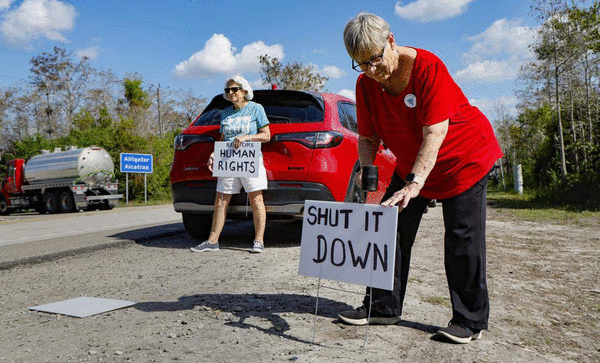
Long after the intense media attention on the first-of-its-kind state-run detention center faded, and the politicians and television crews moved on, Scherben is part of a small but diverse group of activists who still gather outside Alligator Alcatraz almost every day to raise awareness about the site’s continuing operations and pressure the government and its contractors to shut it down.
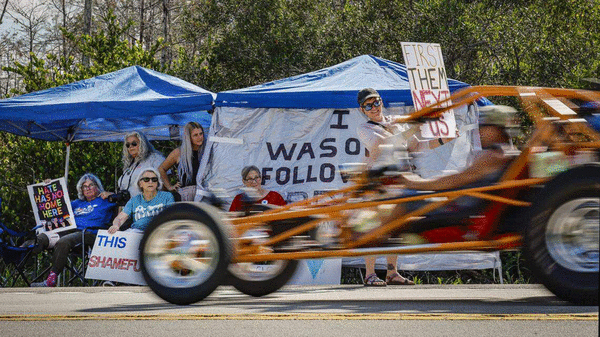
The group of about a half-dozen protesters — which has also become a resource for the confused family members who sometimes show up outside the center’s gates — includes the widow of a Florida federal judge, retirees, locals and a high school student. People have travelled from as far as Chicago to join them.
“I’m hoping that some of what we’re doing with trying to promote what’s going in and out will make a difference now,” Scherben said. “But if it’s not, it’ll at least make a difference in accountability in the future, and businesses not being able to say ‘I wasn’t involved.’”
Though they cannot access or speak to the detainees being held at the facility, they want the men to know that they are not alone.
They bring camping chairs and umbrellas to protect themselves from the Everglades’ harsh sun and passing storms. They place signs and banners across the road, facing the facility entrance. When it gets too hot, they use their cars for air conditioning.
There is no resting area, so each time they need to use the restroom, they travel down Route 41 west towards Naples to Clyde Butcher’s photography gallery or to one of the nearby campgrounds.
There are no set shifts. They say they are not being paid or supported by any donors. They show up during the day when they can.
Scherben shifted her monthly budget to cover her rental cars, which she sometimes lives in. She bought a Starlink router so she could do schoolwork while her dash cam records the activities around the facility.
“I realized there’s not a lot of people doing any work down here,” she told a Miami Herald reporter in an interview, “and so I decided to stay longer.”
“Everybody thinks it was shut down”
The long-running protest at Alligator Alcatraz began with Debbie Clark Wehking, a retiree who now works at the Episcopal Church Center on the University of Miami campus.
Wehking, 75, says she drew inspiration from her experience as one of the protesters who were stationed outside the controversial detention center for migrant children that opened in Homestead during President Donald Trump’s first administration in 2019.
Hoping to close the site, they showed up to political campaign events and forced candidates to commit to visiting the unaccompanied minors facility. Their strategy helped make the detention center a flashpoint for Trump’s policy of separating migrant families, and a near-mandatory stop for Democratic presidential candidates in Miami in 2019 for the first presidential debate of the 2020 election.
Ultimately, the government moved all the kids out and closed the facility, attributing the closure to reasons unrelated to the protests.
When Wehking heard that Florida Attorney General James Uthmeir was proposing something similar, she didn’t believe it would happen.
“That’s so awful. They wouldn’t do that to the Everglades,” she recalled thinking to herself.
The day after President Trump and Department of Homeland Security Secretary Kristi Noem toured the new facility, she drove by and saw a man with a sign protesting. She drove down past the facility and back again. She pulled over to the side of the road and joined the protesters — and has been going back after work ever since.
Wehking posts photos and videos on Facebook of the cars and vans going to Alligator Alcatraz after her visits. She encourages others who want to keep watch to join her.
The Department of Homeland Security and the Florida Division of Emergency Management did not respond to the Herald’s inquiry on whether the protesters have impacted operations at the facility.
In an August press conference, Gov. Ron DeSantis described the protest outside the facility as “10 people with signs and stuff.”
“I would find better things to do,” he said.
The group sometimes doubts the impact of their cause. They have been out there long enough to see a judge order the site closed, only to have an appeals court rule it can remain open. Since then, the global spotlight on the site’s existence has faded.
“Everybody thinks it was shut down,” said Wehking, who gets questions from friends asking why she still goes out to the Everglades.
But they believe keeping watch and showing up matters, and that it could put pressure on state and federal governments and force a shutdown.
“I hope that we can generate some more awareness,” Wehking said.
The unofficial family greeting party
The sky was blue, with patches of clouds overhead when Angela Perez arrived at Alligator Alcatraz on an early November afternoon. She said her friend, a 27-year-old immigrant from Colombia, had been detained during his routine check-in with ICE.
Perez, who lives in Miami, said she had called a number also listed for Krome North Service Processing Center, and the operator told her she could visit the Everglades facility during business hours. She had driven two hours to drop off legal documents but was turned away by a guard.
“They say, I have to be a lawyer,” Perez said to a Herald reporter moments later. “They say this is a detention center and not a jail.”
Perez, confused, had seen the group of protesters under a blue canopy, facing the entrance to the facility, with a banner that read, “I was only following orders.” She parked her car along the road and walked over, asking about access to the facility.
When the detention center opened, family and friends were mostly in the dark about where detainees were being held. Lawyers had sparse access, and their clients did not appear on the ICE locator.
The protesters became an unofficial greeting team for many families, like Perez, who showed up hoping to find out what was going on. They offer them water, sit and listen to their stories, and sometimes cry with them.
“They’re not alone standing here on the side of the road. And I think that’s the powerful thing we’re doing,” said one of the protesters, Nora Espinal. “We’re making a community for them.”
The family interactions also inspired 17-year-old Randy Nazir, who has been showing up at the protests with his mom. Nazir, who is in his senior year at Olympic Heights High School in Palm Beach County, said that when they first arrived, he was shocked by how active the site was, with ambulances and trucks coming and going.
“It could have been my family” inside, he said.
Randy, whose family moved from Guyana to the United States in 2006, decided to take action. With his mom’s help, he established the organization “Migrants Hope” to connect families with legal services and resources. He launched a TikTok channel for the organization, where he posts videos about the families they are assisting and streams live from Alligator Alcatraz. He plans to pitch the program to his school district so more high school students can get involved in helping immigrant families.
“Being the son of an immigrant myself, I could envision myself seeing my mom, seeing my brother, seeing my sister go into Alligator Alcatraz, and it just broke my heart for all the kids that are just being left behind,” he said.
A tourist attraction
Alligator Alcatraz doesn’t just attract protesters.
The pithy name, the endorsement by the Trump administration and the internet memes have made the facility an attraction for supporters of the Trump administration’s immigration crackdown.
On occasion, Wehking’s group watches as people stop by to take selfies in front of the blue sign at the entrance announcing the location of the immigration detention center, located behind a locked chain-link fence, too far from Highway 41 to see. Sometimes it is a family taking a family portrait. Others get creative with a handstand.
Drivers heading east or west across the Everglades occasionally flip them off, or yell “get rid of the illegals.”
Vendors sometimes set up shop, selling Alligator Alcatraz merch.
Tampa resident Amanda Lamb, 41, began joining the protest group in August. Lamb said she had read stories in the local paper, and had to see it for herself.
“I think what sits heavily in my heart is some of the people that come with their children, their young children, and they come and pose in front of the sign with their thumbs up,” she said. “Like it’s a Disney World stop.”
The site has become a landmark for tourists.
One of those visitors is Melissa Nato, a Naples woman who loves to visit the Everglades with her mother. Nato said the existence of Alligator Alcatraz is one of those historical moments people will look back at in disbelief.
“This is one of those things that people are gonna be like, ‘That really, actually happened?’”
©2025 Miami Herald. Visit at miamiherald.com. Distributed by Tribune Content Agency, LLC.






Comments