Cut vaccine mandates? SC lawmakers take cue from Trump administration in 2026
Published in News & Features
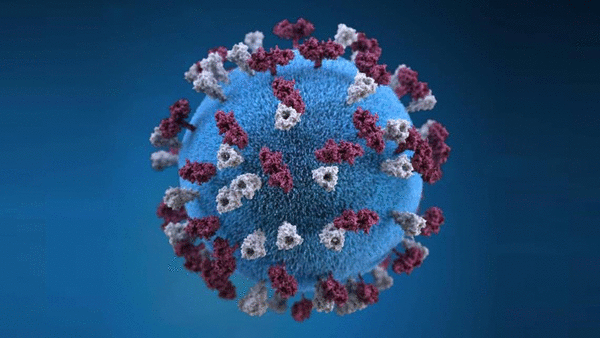
COLUMBIA, S.C. — As South Carolina faces climbing measles cases, a lawmaker wants to ban all vaccine mandates for children under two-years-old.
The bill is one of several proposed policies for 2026 that reflect the priorities of President Donald Trump and his administration.
Some vaccines, including measles, are mandatory for children attending daycare or public school in South Carolina. Religious, medical and special exemptions are available for required immunization schedules. Infants are required to receive two doses of the MMR vaccine, which protects against measles. The first dose is generally given after their first birthday.
The proposed bill would restrict all requirements for infants under 24 months to receive any vaccine. But South Carolina doctors have encouraged recommended immunizations as a measles outbreak has left hundreds, including schools, quarantining in the Upstate.
The Trump administration’s health department, led by Robert F. Kennedy Jr., has been critical of childhood vaccines. Earlier this month, a panel at the Centers for Disease Control and Prevention voted to abandon a longstanding recommendation to vaccinate all newborns against hepatitis B. The administration also warned against “overmedication” and “vaccine injury.”
U.S. Health and Human Services Secretary Kennedy has promoted several policies he says could reduce chronic diseases, dubbed Make America Healthy Again. In addition to state Sen. Carlisle Kennedy’s, R-Lexington, proposed vaccine mandate ban, South Carolina lawmakers have prefiled several bills that take cues from the second Trump administration.
Another vaccine-related bill would require the state Department of Public Health to further publicize available exemptions for childhood immunizations.
State lawmakers return Jan. 13. Over 812 pieces of legislation were prefiled last year, and many were only read and never discussed. Of the almost 2,250 bills and resolutions introduced last year, only 94 bills were signed by the governor.
The Make America Healthy Again bills
Some South Carolina House and Senate members proposed policies promoted in Robert F. Kennedy Jr.’s MAHA report. The report is aimed at reducing chronic diseases, particularly in children.
A Senate bill, prefiled by Kennedy, would restrict fluoride from being added to the public water systems or bottled water. Fluoridation helps reduce rates of tooth decay, according to dentists and public health experts. Despite public health support for fluoridation of public water, the MAHA report calls for more research into its safety.
Another target of the health secretary: restricting junk food purchases with Supplemental Nutrition Assistance Program benefits. State Rep. Tommy Pope, R-York, filed legislation that would ask the U.S. Department of Agriculture to exempt soda and candy from food stamps. Gov. Henry McMaster signed a similar executive order over the summer, and the USDA approved the state’s request. State agencies and institutions could also be banned from purchasing the same food and drinks restricted from SNAP, under a bill filed by state Rep. Annie McDaniel, D-Fairfield.
The MAHA report also calls for children to spend more time exercising and outside. A bill would mandate 60 minutes of daily physical outdoor activity for children in grades K-8, rather than the current 30 minutes.
Other Trump administration-inspired bills
Other proposed bills prop up priorities of the second Trump administration, including curbing some imports and cracking down on people living in the country illegally.
South Carolina House Speaker Murrell Smith, R-Sumter, said South Carolina’s legislative agenda would be partially driven by Trump administration priorities.
“Now that we have the Trump administration in place, they are partnering with us and how we’re moving legislative agendas forward,” Smith said at a press conference Friday.
Enforcing immigration laws is a priority for House Republican lawmakers next year, according to a handout from its caucus. A bill with broad House Republican support would require law enforcement agencies with correctional facilities to enter into 287(g) agreements with a federal immigration enforcement agencies. The agreement gives local police the ability to perform immigration enforcement actions with some federal oversight. In early September, 26 South Carolina agencies had entered into such agreements, up from three at the beginning of the Trump administration.
Another proposed bill would remove state funding from “sanctuary jurisdictions,” which would be determined in court. No South Carolina cities or counties were included on the U.S. Department of Justice’s May 2025 list of sanctuary jurisdictions. The State Law Enforcement Division would also have to compile an “Immigration Compliance Report,” under the proposed bill. State and local law enforcement would also have to transfer custody of all people determined to be in the U.S. illegally to Immigration and Customs Enforcement.
The H-1B visa, which allows people from other countries with higher education training to work in the U.S., has also drawn criticism and new steep fees from Trump. State Rep. Jordan Pace, R-Berkeley, filed legislation to cut off economic development incentives for companies with employees with H-1B visas.
Another proposed bill from state Sen. Larry Grooms, R-Berkeley, would require public works projects to use domestic steel and iron, with some exceptions. A similar bill was also filed by two House lawmakers. Trump placed steep, 50%, tariffs on steel imports this summer.
Lexington’s County’s Kennedy also proposed two bills dealing with protests he defines as “riots.” One bill places financial responsibility on “funding entities” to deal with financial damages associated with a “riot.” Another removes criminal or civil liability in some instances from a person that flees a riot in their car and injures or kills another person in the process.
©2025 The State. Visit at thestate.com. Distributed by Tribune Content Agency, LLC.





Comments