Aldermen pass 2026 budget in historic revolt against Mayor Brandon Johnson
Published in News & Features
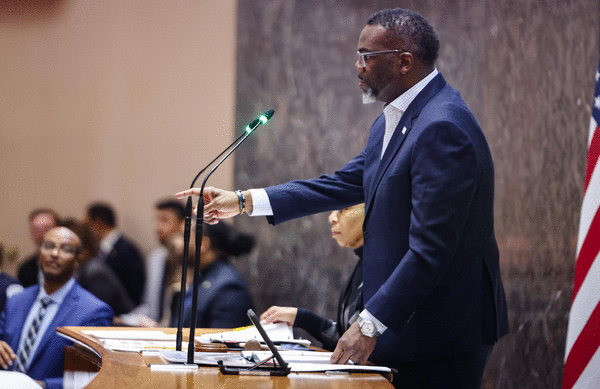
CHICAGO — Aldermen passed the final part of a counterproposal to Mayor Brandon Johnson’s 2026 budget on Saturday, in a historic meeting that redraws the political lines at City Hall and further imperils his progressive agenda.
The consequential day was punctuated by hours of floor speeches with the usual finger-pointing and grandstanding between the council’s ever-deepening factions, before a final 30-18 vote on the remainder of a $16.6 billion budget for next year that Johnson has failed to stop. The revenue package of that plan passed in a 29-19 vote a day earlier.
Now, all eyes are on Johnson and whether he will issue a mayoral veto. The mayor addressed the floor before the vote to reflect on the weight of his office, even in “times of great consternation and division,” by invoking civil rights leaders such as Dr. Martin Luther King Jr. and connecting their struggles with his attempt to tax the rich.
“I know that losing the battle does not mean that we have lost the war,” he said in conclusion. “Though we may not have a majority of the council, we do have the people.”
Johnson’s speech lasted almost 20 minutes but did not reveal his veto decision beyond declaring his stalled budget proposal’s corporate head tax is “a battle that is still not over.” Few aldermen applauded while he spoke, as the mayor at times castigated his opponents for how they have treated him.
“I cannot take responsibility for our emotions that I have nothing to do with,” Johnson said. “We don’t build our hopes on emotions. We build our hope on what is just.”
Ahead of the vote, many of Johnson’s City Council foes did not hold back in blaming him for how messy the 2026 budget process has gotten. But a leader of the opposition — and also Johnson’s handpicked Finance Chair — Ald. Pat Dowell sought to tamp down the rancorous tone.
“I think what happened in this council is good for the city of Chicago, because we came together,” Dowell, 3rd, addressed the floor. “It’s not perfect, but it is a good budget, and one that we can work with. And if we keep involved post-2025 and work together as a collective, it’ll be good for the city of Chicago.”
Some of the sharpest critiques of the mayor came from former allies on his leadership team and the Progressive Caucus. Their frustrations fold into a larger trend of the first-term mayor’s coalition shrinking since he took office in 2023 and found himself steadily isolated inside the mayor’s office on the fifth floor of City Hall, where critics say his activist approach to governance has alienated all but his most loyal supporters.
In a way, the tense atmosphere on the council floor Saturday was the story of the Johnson administration for the last two years now: A freshman organizer-turned-executive who inherited a host of problems, structural budget deficit and underfunded pension and debt obligations notwithstanding, worsened his situation through a series of political missteps. A legislative body, growing into independence for many years now, that broke into full-out revolt as they sensed his struggle to navigate City Hall’s treacherous political waters. And now, a frustrated progressive movement at a crossroads.
The mayor’s council surrogates who remain in his inner circle, however, went to bat for him Saturday. Their attempts to shore up his diminishing position hinged on the moral urgency of Johnson’s budget proposal that would reinstate Chicago’s corporate head tax.
Progressive Ald. Byron Sigcho-López compared his colleagues to an opposition bloc against Mayor Harold Washington, the city’s first Black mayor who four decades ago faced resistance every step of the way from then-Alds. Ed Burke and Edward Vrdolyak and their white allies.
“We have the same fight that we had in the ‘80s: We have the new Vrdolyaks trying to come back,” Sigcho-López, 25th, said.
Washington was the last Chicago mayor to veto a budget, exactly 40 years ago.
Ald. Andre Vásquez, co-chair of the Progressive Caucus, rejected the comparison, turning to the aldermanic crowd, then directly facing the mayor: “This ain’t the Vrdolyak crew. You’re not Harold Washington.” Still, the 40th Ward alderman voted no.
Johnson and his allies have also argued the alternative plan relies on faulty assumptions that ultimately make it unbalanced and have taken particular issue with the plan to sell to debt collectors $1 billion in long-outstanding money owed to the city for pennies on the dollar.
“I support asking those who have benefited the most from our city’s economy to contribute their share,” Johnson ally Ald. Jessie Fuentes, 26th, said. “We must have difficult conversations, but avoiding those is how we end up here year after year.”
Johnson’s slim leverage rests in a potential veto, which would require 34 votes for aldermen to override. He first made the threat over a month ago, but with an end-of-year deadline to pass a budget before a cataclysmic government shutdown now 10 days away, actually escalating the fight to that level would be his riskiest political decision yet.
The mayor’s framing of the fight speaks to the difficult political position he finds himself in. Many of his most ardent progressive supporters view the plan’s added debt sale and dropped head tax as intolerable but agree that the government shutdown that could be triggered by a veto is similarly unacceptable.
Johnson and the Chicago Teachers Union, his top backer in the 2023 election, have positioned this budget fight as one between poor and rich, under a backdrop of President Donald Trump’s “war” on Chicago, in an attempt to sway holdouts. But some aldermen on Saturday said they had grown weary of that strategy.
“Don’t use my people for political theater,” said Ald. Monique Scott, 24th, a member of the opposition bloc and the Black Caucus. “That’s using my people to send your political rhetoric. Don’t do that. We have an obligation as legislators to collect on debt.”
The next step of this struggle will not just hinge on the dollars and cents of the budget negotiations but on who wears the political jacket. That’s the case for either a worst-case scenario of a government shutdown, or a credit downgrade.
Johnson admonished the council for trying to pin the blame on him in his floor speech that again accused the alternative budget of being unbalanced.
“The incredible impact that this shortfall could have, you place it on one person,” Johnson said. “Let’s not pick and choose when someone else has to take the responsibility.”
The budget that passed contains a mix of untouched Johnson proposals — which his allies have been celebrating as a victory — slight tweaks to his original plan and wholesale revenue changes.
Much of Johnson’s original proposal is fully intact. That includes a $1 billion TIF surplus to yield $572 million for Chicago Public Schools and $233 million for the city; short-term borrowing to cover the cost of back pay for Chicago firefighters and legal settlements and borrowing plans for infrastructure improvements.
The city’s tax on personal property leases, which applies to everything from car rentals to cloud computing, goes up from 11% to 15%. Johnson had proposed 14%. The congestion zone for ride-share trips on Uber and Lyft will expand, but not with Johnson’s first proposed percentage-based fee structure.
The head tax is gone. There is no major property tax hike either, save for a $9.1 million increase dedicated to averting cuts at the city’s libraries, nor a hike in garbage fees. That’s a reflection of the political climate, and upcoming 2027 election. And the alternative budget restores the full advance pension payment that Johnson’s original proposal had cut by roughly half.
The alternative revenue plan relies on a constellation of new taxes and raised fees that Johnson did not initially pitch for virtual and traditional advertising on city property, liquor and video gambling.
Meanwhile, Johnson introduced his own revised budget plan Friday that would replace the debt sale plan with the head tax, restore the full advance pension payment that he had proposed halving, not legalize video gambling terminals and count on slot machines being placed at a Midway Airport lounge. Opponents stalled the measure.
The defiant aldermen have said one of their goals was to prevent a ratings downgrade, but experts say based on recent trades, buyers of Chicago debt are already expressing their doubts.
Johnson’s most recent budget triggered a credit downgrade from S&P in January, bringing the city’s rating to just two notches above junk.
S&P warned last month there was a 1-in-3 chance of a lower rating within the next two years if the city failed to implement structural reforms, minimize growth in the city’s pension liabilities and make sure “outyear cost pressures” don’t keep rising in a way that threatens future budgets. Downgrades can make borrowing more expensive, increasing interest costs.
A longtime watcher of Chicago’s finances, Rich Ciccarone, a municipal bond analyst and the emeritus president of Merritt Research Services, said Friday the market has already been pricing city debt “as if it’s on the verge of a downgrade, if not a downgrade.”
“They’re watching and have already started to anticipate the difficulty of the situation,” Ciccarone said.
Once the council adjourned in the afternoon, Johnson staffers and progressives quickly filed out, some of the aldermen recording selfie videos summarizing the momentous fight.
The mayor’s Budget Committee Chair Ald. Jason Ervin avoided weighing in on whether Johnson should veto the spending plan. He did suggest Johnson could issue such a veto after Jan. 1 but declined to explain how that process would work.
“People will have a more conversational tone. I think it’ll be best to assess it going into the New Year,” Ervin, 28th, said. “Eventually, yes, there will need to be tweaks in the budget.”
Meanwhile, the opposition bloc took a victory lap behind chambers to send a final warning to Johnson on conceding this budget fight.
“He’s chosen a path that could bring us to the brink of a city shutdown,” Ald. Samantha Nugent, 39th, told reporters.
But the renegades also sought to cast their nascent countermovement as one of “addition,” not division, after Johnson allies labeled them the “Cuts Caucus,” “Corporate Caucus” and beyond during this budget season.
Ald. Nicole Lee, 11th, dangled an open invite for other council members to join before chuckling at a question over which label she prefers.
“We are just a coalition,” Lee said.
____
©2025 Chicago Tribune. Visit at chicagotribune.com. Distributed by Tribune Content Agency, LLC.





Comments