Cozying up to MAGA pays dividends for Germany's far-right AfD
Published in News & Features
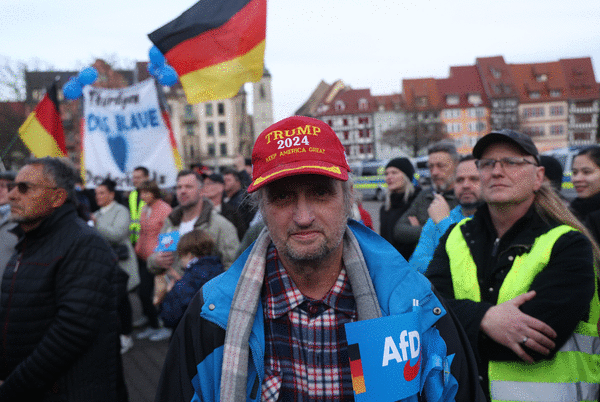
A yearlong campaign by the far-right Alternative for Germany party to court Donald Trump’s MAGA movement is beginning to bear fruit.
Though the country’s largest opposition group is a virtual pariah among the German political elite due to its xenophobic bent, it is gaining traction among ideological allies who hold power in Washington.
Since Trump took office in January, dozens of AfD officials have traveled to the U.S. for meetings with lawmakers and administration officials, and many in and out of the party see Washington’s new national security strategy — warning of the “prospect of civilizational erasure” in Europe because of immigration — as a milestone.
“The current strategy can be read as a declaration of support for right-wing nationalist parties across Europe, like the AfD,” says Marina Henke, director of the Center for International Security at Berlin’s Hertie School.
Critically, tremors in Washington are being felt in Berlin. U.S. officials have urged restraint on Germany — through the Foreign Ministry — on potentially outlawing the party, according to people familiar with the matter. AfD members have lobbied the Trump administration to prevent German authorities from initiating a ban particularly after the domestic intelligence agency in May classified it as a “confirmed right-wing extremist” organization. The German ministry declined to comment.
The State Department has told the U.S. Embassy in Berlin to maintain regular contact with the AfD. That led to a meeting about two months ago between AfD Chair Alice Weidel and the embassy’s chargé d’affaires, career foreign service officer Alan Meltzer, the top U.S. representative in Germany in the absence of an ambassador, according to people familiar with the talks. They described the encounter between the politician and the diplomat as tense and far from cordial.
And at least two State officials have met with AfD members this month: Darren Beattie, a senior cultural-affairs aide who was fired as a White House speechwriter in the first Trump administration for attending a gathering of white supremacists, and Undersecretary Sarah Rogers. “As a matter of standard practice, U.S. diplomatic missions engage regularly with representatives from a wide spectrum of political parties and leaders,” a State Department spokesperson said.
When asked about the administration’s views on the AfD, Secretary of State Marco Rubio said that it’s part of his department’s job to “understand the full political spectrum of countries around the world, including countries we have alliances with.”
“We want to know who they are. We want to meet with them. We want to hear them out,” Rubio told reporters at a press conference Friday.
The mood music has been conducive to the rapprochement from the earliest days of the second Trump term, when Vice President JD Vance spoke at the Munich Security Conference in February — and met Weidel offsite after the speech since the AfD wasn’t welcome at the event. He called for dismantling the so-called “firewall” — a metaphor for the collective refusal of Germany’s mainstream parties to cooperate with the AfD.
Since his address, ties have continued to improve, with contacts becoming more frequent and increasingly coordinated. The prospect for an AfD-MAGA meeting at the 2026 Munich gathering appears promising. After AfD officials encouraged the Trump team to weigh in with organizers, an MSC spokesperson said the plan is to invite politicians from all parties represented in the parliament, including the AfD. The spokesperson stressed that the organization is independent and has no obligation to anyone for extending invites.
But the views of mainstream German politicians haven’t similarly evolved since then-candidate Chancellor Friedrich Merz expressed his disgust in January: “We do not work with a party that is hostile to foreigners, that is antisemitic, that harbors right-wing extremists and criminals in its ranks, that flirts with Russia and wants to withdraw from NATO and the European Union.”
Vance, in a Feb. 14 interview with the Wall Street Journal, said his “firewall” comments about not banning or excluding political parties stem from his belief that European leaders have continuously disregarded the views of their people and voters, especially on immigration.
The white-supremacist current within the MAGA movement says “they love Europe, calling it a bastion of white people and Christianity,” but that it simply has the “wrong politicians,” according to Henke.
AfD lawmaker Beatrix von Storch openly displays her affinity for Trump’s movement. In her Bundestag office in Berlin, a red “Make America Great Again” cap hangs next to a pink “Make Jesus Great Again” one. Framed behind her desk is a quote from Ronald Reagan: “Government is not the solution to our problem. It is the problem.”
“We and the MAGA movement are ideologically like-minded,” said von Storch, who hosted a November event in Berlin with Alex Bruesewitz, a consultant close to the MAGA movement. Shortly afterward, she posted on Telegram: “Patriots are networking globally. We are fighting the same fight. Together.”
It is important, she said, that U.S. administration officials stop discussing the far right with Merz’s conservatives or the Social Democrats and instead engage directly with the AfD, which was founded in 2013 and lacks the international ties of Germany’s established parties.
For all the rhetoric, business still has to be conducted, deals cut and the war in Ukraine ended.
U.S. officials privately and publicly praise Merz, who took office in May and ran on promises of a more stringent immigration policy as well as a historic increase in defense spending. Trump has applauded his leadership on Ukraine and counts Merz as one of the few European leaders who are in the room during negotiations on the matter.
This past week, Merz hosted Ukrainian President Volodymyr Zelenskyy, Trump‘s envoy Steve Witkoff and son-in-law Jared Kushner, and European leaders at the chancellery for talks on a peace deal.
Still, Merz’s CDU is trailing the AfD in some polls. The AfD appears headed to win some state elections in East Germany next year — a scenario that the ruling parties are desperately trying to prevent.
A potential AfD ban would need to be “nipped in the bud” and as the U.S holds significant influence over Germany by historical a.nd political reasons, it would be “beneficial to have advocates in DC,” von Storch said.
“We will soon play a more important role in Germany. The only way they could stop us is if they ban us or keep us from elections through undemocratic means,” von Storch said.
———
(With assistance from Eric Martin.)
©2025 Bloomberg L.P. Visit bloomberg.com. Distributed by Tribune Content Agency, LLC.






Comments