As Epstein's cushy jail sentence raised concerns, his lawyers went on charm offensive
Published in News & Features
Jeffrey Epstein’s team of high-powered lawyers famously negotiated a lenient 2007 deal on his behalf with federal prosecutors in the Southern District of Florida that allowed the financier to avoid a lengthy prison sentence and plead guilty to only two state charges to settle allegations that he had abused dozens of teenage girls.
Never-before-seen documents released this week by the Department of Justice as part of the so-called Epstein Files show how his attorneys continued to try to influence federal prosecutors even after his deal was finalized, and mixed personal and business relationships with the attorneys who had agreed to settle Epstein’s case.
While federal prosecutors pushed back against Epstein’s lawyers, at the end of day, Epstein got what he wanted.
In mid-November of 2008, nearly five months after Epstein began his sentence at the Palm Beach County Jail, his attorney Jay Lefkowitz wrote to one of the Florida prosecutors on the case asking if the prosecutor could meet the week of Thanksgiving.
“Do we need to discuss anything related to Mr. Epstein or is this purely a social visit?,” asked the prosecutor, whose name is redacted.
Lefkowitz replied that he would be seeing Epstein and would provide the prosecutor updates on his client.
“But primarily,” Lefkowitz wrote, “I thought we could have a social visit. For once.”
Lefkowitz didn’t respond to multiple requests for comment.
His correspondence with the unnamed prosecutor came roughly one week before the U.S. Attorney’s Office in the Southern District of Florida wrote to another of Epstein’s prominent attorneys, Roy Black, to raise a significant issue.
They learned that Epstein had applied for and been admitted to a work release program through the Palm Beach County Sheriff’s Office, which operated the county jail.
Under the terms of this program, Epstein was ultimately able to spend up to 12 hours a day, six days a week working at a nearby office he rented in West Palm Beach while he was serving his sentence. Epstein allegedly continued to abuse girls at this West Palm Beach office while still technically serving his incarceration.
In the Nov. 24, 2008, letter, the U.S. Attorney’s Office wrote that Epstein’s participation in the program is a “material breach” of his deal with the government. Part of his agreement required that he spend his incarceration in jail, not on work release.
“Accordingly, the United States demands that Mr. Epstein withdraw his application to participate in the program and complete his eighteen-month term of imprisonment,” the letter states.
Neither of those things would happen.
Epstein continued to participate in the program, and he was released from custody after only 13 months.
Black died earlier this year.
‘A relaxed drink and conversation’
It wasn’t the first time federal prosecutors discussed the conditions of Epstein’s incarceration with his attorneys; the letter indicates that they raised concerns about it in June 2008 as his plea deal with the state was being finalized. It wouldn’t be the last time, either.
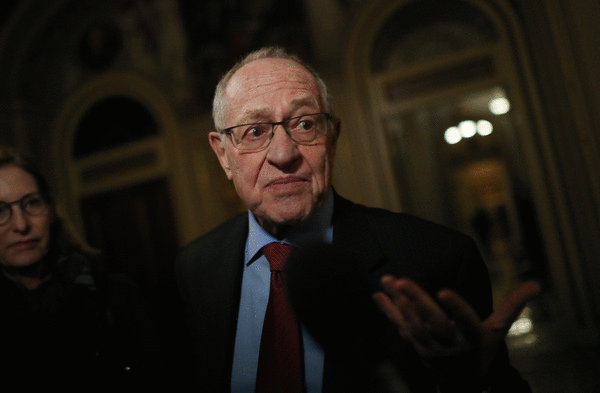
Another of Epstein’s attorneys, Alan Dershowitz, met for a drink in March 2009 with an attorney from the U.S. Attorney’s Office who Dershowitz identified as Jeffrey Sloman, the then-deputy U.S. attorney in Miami.
Sloman at the time was overseeing the Epstein case and succeeded Alexander Acosta as the U.S. Attorney for the Southern District of Florida two months later.
Dershowitz wrote to Sloman after their meeting.
“It was so nice having a relaxed drink and conversation on the porch of our neighborhood bistro,” Dershowitz wrote. “I appreciate your kind words of advice, encouragement and friendship.”
But the visit clearly wasn’t all social.
“I especially appreciate your assurance that the feds will not interfere with how the Palm Beach sheriff administers jefferey’s sentence as long as he is treated like any similarly situated inmate,” Dershowitz added, misspelling Epstein’s name. “My understanding is that if the sheriff were to decide, in the normal course of events, that the circumstances warranted Jeffrey completing the custodial portion of his sentence under alternative custody/in-home detention, your office would not intrude.”
Sloman responded saying that he looked “forward to maintaining and growing our friendship.”
He went on to say that the U.S. Attorney’s Office “will not interfere with how the Palm Beach Sheriff’s Office administers the sentence imposed by the Court.”
But he added that “this does not mean that (The U.S. Attorney’s Office) condones or encourages (The Palm Beach Sheriffs Office) to mitigate the terms and conditions of his sentence.”
If the office was contacted to offer their position on Epstein being allowed to serve out the remainder of his sentence in “alternative custody or in-home detention,” Sloman wrote, “we will object.”
Dershowitz wrote back the following day with a compliment.
“You are a real mensch,” he said.
A few months later Epstein was released from the Palm Beach County jail, five months before the scheduled end of his 18-month sentence.
Dershowitz told the Miami Herald that he did for Epstein what he would do for any client.
“I try to get the best possible situation,” he said.
He added that there was “nothing unusual” about the negotiations between Epstein’s legal team and the U.S. Attorney’s Office throughout the entire process.
Sloman didn’t respond to multiple requests for comment.
‘The possibility of working together’
The prospect of future work complicated the relationship between federal prosecutors in the Southern District of Florida and Epstein’s legal team.
Acosta, who formally signed off on Epstein’s non-prosecution deal with the feds, recused himself from the case in December 2008 because he was in discussions about going to work for the law firm Kirkland & Ellis, according to the Justice Department’s internal investigation into the Epstein deal released in 2020. Kirkland & Ellis employed both Lefkowitz and another of Epstein’s high-powered attorneys, former Solicitor General Ken Starr.
The report also showed that Acosta had met with Lefkowitz for breakfast in October 2007 at a West Palm Beach Marriott.
In a letter to Acosta, Lefkowitz wrote that Acosta had assured him that the U.S. Attorney’s Office would “not intervene with the State Attorney’s Office regarding this matter” and not intervene in Epstein’s state sentence. Acosta disputed that characterization in a letter sent to Lefkowitz in response, the report said. Agreeing to those terms would equate to “the imposition of a gag order,” the response to Lefkowitz said.
Epstein himself was in direct contact with one of the prosecutors who oversaw his case after he was released from custody.
The Herald previously reported that Epstein met with former prosecutor Matthew Menchel several times in 2011, 2013 and 2017, according to Epstein’s calendars released by the House Oversight Committee from material it received through a subpoena to Epstein’s estate.
The new Epstein files include another new piece of information, an October 2010 e-mail between Menchel and Epstein, less than a year and a half after Epstein’s sentence ended.
“I very much enjoyed our talk the other night,” Menchel wrote. “I look forward to the possibility of working together, but regardless let’s keep in touch.” A spokesperson for Menchel provided the Herald with a statement indicating that Menchel never met with Epstein during the time he was involved with the Epstein investigation at the U.S. Attorney’s Office and that the law firm where Menchel went to work after leaving the government, Kobre & Kim, was one of several firms Epstein considered hiring to address various legal issues.
“There was nothing inappropriate about any of Mr. Menchel’s communications or conduct,” the statement said. “Ultimately, neither Mr. Menchel nor anyone else at his firm ever represented Epstein or otherwise did business with him.”
_____
©2025 Miami Herald. Visit miamiherald.com. Distributed by Tribune Content Agency, LLC.





Comments