Florida executed 19 death row inmates in 2025. That caused unusual national uptick
Published in News & Features
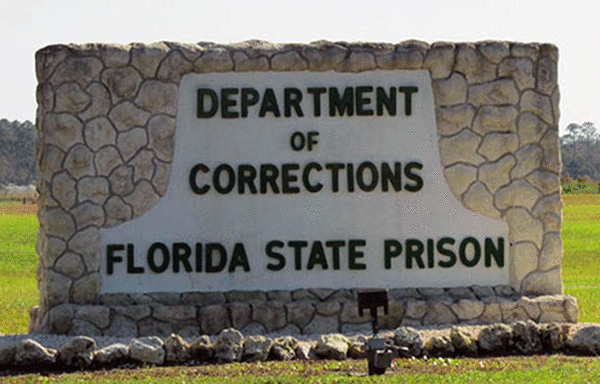
MIAMI — Florida nearly doubled the national average of executions in 2025, with a record-breaking 19 death warrants carried out, according to an annual report released by the Death Penalty Information Center.
Experts say Florida’s “extreme” outlier status — namely, the ramping up of executions — comes at a time when public support for capital punishment is waning. Texas is the only other state that has ever exceeded 18 executions in a year’s span, doing so back in 2009, according to the report.
“The [country’s] rise in executions was driven primarily by the state of Florida, which carried out 19 executions, 40% of the year’s total” of 47, the report concluded.
Without Florida, the national execution rate would be like an average year, with fewer than 30 executions across the country, said Robert Dunham, executive director of Death Penalty Policy Project.
“This is the year of the national execution surge that wasn’t,” Dunham said.
The average age of Florida’s executed inmates was 60, and the bulk of the crimes occurred in the 1980s and ‘90s, according to the Herald’s review of execution data.
Only two of those executed this year were linked to South Florida. Victor Tony Jones, 64, was executed on Sept. 30 for killing an inventor and his wife at their business just east of Wynwood. Michael Tanzi, convicted of the 2000 murder of Miami Herald employee Janet Acosta in the Florida Keys, was executed on April 8. The Herald witnessed Tanzi’s execution.
Florida in context
The increase in executions in Florida hasn’t gone unnoticed in the criminal law community, said Michelle Suskauer, an attorney of more than three decades and a former president of the Florida Bar. The state may have executed a historic number of death row inmates because of the backlog linked to the COVID-19 pandemic, but Florida’s expansion and fast tracking of the death penalty has raised concern.
In recent years, Florida lawmakers have drastically changed the state’s death penalty laws.
Gov. Ron DeSantis in 2023 signed a law that allows juries to recommend a death sentence with an 8-4 vote instead of unanimously. DeSantis pushed for the change after the Parkland school shooter, who killed 17 students and faculty members in a shooting spree at Marjory Stoneman Douglas High on Feb. 14, 2018, was spared from the death penalty in 2022. The Florida Supreme Court had previously ruled that jury verdicts needed to be unanimous.
The Legislature also passed a law to make the death penalty mandatory for undocumented immigrants convicted of capital crimes and expanded the possibility of death sentences involving certain human trafficking, drug trafficking and child sexual abuse offenses. The U.S. Supreme Court, however, in 2008 ruled that the death penalty can only be applicable in murder cases.
According to the Death Penalty Information Center’s report, more than 80% of the inmates executed in the U.S. exhibited concerns related to serious mental illness, low IQ, brain damage or intellectual disability, as well as significant childhood trauma, neglect or abuse.
Suskauer believes some of the inmates executed wouldn’t be sentenced to death if they had gone before a jury today.
“The numbers are overwhelming, but the individual stories are significant,” she said.
Most of Florida’s condemned raised similar concerns in their last-minute appeals. Several, including Miami’s Victor Tony Jones, cited that they were among the hundreds of survivors of the Arthur G. Dozier School for Boys and the Okeechobee School, now-shuttered state reform schools in Florida where children were raped, beaten and tortured. In March 2024, DeSantis approved a law to pay $20 million to compensate victims of the two schools.
At least two of those executed — inmates Norman Grim and Bryan Jennings — claimed they had no access to legal counsel for years before their death warrants were signed.
“It’s complicated,” Suskauer said. “This is the ultimate punishment. If the state is seeking the ultimate penalty, you want to make sure everything was done right and that the defendant had full access to attorneys at every step of the proceeding, including post conviction.”
Dunham likened the “butchery” of Florida’s death row to a line from Shakespeare’s “Henry VI”: “The first thing we do, let’s kill all the lawyers.” DeSantis, he added, targeted the “easiest to execute” — the inmates who had no lawyers and had given up their rights.
Part of the reason Florida’s execution spree was possible, Dunham said, is because there was no meaningful review of appeals. During DeSantis’ tenure, the governor has stacked courts with extreme right-wing judges, he added. In 2020, the Florida Supreme Court also abolished proportionality review, which for 50 years allowed judges to probe the circumstances of death cases to protect defendants from the random imposition of the death penalty.
Frank Walls, the last Florida inmate executed, introduced credible evidence that the Florida Department of Corrections was violating execution protocols, Dunham said. Walls alleged that prison records proved the state used expired drugs and lower doses than required by Florida law.
“There really has been a dismantling of constitutional protections in Florida cases,” Dunham said. “... There is no meaningful review because of the back-to-back executions.”
Justice or politics?
In November, DeSantis said the record number of executions was due to “victims’ families that are wanting to see justice” and him “doing my part to deliver that.”
“We have lengthy reviews and appeals that I think should be shorter,” DeSantis said. “I still have a responsibility to look at these cases and to be sure that the person’s guilty. And if I honestly thought somebody wasn’t, I would not pull the trigger on it.”
However, Dunham said there is no logical justification for Florida to carry out executions at such a rate .
“The bodies on the gurney are only there because it’s politically beneficial for Ron DeSantis,” Dunham added.
For Suskauer, executions are part of the law of the land in Florida and need to be carried out after appeals are exhausted — and as long as the condemned had effective counsel. But the justice system has the duty to protect defendants’ rights while honoring the wishes of victims’ families.
“It’s a very hard balance, and it’s emotional on both sides,” Suskauer said.
Who’s left on Florida’s death row?
There are more than 240 people awaiting execution on Florida’s death row. Seventeen are from Miami-Dade, 13 are from Broward and two are from Monroe.
The longest-serving South Florida inmate is William Thompson, 73, convicted in the 1976 kidnapping, rape and murder of a young woman inside a Miami-Dade motel room.
©2025 Miami Herald. Visit at miamiherald.com. Distributed by Tribune Content Agency, LLC.






Comments