Connecticut politics in 2025: Big actions and many called not enough to address a major issue facing families
Published in News & Features
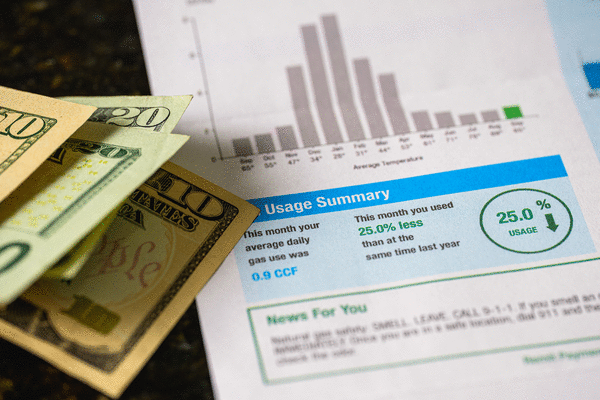
Trying to tackle huge problems facing Connecticut, the state legislature made progress in 2025 with improvements on power prices, affordable housing, and making child care affordable for many families.
While lawmakers acknowledge the progress, they say they need to make further improvements in 2026 to help ease the affordability crisis in a state known for high electric rates, property taxes, real estate prices and overall cost of living.
One of the biggest bills of the year was landmark legislation by Gov. Ned Lamont to fund an endowment account to create more affordable child care in Connecticut by 2032. Lawmakers agreed with Lamont to set aside as much as $300 million per year from the state’s future budget surpluses to create a large endowment fund that would be invested by the state treasurer and could grow in future years. The allocations will be based on the size of the operating surplus.
Democrats hailed the plan for “affordable and accessible” child care, but Republicans questioned the use of large amounts of money for an off-budget account instead of allocating more money for the state’s unfunded liabilities like pensions for state employees and public school teachers. Under the plan, families earning $100,000 or less would pay nothing for child care starting in 2028, as it would be paid by the endowment.
“I think it’s the most important initiative we have in this budget,” Lamont said when the measure passed. “If I can get universal early childhood free of charge for every family under $100,000, it’s great for the kids. It helps mom and dad get back to work. It helps with affordability.”
Electricity
After behind-the-scenes squabbling, negotiators eventually reached a bipartisan compromise on an omnibus bill that attempted to cut electricity costs — while saying they need to go even further in 2026.
Known as Senate Bill 4, the legislation was written and rewritten multiple times as various lawmakers, lobbyists, and advocates tried to get their ideas into the final version that Lamont signed into law.
Despite the often-sharp debate, some lawmakers said the legislation did not go far enough to provide major savings for ratepayers. While estimates varied widely, lawmakers said that residential ratepayers would save about $100 per year and small businesses an estimated $1,200 per year, depending on the amount of usage per customer.
Among the reasons for the ongoing outcry is the cost of the “public benefits” that show up on ratepayers’ bills. Republicans have repeatedly said the public benefits should be stripped out of all electricity bills and covered by the $27 billion annual state budget. Lamont has strongly opposed that idea, saying it would simply shift costs from ratepayers to taxpayers. The final bill included some reductions in the public benefits by borrowing money through bonding to cover the costs.
But the debate is expected to continue as the leading Republican proponent of cutting electricity costs, Sen. Ryan Fazio of Greenwich, is running for governor in a campaign that will heat up in 2026.
Lamont has continued to push for more wind power, but President Donald Trump’s administration moved on Dec. 22 to suspend the leases for all off-shore wind projects in federal waters on the East Coast, including the Revolution Wind project off Connecticut and Rhode Island that had been stopped previously in August and then restarted in September after a federal judge’s ruling.
In a rare show of solidarity, Lamont joined with the governors of New York, Massachusetts, and Rhode Island for a strong statement against the suspension as an anti-business move.
“The Trump administration’s announcement pausing offshore wind leases is its latest egregious attack on clean energy, and it lands like a lump of dirty coal for the holiday season for American workers, consumers, and investors,” the four governors said. “Pausing active leases, especially for completed and nearly completed projects, defies logic, will hurt our bid for energy independence, will drive up costs for America ratepayers, and will make us lose thousands of good-paying jobs. It also threatens grid reliability that is needed to keep the lights on.”
Affordable housing
After years of battling and then months of negotiations, the legislature finally passed a bill in special session on affordable housing in November — nearly five months after Lamont vetoed an earlier controversial plan on housing.
One of the most significant measures in the bill would allow developers to convert commercial buildings into residential structures “as of right,” meaning that they would not need a public hearing and approval from the local zoning commission.
Republicans blasted the idea as taking away local control by dodging zoning commissions. But Democrats countered that the developers would still need to follow all regulations that include setbacks from property lines and towns’ other traditional rules of zoning.
House Majority Leader Jason Rojas, an East Hartford Democrat who spearheaded the bill during twists and turns in recent years, said the state will make progress on housing by taking “underutilized commercial property” to create apartments that residents have been clamoring for.
In a high-cost state, Rojas said that 25% of renters are spending more than 50% of their income in order to live in their home – far beyond the traditional recommended maximum of 30% of gross monthly income for housing costs.
In addition, the words “fair share” were removed from the bill, representing a controversial topic for years that called for towns to provide their “fair share” of affordable housing as the state battles a shortage. The language on fair share was removed because it had been a “sticking point” that led to Lamont’s veto, lawmakers said.
State budget
After months of hearings and deliberations, lawmakers finally passed the two-year, $55.4 billion budget. Even with the mandated spending cap and fiscal guardrails, the legislature increased spending by about $1.2 billion for the current fiscal year to $27.2 billion, up from the previous $26 billion.
“This is a balanced, sensible budget that is under the spending cap, provides predictability and stability for residents, businesses, and municipalities, and holds the line on taxes while keeping us on a sound fiscal path,” Lamont said when the budget passed. “Importantly, it includes significant investments in our education system, beginning with historic levels of support for early childhood education, up through our K-12 public schools and our higher education institutions.”
While Lamont was pleased, Republicans were not. They said the massive, 693-page budget did not adhere strictly enough to the fiscal guardrails that were created on a bipartisan basis in 2017 and said the state was still coming off a “sugar high” from billions in federal coronavirus money that has now dried up.
At the request of Democrats, the budget included sending checks of $250 per year to about 85,000 lower-income households who already qualified for the earned income tax credit for the working poor. The money was directed to the neediest families with children after budget negotiators dropped a previous Democratic plan that would have provided a child tax credit for families earning as much as $200,000 per year.
Rep. Anthony Nolan, a New London Democrat, said the detailed, below-the-spending-cap plan represented an accomplishment that included providing more money for Medicaid, federally qualified health centers, group homes, nursing homes, urgent crisis centers statewide, children’s mental health care, special education, a new education ombudsman, and hold-harmless funding for local school districts.
“You can’t tell me this is not a good budget,” Nolan said at the time. “This budget has some fantastic things in it. We might not always agree, but this budget is good for Connecticut.”
One of the key improvements for businesses was the elimination of the so-called Transfer Act, which will now make it easier to develop once-contaminated properties that have often remained fallow. The new, streamlined system will pave the way for development and the creation of jobs.
“I think that’s really going to help with the conversion of our industrial spaces to either be used for other industrial or residential,” said Chris DiPentima, chief executive officer of the Connecticut Business and Industry Association. “The regulatory gains made in 2025 were great to see.”
Filling federal cuts
Concerned about ongoing cuts at the federal level, the legislature in November set aside $500 million to plug holes in multiple federal programs.
After getting the green light from the legislature, Lamont called for spending nearly $168 million for health insurance, food, and other needs. The money includes health insurance subsidies for more than 150,000 Connecticut residents because the federal Affordable Care Act tax credits will be cut off on Jan. 1. The state subsidies will be provided for the entire year unless lawmakers in Washington, D.C. reach a compromise that has been elusive.
Lamont’s plan also calls for supplying food to more than 35,000 after eligibility changes in the federal Supplemental Nutrition Assistance Program, known as SNAP. The totals included $8.5 million for Planned Parenthood of Southern New England for lost federal reimbursements, plus another $1.9 million to cover a federal grant that has been frozen.
Republicans said that the money for Planned Parenthood and other programs was not an emergency and should have waited for a fuller debate in the regular session that starts on Feb. 4.
“We hope this isn’t a preview of what’s to come,” said a joint statement from House Republican leader Vincent Candelora and Senate Republican leader Stephen Harding. “The governor will be caught between two competing visions: General Assembly Democrats, whose wish list for spending what remains in the emergency fund grows by the day, and our Republican caucuses, who believe Connecticut residents — already burdened by a state government-driven affordability crisis — would rather see money returned to their pockets than spent on expanding bureaucracies.”
Lamont, though, said he was making the right move, and legislative Democrats, who have veto power during the off-session, agreed.
“We should be supporting programs that increase access to food, healthcare, and homelessness prevention and response, and it is a shame that the federal government is cutting back on these services that provide a safety net for those who are most in need and which ultimately support the health and safety of our entire country,” Lamont said. “These are services that must continue to be supported, and here in Connecticut we will stand behind them and do what we can to ensure that this most basic assistance remains available.”
-----------
©2025 Hartford Courant. Visit at courant.com. Distributed by Tribune Content Agency, LLC.






Comments