Raid months in the making captured Venezuela's Maduro in just hours, US says
Published in News & Features
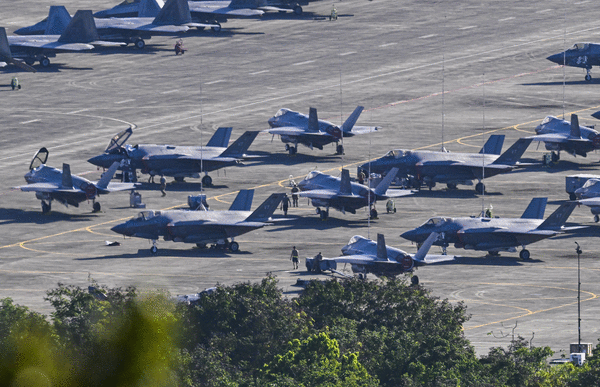
U.S. commandos took less than three hours to bring an end to Nicolás Maduro’s rule after the Venezuelan strongman spent years holding out against rising pressure from the US.
More than 150 U.S. aircraft swept into the country after the U.S. neutralized Venezuela’s air defenses, with an Army Delta Force unit delivered to the military base where Maduro was spending the night. They broke through the steel doors and grabbed him and his wife, before the couple was able to get to a safe room, spiriting them out on a helicopter to a warship en route for trial in New York.
“He was trying to get to a safe place,” President Donald Trump said Saturday. “It was a very thick door, a very heavy door. But he was unable to get to that door. He made it to the door, he was unable to close it.”
Trump, who said he was watching the events in real-time on live feeds, kept a public silence even as reports of explosions in Caracas emerged, taking to social media to announce the capture only once the helicopter carrying Maduro was out of danger.
The lightning operation marked the culmination of years of efforts by Trump — beginning in his first term — to oust Maduro, and carries risk ahead. But for all the questions that remain unanswered about what Trump, who came to office opposing foreign interventions, plans to do now with a country he plans to “run,” US officials said the military operation was the kind the president likes — quick and seemingly decisive.
Here’s what we know about how the military operation happened:
The first sign that Trump had gone ahead with the plan came when residents of Caracas reported aircraft roaring overhead and explosions ringing out. Video footage shows missiles striking targets in the city and a helicopter firing rockets and flashes in the night sky shortly after 2 a.m. Saturday.
Power was cut in several areas, according to witnesses. Smoke and fire were seen in Fuerte Tiuna, near the Armed Forces Ministry, and the La Carlota airbase.
While the U.S. has been amassing military forces in the Caribbean since the summer, the special operations units that captured Maduro had been in place since early December waiting for an opportunity to seize him that would minimize the harm to civilians and maximize the element of surprise.
Trump worked with a small circle on the plans — Secretary of State Marco Rubio, Pentagon chief Pete Hegseth, Deputy Chief of Staff Stephen Miller and CIA Director John Ratcliffe — according to a person familiar with the operation.
A small team from the Central Intelligence Agency had been on the ground secretly in the South American nation since August, the person said, feeding information on Maduro’s pattern of life.
The agency officials had the help of a source within the Venezuelan government that tracked Maduro’s location in the days leading up to his capture and also monitored his movements with stealth drones, the New York Times reported. The U.S. also had offered a $50 million reward for information leading to Maduro’s capture.
Drones overhead monitored his movements, along with those of his forces. The U.S. tracked every detail, from what he ate to his clothing, according to General Dan Caine, chairman of the Joint Chiefs of Staff.
The Delta Force commandos rehearsed the raid at a mockup of his safe house. They spent the weeks through Christmas and New Year’s waiting for the right conditions, after delaying because of bad weather.
“The weather broke just enough, clearing a path that only the most skilled aviators in the world could maneuver through, ocean, mountain, low cloud ceilings,” Caine said.
The U.S. launched aircraft from 20 different bases at land and sea across the Western Hemisphere — including B-1 bombers, F-22, F-18, E/A-18 and F-35 fighter jets, E-2 surveillance planes, rotary aviation and “numerous remotely piloted drones,” Caine said.
The U.S. attacked sites including the Cuartel de la Montana in Caracas, the building that houses the tomb of Hugo Chavez, Maduro’s mentor and predecessor.
Blasts and fires were also reported in the port of La Guaira and a security force facility nearby. Videos of drivers in Caracas’ desolated main highway and from residents in their apartments showed helicopters flying very low and shooting inside the Fuerte Tiuna, a military complex.
The U.S. force arrived at Maduro’s compound in Caracas about two hours after Trump gave the order. Caine said one aircraft came under fire. But it remained flyable and was able to return to base along with the others.
The U.S. force was over the water within about two-and-a-half hours, taking Maduro and his wife to the USS Iwo Jima, an amphibious assault ship that deployed to the region in August as part of a joint Navy and Marine Corps crisis response force.
Trump posted a photo of Maduro, wearing a Nike sweatsuit, a blindfold and his hands apparently bound together, next to a Drug Enforcement Administration agent, minutes before Trump began his news conference on Saturday morning.
The extraction of Maduro may be just the beginning. Trump said on Saturday that the U.S. is “not afraid of boots on the ground.” He said the U.S. had a plan for a much larger strike and is ready to carry out another similar mission if Maduro’s successor proves uncooperative.
©2026 Bloomberg L.P. Visit bloomberg.com. Distributed by Tribune Content Agency, LLC.




Comments