Man left a girl to be mauled by gators in the Everglades. He faces Death Row return
Published in News & Features
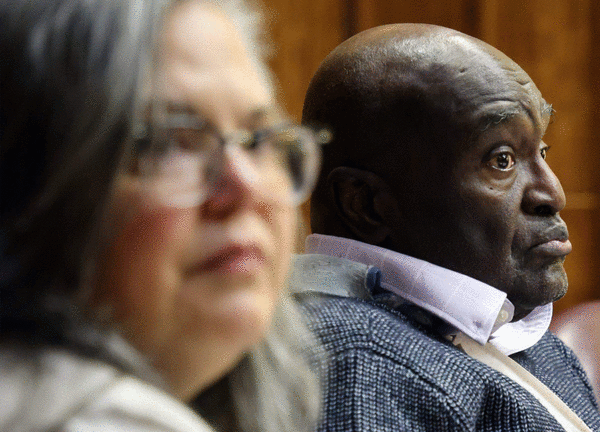
MIAMI — A Miami man who threw a 5-year-old girl into the Everglades and left her to be eaten by alligators could again be condemned to die almost three decades after the girl’s cruel death.
Harrel Braddy, 76, kidnapped Quatisha Maycock, 5, and her mother, Shandelle Maycock — an acquaintance Braddy met in a church group — on the night of Nov. 7, 1998. Braddy beat Shandelle, choked her, put her in the trunk of his car and later left her in a deserted stretch of U.S. 27 near the Broward-Palm Beach county line, according to prosecutors. She survived.
Now, a new jury will hear details of the brutal crime as Braddy again faces execution due to changes in Florida’s death penalty law. Braddy’s resentencing started Monday in Miami-Dade Circuit Court with jury selection.
Braddy’s motive, investigators say, was that he was spurned by Shandelle, who had repeatedly rejected his advances. Fearing Quatisha could identify him, Braddy dumped the child — alive — on the side of Alligator Alley, prosecutors say. Quatisha’s body was found in a canal days later by fishermen.
The girl had bite marks from alligators on her head and stomach, according to the Herald’s archives. Her left arm was severed.
During Braddy’s trial in 2007, a medical expert testified that Quatisha was still alive when alligators bit her. Braddy was convicted and sentenced to death at his trial nine years after the grisly crime.
“The defendant . . . caused this 5-year-old to die, alone in the wilderness, and to be mutilated by monsters of the swamp,” then-Miami-Dade Circuit Court Judge Leonard E. Glick said in his sentencing order. “Adults are supposed to protect children from monsters; they are not supposed to be the monsters themselves.”
Why is the case back in court?
Braddy could be spared from execution due to changes in Florida’s death penalty law.
In 2016, the U.S. Supreme Court found Florida’s death-penalty sentencing system unconstitutional, as it called for a judge to determine whether a death penalty should be imposed, which violated the Sixth Amendment right to trial by jury.
Florida lawmakers, with support of then-Florida Attorney General Pam Bondi, rewrote the state law to allow only 10 of 12 jurors to recommend a death penalty. But the Florida Supreme Court in 2017 ruled the new law was unconstitutional, saying jury verdicts needed to be unanimous.
That was the catalyst that granted about 100 Florida Death Row inmates, including Braddy, the opportunity for a new sentencing. Braddy had been sentenced to death in 2007.
Braddy, however, may again be resentenced to death with a nonunanimous jury vote. In 2023, Florida Gov. Ron DeSantis signed a new law that allows juries to recommend a death sentence with an 8-4 vote instead of unanimously. The Supreme Court has yet to take up a constitutional challenge to the new nonunanimous verdict law.
DeSantis pushed for the change after the Parkland school shooter, who killed 17 students and faculty in a shooting spree at Marjory Stoneman Douglas High on Feb. 14, 2018, was spared from the death penalty in 2022.
Braddy’s case is the third death resentencing in Miami-Dade in recent months. In November, a jury spared the life of Labrant Dennis — convicted of bludgeoning to death his ex and the UM football player she was seeing in 1996. Later that month, another jury said Rafael Andres should be sent back to Florida’s Death Row for beating, stabbing and strangling a La Carreta waitress with a rice cooker cord in 2005.
No stranger to police
Braddy was well-known to law enforcement before Quatisha’s murder. His criminal history included convictions for robbery, kidnapping and attempting to kill a corrections officer by strangling him.
In September 1984, Braddy escaped from custody three times, overpowering a Miami-Dade corrections officer and four Broward sheriff’s deputies, according to the Herald’s archives.
While awaiting trial on an attempted murder charge involving an ex-girlfriend in 1984, Braddy attacked a bailiff who escorted him to a hearing, according to the Herald’s archives. He beat and left the bailiff unconscious inside a courthouse holding cell.
Eleven days after the courthouse escape, Hollywood police caught Braddy breaking into a store, the Herald archives say. However, Braddy overpowered two officers — and escaped a third time. He again went on the lam, breaking into the home of a Hollywood couple and stealing their car. He was ultimately located in Georgia three weeks later.
Braddy was sentenced to 30 years behind bars but was released from prison in 1997 — a year before Quatisha’s killing — after serving only 13 years.
“He’s an extremely dangerous guy,” former Miami-Dade Police spokesman Ed Munn told the Herald at the time of Braddy’s arrest.
While jailed, Braddy also became known for delaying his first trial by going through 10 lawyers and, at one point, representing himself.
©2026 Miami Herald. Visit at miamiherald.com. Distributed by Tribune Content Agency, LLC.






Comments