Iran death toll rises as Trump urges protestors to persist
Published in News & Features
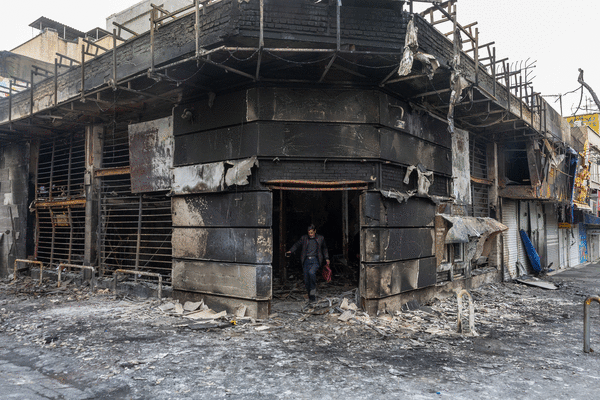
Iran’s death toll from ongoing protests may be in the thousands, activist groups said, as U.S. President Donald Trump urged Iranians to continue demonstrations against the regime of Supreme Leader Ayatollah Ali Khamenei.
The U.S.-based Human Rights Activists News Agency reported Tuesday that at least 2,000 people have died in just over two weeks of violent upheaval across the country. That figure would make this the deadliest wave of demonstrations in the Islamic Republic in decades.
“KEEP PROTESTING - TAKE OVER YOUR INSTITUTIONS!!!” Trump posted on Truth Social on Tuesday, saying he’d canceled all meetings with Iranian officials until the killing of demonstrators stops.
Of those killed, 1,850 were protesters, 135 were government-affiliated, nine were children, and nine were other civilians not participating in the protests, HRANA said.
The Oslo-based Iran Human Rights group earlier warned the “risk of mass and extrajudicial executions of protesters is extremely serious,” including for 26-year-old Erfan Soltani, who it said could be executed on Wednesday, less than a week after his arrest in the city of Fardis, west of Tehran. The IHR said the death toll could be more than 6,000.
Concern about the scale of fatalities is mounting as Trump moved to further isolate Tehran over the violence. His call on protesters to continue their campaign — which began late last year over rising living costs before dramatically escalating — came with a pledge that “HELP IS ON ITS WAY.” He didn’t specify what that meant.
Trump said Monday he’s imposing a 25% tariff on goods from countries “doing business” with Iran. That may impact a range of countries with trading relationships with the Islamic Republic, led by China, the United Arab Emirates and Turkey.
German Chancellor Friedrich Merz predicted that the Islamic Republic is in its “final days” and “effectively finished,” according to comments on Tuesday during a visit to India.
Iran’s government hasn’t given any figures for civilian deaths and the state broadcaster, which has an effective monopoly on domestic news services, has repeated official claims that “terrorists and rioters” killed scores of security forces amid a continued internet blackout.
In one video that’s been verified by the BBC as coming from a mortuary on the outskirts of Tehran, at least 180 bodies can be seen. HRANA reported that almost 17,000 people had been detained in connection with protests.
A video purportedly from downtown Tehran, near the city’s Enghelab Square, which has hosted pro-government rallies, appeared to show hundreds of protesters chanting against Khamenei overnight. Another video showed protesters gathering in Tehran’s main cemetery on Monday, chanting slogans.
Unrest across Iran intensified sharply from Thursday through the weekend, drawing hundreds of thousands to the streets, calling for the downfall of Khamenei. Despite a sweeping crackdown and state-organized rallies challenging the unrest, it remains unclear how long the calm claimed by authorities will hold, while the underlying drivers of the protests remain unresolved.
State-run IRIB News reported on Tuesday that authorities had seized “a large consignment of electronic equipment used for espionage and sabotage,” including what appeared in footage to be Starlink kits.
On Tuesday, foreign exchange tracking websites showed the rial trading at around 1.45 million to the U.S. dollar, roughly the same level that initially sparked protests among traders in Tehran on Dec. 28. Soaring inflation has made it increasingly difficult for millions of Iranians to afford basic food items, and a $7 handout to households is unlikely to ease living costs.
The NetBlocks group, which monitors global internet connectivity, said Tuesday that a nationwide internet shutdown in Iran had entered its fifth day, cutting off millions from global online services. Reports said some citizens were able to make international calls as of Tuesday morning.
Trump has called on Starlink — which some Iranians already use, despite it being banned in the country — to help restore communication.
Connecting Iran to the internet via Elon Musk’s service won’t be easy. Owning a Starlink terminal is illegal, so equipment would have to be smuggled in. The military is also working to jam Starlink and is hunting down any users, according to Amir Rashidi, director of digital rights and security at Internet human rights group Miaan Group.
An unspecified number of protesters have been taken to court and charged with “moharabeh” — or taking up arms in order to cause fear — which under Iran’s Islamic penal code carries the death penalty, the semi-official Tasnim news reported on Tuesday, citing Tehran’s chief prosecutor.
In a brief video statement on Tuesday, Reza Pahlavi, the son of Iran’s former Shah, urged workers in the telecommunications industry, without elaboration, to “target” the country’s information infrastructure to restore international internet access.
----------
—With assistance from Eltaf Najafizada, Patrick Sykes and Loni Prinsloo.
©2026 Bloomberg L.P. Visit bloomberg.com. Distributed by Tribune Content Agency, LLC.




Comments