Chicago video gambling legalization in flux as aldermen, Mayor Brandon Johnson weigh changes
Published in News & Features
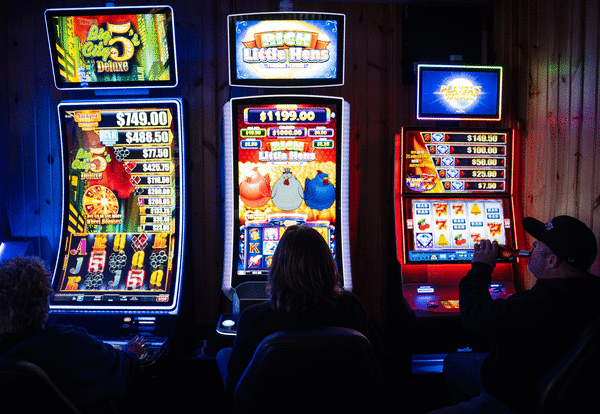
CHICAGO — Chicago’s new plan to legalize video gambling terminals — finally passed last month as part of the 2026 budget after years of debate — is not a done deal as Mayor Brandon Johnson and key aldermen say negotiations must continue.
The ongoing discussions between Johnson’s administration and aldermen over the gambling terminals mark the first major efforts to amend the budget passed by the City Council against the mayor’s wishes in late December.
Top Johnson adviser Jason Lee said the legalization of gambling machines in bars and restaurants across the city “requires more time and some judicious collaboration,” the clearest sign yet that it’s not a settled matter at City Hall.
“There are a number of aldermen who are uncomfortable with the VGT expansion, particularly in the way it was done,” Lee told the Tribune.
At the time the budget passed, all sides agreed the unprecedented aldermen-backed plan quickly passed to avert a city government shutdown would be a “living document.” And as talks emerge, millions of dollars are on the line.
Aldermen counted on the legalization to bring in $6.8 million this year when they passed the budget, a minuscule sum in the city’s $16.6 billion spending plan. Johnson holds broad power over the policy’s implementation, giving him leverage to force state officials and vendors eager to get the machines online back to the table.
Lee cited a number of concerns about the current plan, including a lack of vendor diversity and little input from the operators of the downtown Bally’s Casino and labor groups. Aldermen need more discretion over where machines are allowed in their wards, he added.
“I think there’s a right way to do it, and then there’s a way to do it that’s suboptimal, and that if it is going to be done it should be done in the right way,” he said.
But the biggest issue looming over the legalization push is the city’s need for a better split in tax revenue with the state, he said.
As it stands, Chicago would receive just 5% of the revenue from the machines, while state government would get a 30% split. The city’s video gambling machine share is far below the around 20% it receives from casino slot machines.
Even the optimistic timeline aldermen relied on in their estimates predicted terminal licenses would only first be issued in July. Alderman projected machines would open at 1,800 locations this year, though state regulators only issued 790 such licenses across Illinois last year and have a backlog of almost 500 more establishments to vet, according to the Illinois Gaming Board.
All Johnson needs to do to finish legalization and allow businesses to enter the licensing process is give the state notice of the city’s plans, Ald. Anthony Beale said. Beale, 9th, a chief legalization supporter, accused Johnson of “Trump-like tactics” for not moving ahead.
“There’s other ways to negotiate this other than trying to always pour sour milk on everything,” he said. “Do your job, and that is to carry out the duties of the budget that was passed, not to pick and choose on what you want to do, that is not the role of the executive branch.”
Beale argued that Chicago should pursue change to the statewide revenue sharing formula only after legalization. The machines would be “a lifeline for a lot of small businesses,” he said.
Melvin Brooks, owner of Grand Crossing’s President’s Lounge, agreed the money from the machines is “much needed.”
When he first bought owned the bar two decades ago, his spot had one jukebox, one dartboard and three video gaming machines. But he took down the machines, which he said did not offer payouts, when city regulators warned they could not be properly licensed and could preclude him from getting approval for the now-at-question gambling machines.
“We just sat back and waited,” Brooks said. “That was our form of entertainment during the day.”
But insurance costs are rising, property taxes are spiking and the cost of doing business just won’t stop going up, he said. He wants to finally add video gambling machines to his bar.
“You’ve got to find a way to subsidize these hikes, and you don’t want to keep raising your prices,” Brooks said. “We’re paying all types of fees as it is. Are we in business for the city and the city only?”
John Canham, chief revenue officer for Gold Rush Gaming, a Hoffman Estates-based video gambling machine vendor, estimated Chicago has lost out on $500 million in revenue since terminals first came to the state around 2011. “They’ve left a lot of money on the table. They continue to leave a lot of money on the table,” he said.
He estimated that, once up and in running, Chicago would bring in around $36.5 million in tax revenue annually from the machines, assuming 2,000 different locations put in an average of five machines each that earn $200 a day.
Though Johnson’s administration has warned such a massive haul — $730 million in revenue, by Canham’s estimates — would cannibalize the revenue at the Bally’s Casino, Canham blasted the concern as “squawking.” The casino is already being undercut by legally questionable “sweepstakes” machines common across South and West Side gas stations that dodge laws by avoiding cash payouts, plus the video gambling terminals that are ubiquitous in suburban establishments just across the city’s border.
“The minimal impact Bally’s will receive is more than outweighed by how much the VGT revenue will add. It’s asinine that they’re actually going back and forth on whether they should allow this after it’s proven that it’s a revenue producer. It makes no sense to anybody with half a brain,” he said.
Asked if he worried that the estimated loss of nearly $1 billion by customers in Chicago neighborhoods would harm city residents, Canham pointed to ongoing sweepstakes and suburban gambling. Video gambling in Chicago would bring an “economic multiplier effect” by creating thousands of new jobs — collectors, technicians, sales people and more — while supporting small-business bars, he said.
“I see it as people with discretionary income,” he said. “They’re going to gamble. That’s just the nature of people, they like to gamble.”
But several aldermen have already moved to ban video gambling terminals, citing addiction concerns.
“I don’t personally want mini casinos on every corner of my ward,” Ald. Jessie Fuentes, 26th, said of her ward-level ban. “Gambling addiction harms families. It harms the mental health of individuals in our communities. And it can destroy lives.”
Lee did not make similar arguments opposing neighborhood gambling by arguing it harms poor or working-class Chicagoans, a sign Johnson — a harsh critic of regressive taxes — will not label video gambling terminals as one. Alds. Walter “Red” Burnett, 27th, and Rossana Rodriguez-Sanchez, 33rd, also banned the gambling machines in their wards.
Asked by the Tribune if he views video gambling as a regressive tax last week, Johnson did not directly answer, but said working people want the ultra-rich and corporations to pay more in taxes.
“There are a number of taxes that are not necessarily taxes I promote,” he said.
Fuentes also shared concerns that labor groups and Bally’s leaders were not brought in to discuss the video gambling legalization. She added that she does not believe the revenue projections used for the machines when the budget passed.
Beale told the Tribune the budget projections estimated only the income from licensing fees and left out the 5% revenue split, making his estimate a likely undercount in the long run.
Johnson’s administration has also noted legalizing the machines would mean the almost certain end of a $4 million annual payment made by Bally’s as part of the host agreement they reached with the city to land a casino. Without that money, video gambling legalization could end up costing the city money this year and would at best generate only a small sum, the administration has argued.
Ald. Brian Hopkins, a vocal supporter of the aldermen-backed budget, told the Tribune there is a “considerable amount of discussion going on” regarding the video gambling terminals.
“We recognize that, in our haste to finalize a budget, there were some details regarding video gaming that were overlooked that can be cleaned up,” he said.
Like Lee, he said it is possible that terminal licensing might not begin this year. But he said he senses legalization could be “inevitable” and added that he does not think the matter should be “studied to death.”
“Go down I-55 on your way to Springfield, you can’t stop at a gas station that isn’t loaded with these things,” he said. “That horse left the barn a long time ago. It’s highly likely we’ll do something in Chicago … what we don’t want to do is cannibalize the casino gaming industry.”
_____
©2026 Chicago Tribune. Visit chicagotribune.com. Distributed by Tribune Content Agency, LLC.






Comments