In the immediate moments after a fatal ICE shooting, what does federal protocol require of agents?
Published in News & Features
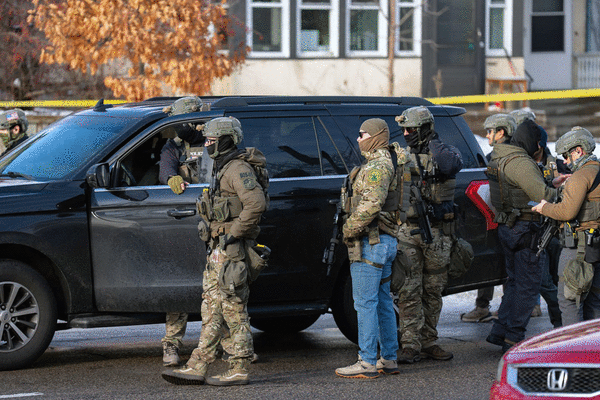
In the chaotic moments after he fatally shot Renee Good on Jan. 7, bystander video shows ICE agent Jonathan Ross approach her SUV, peer inside, then briskly walk away.
“Hey, call 911!” he yells to other agents before adjusting his mask. The SUV he arrived in then drives away amid a growing crowd of distraught neighbors.
“Don’t let him leave!” the woman filming him shouts.
It’s unknown to the public where the Tahoe went, or where it is today. It also isn’t clear if Ross is on administrative leave as authorities investigate the shooting.
Ross’ immediate actions captured on video prompted public questions about standard protocol for federal agents after a shooting — including where they go and how evidence is handled.
In September, federal authorities allowed a Border Patrol agent who shot a woman in Chicago to drive the government SUV back to his home state of Maine before the defense could examine it.
Defense attorneys argued that moving the vehicle more than 1,000 miles could compromise key evidence. A federal judge ordered the SUV returned to Chicago and pressed the government to explain why it had been treated differently from other evidence still held locally.
Prosecutors told the court that the FBI had photographed the vehicle, taken paint samples and downloaded data before it left Illinois, and that it was later stored under surveillance in Maine before its return.
Chuck Rylant, a use-of-force expert witness and retired California police officer, said leaving the immediate scene is not necessarily inconsistent with how federal agents are trained to respond after a use-of-force incident.
Leaving the scene, Rylant said, can be intended to prevent the situation from escalating.
“If he stays on scene, it’s just going to be chaos, which would be more dangerous to the officers and to the public,” Rylant said. It is also within the norm to investigate the officer away from the scene, he said.
“Removing him is not only acceptable, but probably the best way to de-escalate the crowd,” he said.
The approach differs from what many Minnesotans may expect based on local policing practices, where officers are typically placed on administrative leave and remain at or near the scene.
Under the Minneapolis Police Department’s use of force and de-escalation policy, “the employee who used force shall remain on scene and immediately make direct contact with a supervisor by phone or radio.”
Rylant said federal agencies operate under very different operational policies from local law enforcement, many of which are not publicly available nor subject to local or state oversight.
ICE agents are trained to use the minimum amount of force necessary to resolve dangerous situations while prioritizing public and officer safety, Department of Homeland Security Assistant Secretary for Public Affairs Tricia McLaughlin said in a statement. Agents regularly receive training in de-escalation and use-of-force standards, she said. She added that ICE’s current use-of-force policy is unchanged from 2023, during the administration of former President Joe Biden.
“Every use-of-force incident and any discharge of an ICE firearm must be properly reported and reviewed by the agency in accordance with agency policy, procedure and guidelines,” McLaughlin said. “All shootings are initially reviewed by the appropriate federal, state, local or tribal law enforcement agency principally charged with first response to the incident.”
ICE will conduct an independent review of the incident after the appropriate investigative agencies review it, McLaughlin said.
DHS has not publicly detailed Ross’ movements or employment status after the shooting, saying only that the agency was following standard protocol procedures. When asked about Ross’ status, McLaughlin declined to confirm or deny employment details. McLaughlin added that Ross acted according to his training.
DHS’ use-of-force policy instructs agents to obtain medical assistance for any person with visible and apparent injuries or who complains of injuries or requests medical attention.
“This may include rendering first aid if properly trained and equipped to do so, requesting emergency medical services, and/or arranging transportation to an appropriate medical facility,” the policy reads.
Rylant said calling for emergency medical services should generally satisfy that requirement under federal standards.
-------------
©2026 The Minnesota Star Tribune. Visit at startribune.com. Distributed by Tribune Content Agency, LLC.





Comments