Immigrant mothers are being detained by ICE, despite federal protections
Published in News & Features
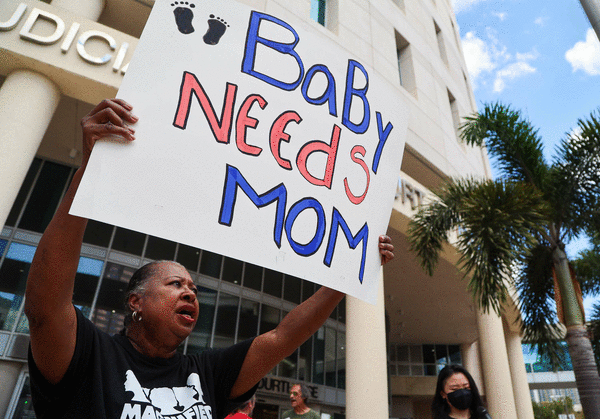
Mabelyn Hernandez-Diaz was still breastfeeding her 6-month-old son in September when Hillsborough County sheriff’s deputies approached the vehicle she and her boyfriend, the boy’s father, were sitting in while it was parked in front of a store in Wimauma.
Hernandez-Diaz, a 20-year-old immigrant from Guatemala, held her infant son Aiden Garcia Hernandez while deputies questioned Esquivel Garcia Diaz, who had an outstanding warrant for failing to appear in court on a charge of driving without a valid license. He was arrested — as was Hernandez-Diaz, who, according to an arrest affidavit, pushed the deputy during the confrontation, leading to charges of battery on a law enforcement officer and resisting an officer without violence.
Both parents were in the country without legal documentation. Garcia Diaz was released on bail. But Hernandez-Diaz faced a detention hold from U.S. Immigration and Customs Enforcement for missing an asylum hearing after she crossed the border in 2023.
She moved between jails in Hillsborough and Pinellas counties, then a private detention center in Louisiana before signing papers to leave the United States voluntarily.
During the two weeks she was in custody, Hernandez-Diaz could not nurse her son. She said her breasts were swollen and sensitive, and she had to express milk in the shower. She had headaches and discomfort whenever she tried to sleep.
“It was painful,” she said by phone from her hometown of Chiquimula, Guatemala.
Under U.S. immigration policy, pregnant and new mothers like Hernandez-Diaz are to be arrested only in limited circumstances, such as when they pose a flight risk or danger to the community.
But under an administration that has enacted mass deportation initiatives, advocates say more mothers are being detained despite federal and state protections meant to shield them during a critical time for infant development and parental bonding.
Congressional documents, legal filings and media reports indicate pregnant, postpartum and nursing women were detained across the United States throughout 2025, suggesting Immigration and Customs Enforcement is not following mandates set forth by Congress.
How many mothers have been arrested is unclear. In 2019, Congress began requiring Immigration and Customs Enforcement to report on the number of pregnant and postpartum detainees. But last year, Congress omitted the reporting mandate from the agency’s budget, eliminating the only mechanism for tracking these cases.
Mothers have been arrested at court hearings, traffic stops and immigration check-ins. According to one Senate report, mothers in detention have received insufficient food, been forced to sleep on floors and been denied medical attention.
The agency has rejected these claims, asserting in August that “ICE detention facilities have higher standards than most U.S. prisons that detain American citizens.” The agency said pregnant women receive regular prenatal visits, mental health services, nutritional support and accommodations aligned with community standards of care.
In Florida, where state and local authorities have embraced federal immigration initiatives, the Tampa Bay Times has found multiple cases of detained pregnant and nursing mothers who claimed that they were not given full protections or medical care.
U.S. Immigration and Customs Enforcement did not address questions from the Times about Hernandez-Diaz or the treatment of pregnant or nursing detainees in general. Instead, an agency spokesperson called her, in a statement, “a criminal illegal alien from Guatemala.”
Spokespeople for the Hillsborough and Pinellas County sheriff’s offices, both of which detained Hernandez-Diaz before her transfer out of state, declined to comment on the case, citing federal policy.
Advocates like Zain Lakhani, director of migrant rights and justice at the nonprofit Women’s Refugee Commission, describe the current state of immigration detention as a black box.
Until recently, organizations like Lakhani’s were allowed inside detention centers to interview detainees and conduct trainings. That access has since been revoked, she said, impairing their ability to assess conditions and treatment of detainees, including pregnant and postpartum women.
“When people disappear into those facilities, we don’t actually know where they are,” Lakhani said, “or what is happening to them.”
More mothers, similar stories
The 2021 directive that generally prohibited the arrest of pregnant, nursing and postpartum mothers was passed under President Joe Biden, but resembled protections enacted under President Barack Obama.
A policy that pregnant women were not subject to mandatory detention was eliminated during President Donald Trump’s first administration. As a result, according to a 2019 Government Accountability Office report, the number of pregnant women held in immigration detention rose by 52% from 2016 to 2018.
Under Biden-era guidelines still on the books, ICE must provide ongoing health assessments, access to pre- and postnatal medical care, physical and mental health monitoring and transfer to appropriate facilities when necessary, with regular follow-ups and reviews of their custody status.
Some mothers say that’s not happening.
Hernandez-Diaz said that during her stop at a privately-operated detention center in Louisiana, she never received medical care despite guards knowing she was a breastfeeding mother.
Aidaena Salazar, a mother of five who lived in Seffner, was detained in October during her last probation check-in. Salazar, who came to the United States from Mexico as a teenager and has lived here for about 20 years, was on probation for public assistance fraud. At the time, she was breastfeeding her 6-month-old daughter.
Her husband, Francisco Rodriguez, who is also in the country without permanent legal status, told the Times his wife is not receiving regular medical care at a detention center in Phoenix, Arizona. Salazar is ineligible for bond and their baby is now on formula.
Experts say the sudden separation of mothers and infants can have severe mental and physical consequences.
“The inability to nurse or pump regularly can cause extremely painful breast engorgement, clogged ducts and mastitis,” said Vickie Dugat, a research associate at USF Health and director of the school’s Connecting Kids to Coverage program. “Beyond the physical risks, disruptions in lactation can also create emotional distress, especially for mothers who strongly desire to breastfeed but lack the environmental support to do so.”
The American Academy of Pediatrics says that family separation can impact children’s health, exposing them to “toxic stress that can disrupt children’s brain architecture and affect their short- and long-term health.”
Heidy Sánchez Tejeda, who was arrested in April during a regularly scheduled check-in with immigration officials in Tampa, said her deportation to Cuba has been painful and traumatic for her family in Florida. She said her 2-year-old daughter cries a lot and does not eat well. She was not allowed to see her daughter during her detention.
“She always asks for her mom,” Sánchez said. “We are trying to be strong, but at night it is very hard, like when she calls me and touches my face through the phone while I sing to her, and she just sighs and cries.”
Pregnant women, too, have been arrested and deported during the past year’s immigration crackdown.
A recent University of South Florida report on how increasingly strict state and federal immigration policies are impacting communities in west and central Florida detailed the arrest of a pregnant U.S. citizen from Puerto Rico. The woman was arrested alongside her husband, who did not have legal documentation, on their way to work. According to the study, the woman said she was physically assaulted, and family members said she was thrown to the ground and kicked repeatedly. Her husband, the study said, believes the experience led to a miscarriage.
In June, the Broward Transitional Center in Pompano Beach was the site of a potential miscarriage or obstetric emergency, according to a 911 call log report. Emergency services responded to a pregnancy-related issue, though additional details are shielded from public records law due to health privacy exemptions.
In February, a 17-year-old from Honduras was arrested in Louisiana and flown to Florida at 36 weeks pregnant, according to her Fort Lauderdale attorney Zadeyeh Rios — later than doctors advise pregnant women to fly. She had been detained during a routine immigration check-in.
Rios said her client otherwise received good care at a nonprofit shelter for minors, but the flights were a problem.
“She was technically not supposed to be on a plane, but either they disregarded that information or there was a miscommunication amongst the officers,” said Rios.
Demands for accountability
In the absence of data from ICE, advocacy groups for women and immigrants have tried to gather information on pregnant and nursing detainees themselves.
The Women’s Refugee Commission is tracking cases of pregnant, postpartum and nursing detainees by collecting reports from health care providers, lawyers, and family members.
In October, the American Civil Liberties Union and partner organizations sent ICE a letter demanding the immediate release of all pregnant, postpartum and nursing individuals from detention. The letter was based on interviews with more than a dozen women from facilities in Georgia and Louisiana who spoke about being shackled during miscarriages, denied prenatal vitamins, placed in solitary confinement and given inadequate food and water.
“I think the women that we were able to interview were just the tip of the iceberg,” said Eunice Cho, senior counsel for the ACLU.
U.S. Department of Homeland Security spokesperson Tricia McLaughlin has rejected the claims in statements and previous interviews.
“The ACLU’s letter includes anonymous, unsubstantiated, and unverifiable claims,” McLaughlin said in a statement. “Pregnant women receive regular prenatal visits, mental health services, nutritional support, and accommodations aligned with community standards of care.”
In November, more than 60 members of the Congressional Democratic Women’s Caucus, including four Florida Democrats, signed a petition requesting information on the number of pregnant mothers in detention, the number of births in custody, and medical incidents — data ICE’s directives already require it to keep. So far, the group has received no response.
“It should go without saying that ICE should not detain pregnant, postpartum, or nursing people,” Rep. Frederica Wilson, one of the Florida Democrats who signed the petition, said in a statement. “But that protection has never been guaranteed, and based on what I have seen firsthand at these facilities recently and what the press has reported, there is no real assurance that women are being treated with basic human rights at these facilities.”
For mothers who have already been deported, the next step is finding a way to reunite with their children.
Since her deportation, Hernandez-Diaz has been staying with family in Guatemala. A former neighbor in Wimauma watches her son while her husband, Garcia Diaz, works nearby. He says he plans to join her, but does not know when.
“I’m suffering a lot because I am far from my baby,” Hernandez-Diaz said. “It’s not fair. He needs his mother.”
©2026 Tampa Bay Times. Visit at tampabay.com. Distributed by Tribune Content Agency, LLC.






Comments