Operation Metro Surge has no end date. How long could it last?
Published in News & Features
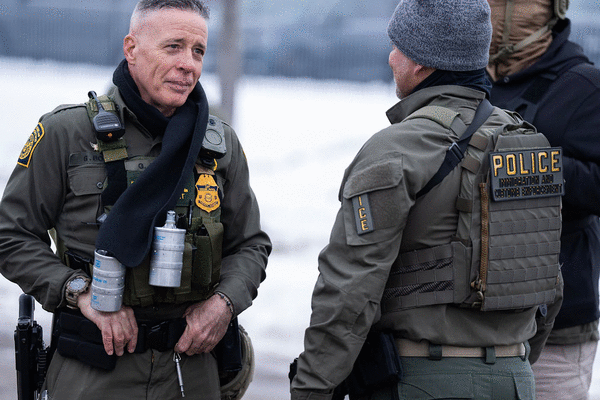
MINNEAPOLIS — As Operation Metro Surge nears the 50-day mark, federal officials won’t say when it will end, an ambiguity consistent with how similar immigration enforcement campaigns have unfolded elsewhere in the country.
Similar questions emerged last fall in Chicago, where federal officials launched a large-scale enforcement effort with no clear end date. ICE’s Operation Midway Blitz began in early September with highly visible raids, mass arrests and a heavy federal presence. Arrest numbers climbed rapidly in the first few weeks, amid near-constant enforcement activity, protests and legal challenges.
By mid-November, however, there were signs the operation was easing. DHS left its staging site at the Great Lakes Naval Station, and senior enforcement figures departed the region. The National Guard’s role in Chicago formally ended on Dec. 31.
The Department of Homeland Security launched the operation in the Twin Cities on Dec. 1, billing it as the largest immigration enforcement effort in the agency’s history. Federal officials say more than 2,500 people have been arrested since then.
The DHS said Operation Midway Blitz resulted in the arrest of more than 4,500 unauthorized immigrants.
Emmanuel Mauleón, a University of Minnesota Law School professor who studies race and the Fourth Amendment and has closely followed immigration enforcement surges in Chicago and Los Angeles, said if Operation Metro Surge follows a similar pattern to Midway Blitz, the most visible phase of enforcement could last a few months — even as officials avoid stating a formal end date.
However, he said key differences, including the large number of officers deployed in Minneapolis and continued escalation even after two shootings, make it difficult to predict what will happen next.
“It’s more about shifting resources than any internal logic or perfect metric,” he said.
Mauleón said federal immigration operations typically wind down for one of three reasons: after an initial burst of enforcement meant to “make a big show,” when agents are needed in another city, or when legal challenges make it difficult for the government to continue operating at the same scale.
“What I’ve seen in the other examples, it would seem that either political pressure, legal pressure, or a desire to move on to a new location to make an example out of another city might be what is motivating the operational logic, rather than some sort of predetermined plan,” he said.
Legal pressure, Mauleón added, played a significant role in the slowdown of enforcement efforts in both Chicago and Los Angeles, where federal deployments were met with lawsuits challenging the use of force, warrantless arrests and the deployment of the National Guard over state objections.
“Although ICE certainly continued operations in both Los Angeles and Chicago, it wasn’t to the same degree as when they were trying to make big, splashy headlines,” he said.
That dynamic, Mauleón said, makes it difficult to predict how long Metro Surge will last in the Twin Cities.
“My sense is that it’s open-ended,” Mauleón said.
Federal officials have reinforced that uncertainty. DHS Secretary Kristi Noem said Jan. 15 there are “no plans to pull out of Minnesota,” and U.S. Customs and Border Protection Cmdr. Gregory Bovino said in a recent television interview with WCCO that the operation has no end date.
“We will be here until the mission is complete,” Bovino said.
______
©2026 The Minnesota Star Tribune. Visit startribune.com. Distributed by Tribune Content Agency, LLC






Comments