Hundreds return to Broadview, Ill., to denounce federal agents' killings in Minneapolis, Chicago area
Published in News & Features
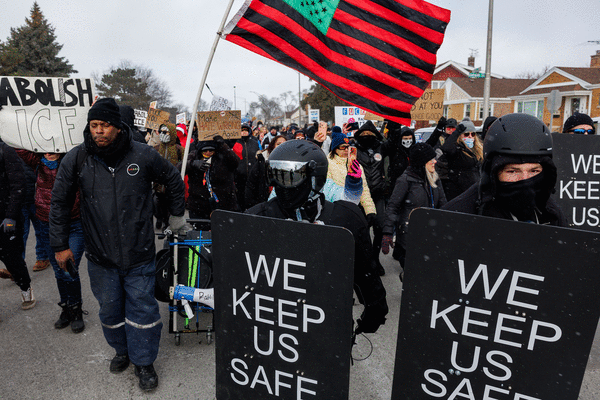
CHICAGO — Andrew Pollock wore four layers of clothing to a freezing protest outside the Broadview Immigration and Customs Enforcement processing center Saturday to deliver what he said was a “pretty straightforward” message to the federal government: “Killing American citizens is bad,” he said. “And they should stop doing that.”
Pollock, 39, was one of hundreds to gather and march outside the west suburban facility to condemn recent violence by federal agents executing President Donald Trump’s nationwide campaign to arrest and deport people in the country without legal status.
The demonstration, one of the first large-scale events to occur in Broadview since federal agents pulled back from their 64-day surge of immigration enforcement raids in and around Chicago, took place less than two weeks after ICE agent Jonathan Ross shot U.S. citizen Renee Good to death in Minneapolis.
Good’s life and death were top of mind for many of the demonstrators who packed the street outside the processing center Saturday alongside Pollock, but so was the memory of a man from the Chicago area who died at the hands of federal agents in the early days of last year’s surge in Chicago.
“Before Renee Good was killed in Minnesota, Silverio Villegas-González was killed here, in Franklin Park,” independent congressional candidate and activist Myra Macías reminded the crowd. “We should be a model for what a just government looks like, but instead, we are a model of how to assassinate people and get away with it.”
Chela García, of the Little Village Community Council, called on those gathered outside the building to remember Villegas-González, a Mexican immigrant, alongside Good.
“Silverio was a father,” García said. “Silverio was a person. Silverio’s life mattered. Everyone’s life mattered.”
Villegas-González and Good were both on Rebecca Hatfield’s long, cardboard list of people who died in the custody or at the hands of federal immigration agents over the last year. There were 37 names on the list, she said.
“I’m just here today to share the names of everyone who has been killed in detention or in the streets,” she said.
Hatfield, 38, said she’d been working with local rapid response volunteer groups in the western suburbs and planned to keep that work up, particularly should agents refocus on the Chicago area in this spring as they have pledged to do.
“You have to be out there, patrolling, and alerting communities and alerting our neighbors and just keeping each other safe,” she said.
For many like Hatfield outside the processing center Saturday, the demonstration was a continuation of their volunteer efforts and local organizing to support immigrant families throughout the fall, when federal agents bore down on the city and suburbs in what Trump administration officials dubbed Operation Midway Blitz. As agents swept up thousands of people — most of whom had minimal or no criminal records — from around the city and suburbs, they faced off with enraged neighbors and filled city blocks with tear gas and pepper balls in an attempt to subdue crowds, hundreds of people gathered weekly outside the processing center to attempt to block federal vehicles, encourage detainees and exhort federal agents to “quit your jobs.”
Katherine “Kat” Abughazaleh, a progressive content creator and candidate in the race to represent Illinois’ 9th Congressional District, spoke to the crowd about the early days of protests outside the processing center, which at points was effectively a battleground as federal agents faced off with protesters week after week throughout the blitz, where agents deployed copious amounts of chemical munitions hitting journalists and clergy alongside demonstrators, and chased protesters well beyond the immediate surroundings of the processing center into private yards across 25th Avenue in Broadview and Maywood.
“The taste of pepper bullets and tear gas coats my throat,” she said. “I am just one of so many people here and around the country who know what ICE does. I have been beaten, thrown, shot with pepper and rubber bullets.”
Abughazaleh is one of the “Broadview Six” — five political operatives and one garden store worker who are under federal indictment for allegedly attempting to impede a federal vehicle as it drove through a furious crowd toward the processing center. Abughazaleh is still campaigning, but one of her co-defendants, Catherine “Cat” Sharp, announced Monday that she was ending her campaign for the Cook County Board’s 12th District seat because she needed to “focus on winning the legal battle against the Trump administration.”
While the protest marked a return to familiar terrain for many of the demonstrators, others like Michelle Wesley and George Shalhoub, were just starting to step up their activism in response to federal immigration raids. Wesley, 37, said she’d kept up with news of the blitz and helped to hand out whistles around Chicago’s North Side over the fall, but increasingly was looking for more ways to participate in the opposition, particularly in the wake of Good’s killing.
“As things continue to get more and more egregious, we’re going to get more active,” Wesley said.
She carried a sign that read, “I will dance at your Nuremberg trial,” a reference to the international criminal trials of Nazi officials that followed the end of World War II.
“I just have hope that one day justice actually prevails here, and that we do a postmortem on everything that’s happened here and that we hold people to account,” she said. “I hope we have an organized fashion of holding these agents and their leadership accountable, and that is not a certainty.”
_____
©2026 Chicago Tribune. Visit chicagotribune.com. Distributed by Tribune Content Agency, LLC.


Comments