US readies FBI, troops for possible Minnesota surge to back ICE
Published in News & Features
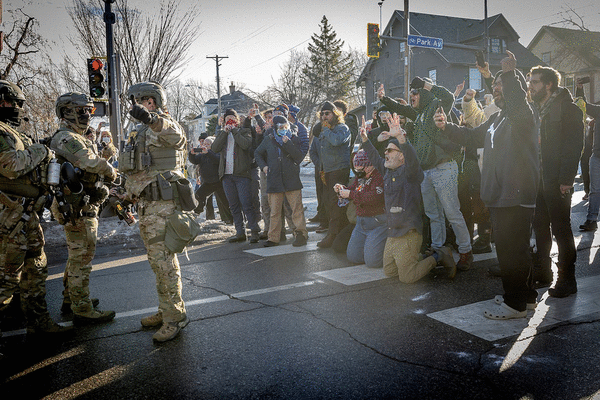
The U.S. is taking steps to vastly increase the number of law enforcement agents and potentially send military personnel to Minneapolis, where immigration agents have tangled with residents protesting their tactics.
The Pentagon has ordered 1,500 U.S. troops based in Alaska to prepare to deploy to Minnesota as a precautionary measure in case the administration decides to send them, a US official said, speaking on condition of anonymity. The unit of the 11th Airborne Division is a cold-weather unit nicknamed “The Arctic Angels.”
At the same time, the FBI is sending messages to its agents nationwide seeking volunteers to temporarily transfer to Minneapolis. It wasn’t immediately clear what the FBI would ask agents who volunteered to travel to Minneapolis to do. FBI agents have traditionally focused on national security-related tasks such as counter-terrorism, organized crime and high-profile violent offenses, not street patrols or immigration-related enforcement.
These actions come as Minnesota Governor Tim Walz mobilized the state’s National Guard to support local law enforcement and emergency management agencies. Minneapolis has become a focal point of anti-ICE protests since an officer shot and killed Renee Good on Jan. 7 while she was in her car.
“They are not deployed to city streets at this time, but are ready to help support public safety, including protection of life, preservation of property and supporting the rights of all who assemble peacefully,” the Minnesota Department of Public Safety said in a post on X regarding the mobilization.
Walz and Minneapolis Mayor Jacob Frey have denounced the crackdown by U.S. Immigration and Customs Enforcement personnel, accusing the Trump administration of sowing chaos and violence through the operations and demanding that the federal personnel leave.
The Washington Post first reported the Pentagon’s preparations for possible troop deployment.
Around the Twin Cities, yard signs, graffiti and placards at restaurants and businesses make clear that residents oppose ICE’s presence.
“Everyone is welcome here! Except ICE,” read a notice on the front door of Claddagh Coffee in St. Paul. At the El Burrito Mercado, a sign hanging in the window of the closed business read, “ICE does not belong in the streets, is not welcome in our communities, and especially not in our business,” read the sign, posted next to another stating “NO ICE ACCESS IN THIS BUSINESS.”
FBI involvement
FBI Director Kash Patel and U.S. Deputy Attorney General Todd Blanche visited the city on Friday, according to a post shared on Patel’s X account. Patel said in the post that the FBI was “cracking down on violent rioters and investigating the funding networks supporting the criminal actors with multiple arrests already.”
Roughly one-quarter of agents within the bureau were assigned to work on immigration-related duties, according to data that Senator Mark Warner, a Virginia Democrat, shared with media outlets in October.
President Donald Trump last week threatened to invoke the Insurrection Act and deploy military troops on U.S. soil, though he backed away from that move a day later. The 1807 act permits the president to assume control of a state’s National Guard — as he did in California and elsewhere last year — or deploy active-duty troops to quell a rebellion.
The last time that power was invoked was when President George H.W. Bush deployed troops to quell the looting and burning of Los Angeles during violent protests against police brutality in 1992 following the verdict in the Rodney King case.
“We have to send more officers and agents just to protect our officers to carry out their mission,” ICE Director Todd Lyons said on Fox News’ "Sunday Morning Futures." “The majority of those are there to protect the men and women who are already there. Now we need 10-15 officers per arrest to protect each other” against protesters.
Social media is filled with residents’ recordings of ICE agents using extraordinary force against people yelling at them, including arresting them, spraying chemical agents, or pushing them to the ground.
“Active duty military troops are not a peacekeeping force,” said Susanna Gibbons, a director at the Carlson School of Management at the University of Minnesota, who lives in Minneapolis. “What federal building are they going to protect? I’m not a legal expert but it stretches any definition I have seen of the Insurrection Act.”
Blanche, speaking on Fox News Sunday, denied that agents were acting with undue harshness. “These blatant accusations that they’re violating the First Amendment or somehow committing crimes are not only completely false, but they’re doing real damage to our law enforcement officers around the country.”
U.S. District Judge Kate Menendez last week ordered ICE agents not to retaliate against peaceful protesters and banned the use of pepper spray or other “crowd dispersal tools,” as well as ordering federal agents not to stop protesters in vehicles, like Good, who were not directly interfering with their immigration work.
Minneapolis Mayor Frey, speaking on NBC’s "Meet The Press," insisted that any increase in law enforcement in the city was unnecessary, and called the possible use of the Insurrection Act, a “shocking step.”
Noting that crime is down across the city, Frey said the unrest is caused by the presence of “thousands of ICE agents and border control and apparently military, even, potentially on our streets.”
_____
(With assistance from María Paula Mijares Torres, Margi Murphy and Jeff Stone.)
_____
©2026 Bloomberg L.P. Visit bloomberg.com. Distributed by Tribune Content Agency, LLC.





Comments