Human trafficking is real. Bay Area sex workers and cops say the Super Bowl surge is myth
Published in News & Features
SAN JOSE, Calif. — The tradition arrives with the Super Bowl every year, as much as part of the pregame lead into the contest as the arrival of the two teams, the weeklong Super Bowl Experience, and the never-ending parties with high rollers. When America’s biggest sporting event comes to town, so does the assumption that human trafficking is about to explode.
But as Super Bowl LX approaches, law enforcement officers and sex workers alike are saying that similar to the attention surrounding the game, much of this is mythical hype.
“Essentially,” Joshua Singleton, a lieutenant with the Santa Clara District Attorney’s Office Bureau of Investigation said, “human trafficking is an everyday problem.”
The everyday problem at this year’s Super Bowl will come with the shadow of the Department of Homeland Security and the Immigration and Customs Enforcement agents and a new California law — AB 379 — that makes loitering with the intent to purchase sex a crime.
Federal authorities have said ICE will not have a presence at the Super Bowl. But Maxine Doogan, a self-described “working prostitute for 30 years”, said she isn’t buying it, adding that the wording of AB 379 only adds to the concern.
“ICE is a really, really big concern,” Doogan said. “You can be deported for prostitution crimes and kept out of our country. And now … you have the feds coming, and they’re doing prostitution arrests under the guise of stopping human trafficking. So it’s the perfect storm for people who don’t speak English as a first language to be trapped in these operations … . And now you’re arrested. And now you can be deported.”
Such is the kind of spotlight that surrounds human trafficking during Super Bowl week. Still, those familiar with the criminal business of human trafficking say it doesn’t spike or fall based on the Super Bowl. Business may go up for a time, but the foundational structure doesn’t change.
Singleton oversees the task force that uses police resources throughout the region to lay cracks in that structure and slow down human trafficking. The criminal industry takes its form both in commercial sex work and forced labor that can be non-sexual, such as domestic servitude or forced work for children. Singleton said that for those trying to combat the practices, it will be business as usual during the Super Bowl — and again in June, when World Cup matches will again bring thousands of visitors to the Bay Area.
“It’s not like we ramp up our efforts just because the Super Bowl and later the World Cup come to the area,” he said. “The sporting events don’t create the trafficking. What creates more of it are the economic opportunities that come with having such a big event in your region. Because more people come to your city, there is more demand for prostitution or forced labor or whatever it may be. But the events themselves are not creating anything new.”
Or as another member of the task force, Pittsburg police Sgt. Kyle Baker put it, the notion that the Super Bowl brings human trafficking with it is “a myth.”
“Ultimately, what these major events do is they bring the issue to the forefront,” he said.
The term “myth” was also used in a 2019 Anti-Trafficking Review article that found that media coverage had uncritically reported a Super Bowl sex-trafficking surge for years, despite a review of evidence that found no link between the event and a surge in the criminal market.
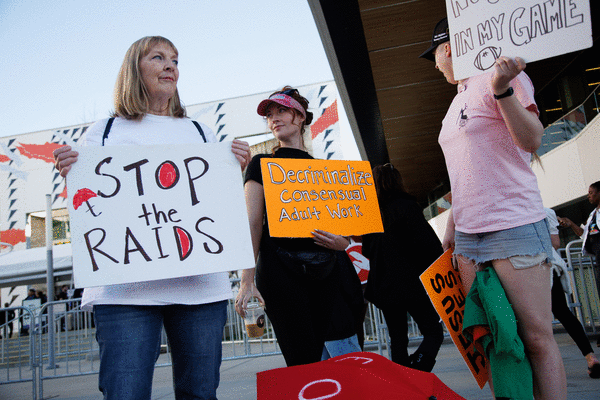
However, Doogan worries that could change with AB379, which took effect at the beginning of this year. She lives in San Francisco and is a spokesperson for a coalition called Stop the Raids, which aims to push back at prostitution raids. Gov. Gavin Newsom cited his efforts to end human trafficking when he signed the bill.
“ ’Loitering with the intent to purchase,’ ” said Doogan, who lives in San Francisco and is a spokesperson for a coalition called Stop the Raids. “I mean, what is that? That can be anything.” Doogan spoke at a recent rally in San Jose with other performers who decried AB 379.
Federal officials have said that the Department of Homeland Security would be involved in security for the game, but the degree to which they might be involved in immigration or anti-human trafficking operations is not clear.
Singleton and Baker said the trapping of immigrants in illicit operations is why law enforcement works to eliminate trafficking. Immigrants often arrive with the promise of a road to citizenship, a financial debt stemming from their travel, and an inability to pay it. An offer for a hairdressing or massage job can instead lead to illegal work and conditions that resemble enslavement.
Officials tend to tout such operations as the recent “Stand on Demand,” a statewide operation from Jan. 19-24 that resulted in 120 arrests, including 25 for solicitation. State Attorney General Rob Bonta in a statement touting Human Trafficking Awareness Month, announced those arrests and said the operation was “to protect the public and take a stand against the demand” for human trafficking.
Oakland police also recently trumpeted their arrest of 45 men so far this year, on suspicion of either soliciting prostitution or loitering with intent to solicit — the new misdemeanor charge created by AB 379 — to “(hold) sex buyers accountable.”
Antonia Lavine, the director of the San Francisco Cooperative Against Human Trafficking, said that during the week of the big game, calls to the national human trafficking hotline increase, both from survivors looking for a way out and others who seem to become interested in the issue.
“We will collaborate with our national partners to ensure that there is a quicker response… ,” Lavine said. “It will increase the calls we get from survivors and support networks. We also get calls from families, and we get calls from citizens. They ask what human trafficking is, how can they stop it. They want to help.”
Doogan, while calling human trafficking in all its forms “disgusting,” said the perception that all sex workers are “trapped” is not true and that such a repeated message from law enforcement is propaganda. She pointed to her own experience and cited academic work that debunks earlier studies linking prostitution to increases in human trafficking. Ronald Weitzer of George Washington University, in his academic work, said such assumptions could tumble like a “house of cards” under a system that gave more legal freedom to the sex worker.
In the “Stand on Demand” operation, only eight people were arrested on suspicion of pimping or pandering. Oakland police did not mention any such arrests in recent releases about the solicitation arrests, but a statement did note that officers “are now equipped to make more arrests” under AB 379.
“It gets back to the fact that a lot of the people that are out there are doing it by choice, not because they’re being forced,” Doogan said. “You don’t see a lot of pimps being arrested when they have these raids.”
Doogan said it’s important for all sex workers to know that there are resources to lead them out of the industry if they don’t want to be a participant and are forced to be. A 24/7/365 human trafficking hotline — 888-373-7888 — exists for those seeking help, with interpreters for 240 languages available.
Still she insists that the notion that there will be thousands being forced to sell their services this week is part of the “false and misleading narratives” that she believes law enforcement puts out “to gaslight the public.”
“All of this attention diverts from the fact that there is no social safety net for people in this country, and that prostitution is the only one there is,” she said. “I know people in the business who were involved as in prostitution as teenagers who didn’t have a pimp. They didn’t have anyone forcing them. They were there because the social safety nets failed them, and they had no other choice.”
_____
©2026 MediaNews Group, Inc. Visit at mercurynews.com. Distributed by Tribune Content Agency, LLC.






Comments