Potomac River sewage spill still not contained, could take months to fix
Published in News & Features
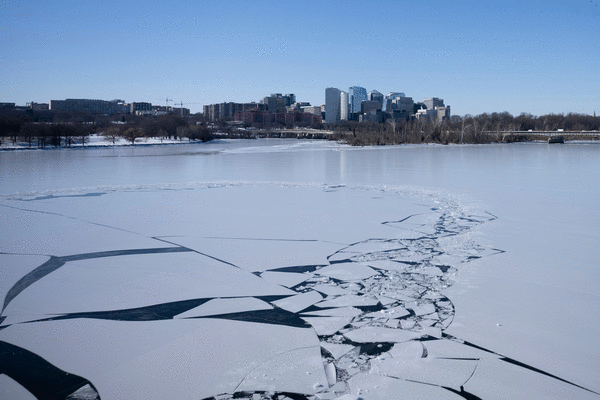
A roughly 300 million-gallon sewage spill into the Potomac River — which environmental advocates say rivals the scale of the Deepwater Horizon oil disaster — could take several more months to fully clean up after a major sewer line collapse, according to University of Maryland, College Park researchers, utility officials, and the Potomac Riverkeeper Network.
The Jan. 19 rupture of a sewage line inside the C&O Canal National Historical Park has sent repeated discharges of untreated wastewater into the river and prompted health advisories in Montgomery, Prince George’s and Charles counties, warning residents to avoid affected areas. Officials said drinking water across the region remains safe because the break occurred downstream of active water intakes.
In an interview with The Sun, Dean Naujoks, the Potomac Riverkeeper, said that Maryland, D.C. and Virginia need to issue stronger advisories, as modeling shows unsafe E. coli levels as far as 40 miles from the initial spill site.
Data from D.C. Water shows typical E. coli levels in the Potomac River can range from 10 to 5,000 MPN/100mL. That stands for most probable number per 100 milliliters of water. On Jan. 29, that number was at 579,000. It has declined in the last few weeks, falling to 242,000 as of Feb. 6 and then to 130,000 as of Sunday.
Naujoks said the largest comparable spill he could find was a 230-million-gallon sewage spill in 2017 along the U.S.–Mexico border near San Diego.
“This is one of the largest sewage spills in U.S. history. We’re talking almost 300 million gallons and counting,” he said.
Despite the size of the spill, scientists said impacts beyond the Potomac watershed may be limited because pollution will dilute as the river flows into the Chesapeake Bay and Atlantic Ocean.
“The Potomac River will take the brunt of it,” said Steve Taylor of the Maryland Coastal Bays Program.
Weather conditions have actually helped
One benefit, Naujoks said, is that cold temperatures and ice may have created a delayed release.
“All this stuff is trapped in the ice. There’s definitely stuff moving under the ice where our data shows that we sampled at eight locations downstream,” he said.
All of that is changing now, as the temperature rises and ice begins to melt. That’s why Naujoks is pushing for a quicker, more involved response, to address the situation before it gets worse.
Officials from the D.C. Water utility said beyond the initial incident, additional accidents have complicated the situation, causing more wastewater to spill into the Potomac. The latest example happened Sunday, as multiple bypass pumps, clogged by nonflushable wipes, were taken out of service for cleaning. The utility experienced a “high-flow period” at the same time, with significantly more wastewater coming through than expected. Preliminary estimates show several hundred thousand gallons spilled during that event alone.
Crews are installing additional bypass pumps and building new upstream and downstream access points so workers can place a bulkhead and remove a rock blockage before repairing the damaged pipe. That’s the most time consuming piece, as heavy machinery will need to be brought in from out of state.
D.C. Water officials said the company is also preparing an environmental restoration plan and plans to continue water-quality sampling.
What’s being done?
Maryland Department of the Environment (MDE) spokesman Jay Apperson said state, federal and local agencies have inspected the site and coordinated monitoring. He again emphasized that no Maryland drinking water supplies are affected.
“There are no active drinking water intakes in Maryland that would be affected by this sewer line break and resulting overflow,” Apperson said.
As a precaution, Apperson said Maryland also closed shellfish harvesting areas along part of the lower Potomac River from the Port Tobacco River region to the U.S. Route 301 bridge. Health advisories were issued in Montgomery, Prince George’s and Charles counties, and anglers and hunters were warned to avoid contaminated areas.
Apperson said the state is also aware of the E.coli testing by D.C. Water.
“D.C. Water said elevated bacteria levels remain near the Lock 10 area, though downstream samples generally show declining contamination within federal standards,” Apperson said, adding that the state is coordinating on a water-monitoring plan.
He added that winter weather has complicated repairs. While it has slowed progress of the contamination, snow and extreme cold have hindered multiple planned repair operations, but everything is being done as fast as possible.
Despite the work, environmental groups say residents should take precautions, urging the public not to fish near the site or allow pets near the water because releases could continue for months.
“People want to know if the river is safe,” Potomac Riverkeeper Network President Betsy Nicholas said. “Right now, the Potomac River is not safe.”
______
©2026 Baltimore Sun. Visit baltimoresun.com. Distributed by Tribune Content Agency, LLC.





Comments