Inside the US case claiming the Venezuelan government ran a drug empire
Published in News & Features
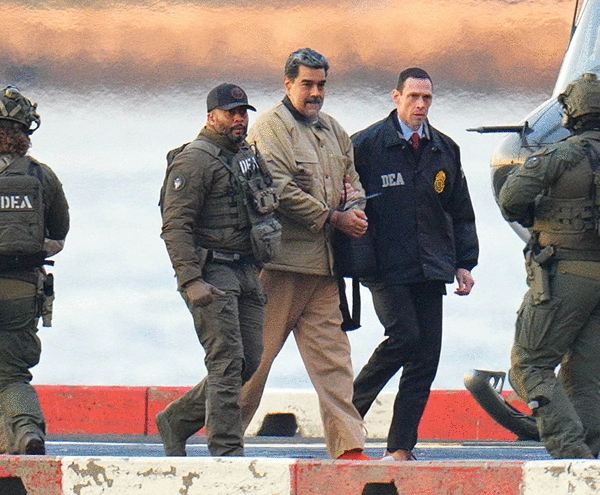
On paper, it reads like the blueprint of a government. Ministries. Intelligence agencies. Military commands. Diplomatic missions.
But in a sweeping federal indictment filed in New York, U.S. prosecutors describe something else entirely — a system they say was repurposed into one of the most sophisticated drug trafficking enterprises in the world, operating from the highest levels of power in Caracas.
“For over 25 years,” the indictment states, “leaders of Venezuela have abused their positions of public trust… to import tons of cocaine into the United States.”
At the center of that system, prosecutors say, stood Nicolás Maduro and a tight inner circle of political and military power brokers — what U.S. officials have long called the Cartel de los Soles, the Cartel of the Suns.
Maduro and his wife, longtime political figure Cilia Flores, are facing criminal charges in the Southern District of New York as part of a sweeping narcotics and narco-terrorism case accusing senior Venezuelan officials of participating in a decades-long conspiracy to traffic cocaine bound for the United States.
The superseding indictment charges that Maduro and members of his inner circle used their positions to shield shipments and coordinate with trafficking networks, placing the case squarely within U.S. jurisdiction because prosecutors say the conspiracy targeted the American market.
Though filed weeks ago, the indictment has largely remained in the background of Venezuela’s fast-moving political drama, overshadowed by arrests, diplomatic maneuvering and shifting alliances. A close examination of the document, however, reveals prosecutors’ most comprehensive account yet of what they describe as the Cartel of the Suns — a system they say operated from the highest tiers of government.
Despite the scale of the allegations, the filing has received only limited sustained scrutiny, leaving much of its narrative unexplored. The indictment lays out in stark detail how authorities say state institutions, military structures and political networks were intertwined with international trafficking operations, offering a roadmap of alleged corruption whose implications extend far beyond the courtroom.
The case took renewed urgency after a Jan. 3 operation that resulted in Maduro being taken into custody by U.S. forces, a move officials described as the culmination of years of investigation into the network outlined in the indictment filed that same day in federal court.
Prosecutors argue that bringing the case in New York reflects both the impact on the United States and longstanding federal efforts to prosecute international narcotics conspiracies in U.S. courts, where several co-defendants and associates have previously faced related charges.
A state apparatus repurposed
The document portrays a country whose institutions were transformed into the logistical backbone of a multinational drug pipeline.
Maduro is described as being “at the forefront of that corruption,” accused of partnering with co-conspirators to use “illegally obtained authority and institutions he controlled” to move thousands of tons of cocaine.
According to the indictment, the operation relied on a simple but powerful model: traffickers provided money and loyalty; officials provided protection, infrastructure and impunity.
Shipments moved through Venezuela by sea and air, departing from clandestine airstrips or ports, often under the protection of corrupt military and intelligence officials.
The profits, prosecutors say, enriched regime insiders and their families while reinforcing political power.
Taken together, the indictment portrays the Cartel de los Soles less as a traditional criminal syndicate than as a patronage system embedded at the highest levels of the Venezuelan state, where political loyalty and access to power determined participation in — and protection from — illicit activity.
The filing describes a hierarchy with senior officials at the apex, overseeing a network that blended political authority with criminal enterprise, allowing trusted allies and family members to benefit from and sustain the system.
The structure is depicted as rooted in military leadership — symbolized by the “suns” insignia worn by high-ranking officers — and fueled by the enormous profits of cocaine trafficking.
Those revenues, prosecutors say, flowed through a web of corrupt civilian, military and intelligence officials who provided protection, logistical support and institutional cover, creating what authorities characterize as a durable ecosystem where state power and organized crime operated in tandem.
“The profits of this illegal activity flow to corrupt rank-and-file civilian, military, and intelligence officials, who operate in a patronage system run by those at the top—referred to as the Cartel de Los Soles or Cartel of the Suns,” the indictment states.
The filing presents a sweeping narrative: not merely corruption, but a system in which political power, military force and criminal alliances merged into a single enterprise — one prosecutors say operated for decades with global reach.
It is, in essence, the U.S. government’s most detailed attempt yet to define what officials mean when they invoke the name Cartel of the Suns.
At its core lies a stark accusation: that the machinery of a state was transformed into the infrastructure of a criminal enterprise, where power protected profit and profit reinforced power — a cycle prosecutors say endured for a generation.
A transnational trafficking ecosystem
The indictment also depicts the Cartel of the Suns not as an isolated network but as a hub linking some of the hemisphere’s most powerful criminal organizations.
Among them: Colombia’s FARC and ELN guerrillas, Mexico’s Sinaloa Cartel and Los Zetas, and the Venezuelan criminal network Tren de Aragua.
These partnerships allowed cocaine produced in Colombia to move through Venezuelan territory before heading north through Central America and Mexico toward U.S. markets.
Officials allegedly provided safe haven and protection while coordinating shipments and, in some cases, discussing weapons transfers with guerrilla leaders.
“Venezuelan officials and their family members… partnered with narcotics traffickers and narco-terrorist groups, who dispatched processed cocaine from Venezuela to the United States via transshipment points in the Caribbean and Central America,” the indictment states.
The document outlines a transnational ecosystem in which each group controlled a piece of the pipeline — production, transport, security and distribution — while Venezuelan officials ensured the system functioned smoothly.
Power, loyalty and the inner circle
The portrait of Maduro that emerges is that of a political leader who leveraged decades in government to build and sustain the network.
As foreign minister before he became president, prosecutors say, he sold diplomatic passports to traffickers and provided diplomatic cover for flights used to move drug proceeds, shielding them from law enforcement scrutiny.
Later, as president and “now de facto ruler,” Maduro allowed “cocaine-fueled corruption to flourish for his own benefit” and that of members of his regime and family, the indictment says.
“Through this drug trafficking, NICOLÁS MADURO MOROS… and corrupt members of his regime enabled corruption fueled by drug trafficking throughout the region,” prosecutors wrote.
The filing also draws parallels between Maduro and his predecessor, Hugo Chavez, saying he “participates in, perpetuates, and protects a culture of corruption in which powerful Venezuelan elites enrich themselves through drug trafficking.”
Interior Minister Diosdado Cabello appears as a central figure within the alleged network — a man prosecutors say wielded influence across the military and security services.
The document links Cabello to shipments protected by Venezuelan military officials and to coordination with intelligence figures involved in trafficking operations.
Authorities describe a system in which senior officials like Cabello helped ensure shipments moved safely while maintaining contacts with traffickers and criminal intermediaries — reinforcing his role as a key operational figure within the network’s power structure.
The indictment also draws Maduro’s son, Nicolás Ernesto Maduro Guerra, into the alleged conspiracy, portraying him as part of the inner circle that helped sustain operations. He is accused of participating in meetings tied to trafficking activities and of being connected to flights linked to the state oil company, PDVSA, that were sometimes used to move drugs.
His role, prosecutors suggest, illustrates how the alleged network extended beyond political leadership into family structures — reinforcing loyalty and continuity across generations of power.
A pipeline measured in tons
Throughout the document, prosecutors describe multi-ton shipments moving through Venezuela with protection from corrupt officials.
In a recurring pattern, traffickers allegedly paid bribes or shared profits while officials provided security, access to infrastructure and political cover — a system prosecutors say allowed cocaine to flow steadily north for decades.
The indictment repeatedly underscores the scale of the operation, describing “tons of cocaine” transported through the network over the years.
The case includes counts of narco-terrorism conspiracy and cocaine importation conspiracy, accusing the defendants of working with organizations designated as terrorist groups while coordinating large-scale trafficking operations.
Maduro and his allies have long denied the allegations, calling them politically motivated attempts to undermine Venezuela’s government.
_____
©2026 Miami Herald. Visit miamiherald.com. Distributed by Tribune Content Agency, LLC.




Comments