Venezuelan media sees signs that restrictions are loosening, but perils remain
Published in News & Features
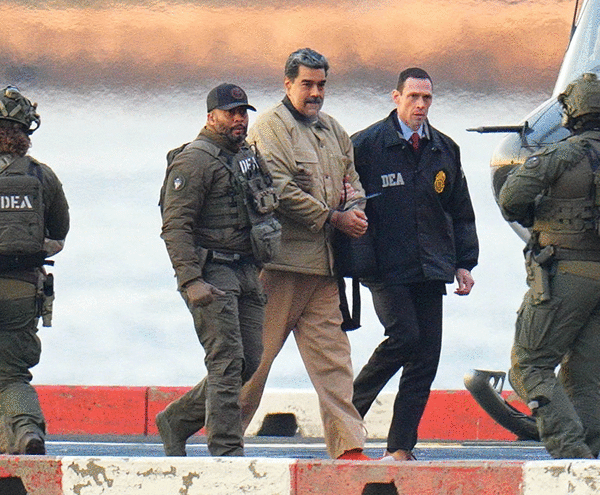
CARACAS, Venezuela — Traditional media outlets in Venezuela that have been censored for years are daring to take a new direction following Nicolás Maduro’s capture by U.S. forces in early January.
After years of harsh repression, television channels and social media accounts have begun to include the voices of opposition figures and relatives of political prisoners in their reporting.
But while regular citizens notice a shift in coverage, journalists warn that repression and fear remains an obstacle to their work.
Free-to-air television channel Venevision has become a salient example of increasing media freedom, incorporating content that some Venezuelans believe represents an important step towards restoring freedom of expression.
One of the most notable changes came at the end of January when the channel broadcast statements by exiled opposition leader María Corina Machado, who discussed her desire to return to Venezuela soon.
The reporting prompted Interior Minister Diosdado Cabello to react on his own program Con el mazo dando — Striking with the hammer. “Listen to me, Venevision, listen up. Without media hype, [Machado’s] figure fades away,” he said. “Without headlines she simply disappears.”
Venevision is also covering the complaints of relatives of political prisoners for the first time in years, and broadcasting opposition protests, such as the caravan last week led by Juan Pablo Guanipa and other political leaders shortly after they were released from prison.
In a sign of shifting tides, the channel even interviewed student leaders from the Central University of Venezuela, who used the opportunity to call for a march on Feb. 12.
Another state-run television channel, Televen, also ran an editorial about the student march, saying, “The true national unity is not uniform. It is the ability to agree on a common purpose: peace.”
Citizens say they have noticed the shift in media coverage and believe it suggests that it is becoming less dangerous to oppose the government.
“I think that with the attack ordered by Trump, they said ‘enough is enough’. They no longer face the pressure they used to,” said Margarita Carrasquel, a 68-year-old housewife who frequently watches Venevision.
Natalia Gutiérrez, a 51-year-old accountant, feels that the new coverage is a sign of how Venezuelans are tired of the Chavista government. She finds it “amazing” that an important channel like Venevision can report on political opposition, given that traditional media in the country is mostly dominated by the government.
“I think it’s great that they can finally speak out and be given a voice, because here in Venezuela, what they say on Channel 8 [state television] is not what is happening,” she said. “Here, there is another reality.”
Designer Samuel González, 25, admits that he does not watch much television, but he has noticed on social media how Venevision is incorporating a news agenda that did not exist before. “I think they are opening the door to communicating information without fear again,” he said.
On social media, the Venevision Instagram account receives many comments from users applauding the editorial shift since Jan 3, the day Maduro was captured. Messages include: “Venevisión without fear”, “The self-censorship they had is over” and “We Venezuelans are so happy for Venevisión”.
Continued press fear and repression
While citizens say they have noticed a loosening of media constraints, Venezuela’s journalists say this change is just a small step on a long road to restoring freedom of expression in the country.
Luis Carlos Díaz, a Venezuelan journalist and activist, describes the shift in media freedom as “millimetric,” saying that the press continues to face repression.
“The traditional media remain under the control of the National Telecommunications Commission, which is still in the hands of the same military official,” Jorge Elieser Márquez, Díaz said. “The only thing that has changed in recent weeks is that, as Venezuela is in the international spotlight and there has been this change with the United States, some media outlets have moved forward a millimeter. But it is only a millimeter.”
In 2017, the National Telecommunications Commission suspended transmission of CNN en Español from the country and has imposed strict controls on Venezuelan media outlets.
Díaz described a “hunger for information” in the country, saying the population has been misinformed for years due to censorship and the closure of at least 400 radio and television stations, in addition to the blocking of social networks such as X.
The journalist also pointed out that the commission has ordered many media outlets not to show opposition figures such as Machado. “As long as Conatel remains under the control of a military officer, that officer has to show loyalty to [interim president] Delcy Rodríguez and will continue to censor,” he said.
Maria, a reporter for a digital media outlet who asked for her last name not to be used for fear of government reprisals, said journalists remain nervous about doing their jobs.
“We are in a state of total uncertainty. There is a kind of calm, but that does not mean you can practice your profession or do your job peacefully. It simply means that perhaps they will not do anything to you at the moment,” she said.
To protect her safety, Maria maintains security measures such as travelling in groups and deleting her chats in case her phone is searched by authorities.
According to Díaz, the real break has yet to happen, with websites still blocked, continued pressure against journalists, and the stigmatization of civil society organizations who provide independent information.
He called for action from the government to demonstrate a commitment to a free press, insisting primarily on the release of jailed journalists. At least four members of the press remain detained to date.
In addition, Díaz said the National Telecommunications Commission must be autonomous and not controlled by the regime. He also stressed the importance of lifting bans on news outlets and removing digital blockades.
Díaz added that opposition voices like Machado and Edmundo González, the man who many people and western governments believe won the presidential election in July 2024, must be allowed to be freely broadcast regularly: “If only the opposition chosen by Chavismo can speak, then that is neither opposition nor the real country. The opposition leaders legitimized in elections must speak, and that has not happened so far.”
Still, some journalists fear that even if they are given these freedoms, it will be hard to move on after years of press repression.
“I think they’ll tell me, ‘It’s all over, and you’re free to say whatever you want,’ and I’ll be afraid to say it,” Maria said.
©2026 Miami Herald. Visit at miamiherald.com. Distributed by Tribune Content Agency, LLC.



Comments