Florida taxpayers likely on the hook for Alligator Alcatraz
Published in News & Features
TALLAHASSEE, Fla. — Gov. Ron DeSantis proclaimed on social media in early October that the federal government had awarded the state $608 million to help recoup the cost of building Alligator Alcatraz.
“We were right; media was wrong,” he wrote, targeting earlier media reports that questioned whether the federal government would pony up.
Within a week, though, that money was put on hold as federal officials sought more information from state officials about their expenditures. By then Florida had already spent about $400 million.
Now, five months later, Florida has received about $90 million from the federal government, but most of the grant money it wanted is sitting in limbo and may never be disbursed — a possibility lawyers for the state and federal governments stated in court filings last week.
The DeSantis administration initially committed nearly $1.5 billion in state taxpayer dollars to house immigrants for deportation, confident the tab would be paid back by the federal government, new court records obtained by the Orlando Sentinel show.
State officials even began building the tent city on a little-used jetport run by Miami-Dade County before they asked permission to use the property and before they applied for the federal reimbursement grants, those records show.
But they soon scaled back their ask because the Federal Emergency Management Agency said it exceeded the amount available, the court records show. Florida dropped its request to about $1 billion, and then again to the $608 million DeSantis announced on social media, after FEMA nixed the inclusion of construction costs.
The records, which include emails between FEMA and Florida counterparts, document ongoing negotiations over what of Alligator Alcatraz’s expenditures would be covered under the federal government’s detention center reimbursement grant program.
“These files illustrate a staggering waste of taxpayer dollars — funds meant to protect Floridians in times of natural disaster — diverted instead to construct an ICE detention center in the heart of the Big Cypress National Preserve that continues to inflict grave harm on the Everglades,” said Eve Samples, executive director of Friends of the Everglades.
The files, including thousands of pages of emails and documents, were released over the weekend under a court order as part of an ongoing lawsuit filed by Friends of the Everglades, the Center for Biodiversity and the Miccosukee Tribe against Florida for the construction of the detention center.
The lawsuit, filed in June in a Tallahassee circuit court, claims the detention center was built without an environmental impact statement, public input or permits required by the National Environmental Policy Act. The groups that sued also said the facility was not authorized to be a mass detention center.
The newly released records detail the state’s attempts since June to obtain a federal grant to cover most of the project’s costs.
Lawyers for the state argued in court that the facility is run by the state and therefore exempt from those federal environmental review requirements, though it was built to aid President Trump’s anti-immigration policies and is used to expedite federal deportation proceedings.
Last week, as part of the case, an attorney for the U.S. Department of Justice filed a statement in court that Florida would only be reimbursed for day-to-day operations per detainee and not construction or facility modification. That is the same message FEMA officials gave state officials months ago when they filed their grant paperwork.
“As it likely will be structured, there will be no potential federal funding of the facility’s design, siting, maintenance, or construction, and no federal approval authority over whether the facility is built at all,” said Adam Gustafsom, a deputy assistant attorney general with the DOJ’s environmental and natural resources division.
Attorney General James Uthmeier filed a statement admitting that Florida had accepted the “risk” that it might not get reimbursed at all.
A federal judge in August ordered the state to shut down Alligator Alcatraz, but an appeals court lifted the order to allow the state to operate the detention center while the environmental case is pending.
State lawyers also said Alligator Alcatraz’s environmental impact was minimal since it was built on a pre-existing jetport run by Miami-Dade County on property owned by and located in Collier County.
But federal officials said that an environmental impact study was required and was among the reasons they have withheld funding, starting back in August.
The ongoing legal battle was an early concern for FEMA officials. They sent an email to state emergency management officials in September saying they were awaiting word from the Department of Homeland Security’s general counsel on “the environmental litigation matter.”
A month later FEMA issued Florida an award, but within days of DeSantis announcing the $608 million grant, the money was frozen over legal and budget concerns, and federal and state officials were once again at loggerheads over the documentation of expenses and daily operating costs per detainee, the records show.
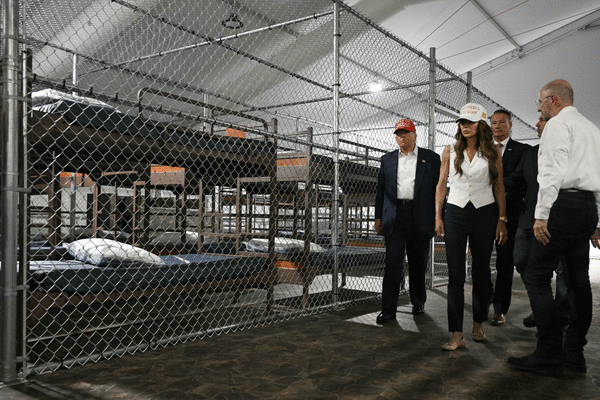
The 158,000-square foot detention center — designed to hold up to 3,000 people — was built in less than a week in June with little oversight or competitive bidding under an emergency order that’s been renewed 20 times to use state resources to combat immigration. It allows Gov. Ron DeSantis to suspend state laws, building codes and the public, competitive bidding process to award millions of dollars from an account he alone controls.
Alligator Alcatraz’s population of 1,350 as of Feb. 5 was down from its peak of 1,468 on July 29. Its all-time low was 98 on Sept. 4 after the federal court judge ordered the facility to be shut down.
State emergency management officials calculated it cost the state nearly $3,400 a day per inmate to house an average 771 detainees during the first 110 days of operation – or $2.6 million a day. That number includes the one-time construction costs as well as daily operational costs.
That’s an astronomical rate compared to the daily rate of $187 per detainee reported by Immigration and Customs Enforcement as of mid-2025.
Florida officials used their daily rate to project the annual cost of running the detention center and, combined with the one-time costs to set up the facility, came up with a total of $1.492 billion. That was the amount the state initially requested from the FEMA-administered Detention Support Grant Program.
But problems arose when FEMA officials told them they couldn’t include construction costs in the daily rate and had to come up with a new rate based just on the day-to-day costs of keeping detainees locked up.
Federal officials in July said they wanted more detailed information so they could decide whether Florida’s costs were reasonable and allowable under federal law. Florida officials had said they wanted to submit expenses without providing a per-bed cost.
The state’s application included some line items, among them $388 million for “clothing and bedding” for up to 4,000 detainees, $89 million for food services and $92 million for portable toilets and waste removal.
“When can we expect to receive the additional details?” said Betsy Hernandez, Branch Chief for FEMA’s national grants program. “Additional details are needed to ensure costs are reasonable, allowable and allocable.”
Those details were long in coming, and the state didn’t satisfy federal scrutiny until late November when it amended request was finally approved, and Florida was greenlit to receive $89.67 million.
The months of back and forth over budgets and allowable expenses seems part of Florida’s strategy to get the tent facility constructed quickly and without providing details that would be too carefully scrutinized, said Paul Schwiep, an attorney for Friends of the Everglades.
It was an intentional act of gamesmanship “to sidestep compliance with federal environmental law,” he said. “Until the mandated review is completed, operation of the facility should cease.”
-------------
©2026 Orlando Sentinel. Visit at orlandosentinel.com. Distributed by Tribune Content Agency, LLC.






Comments