House members vying for Senate face conundrum with Iran votes
Published in News & Features
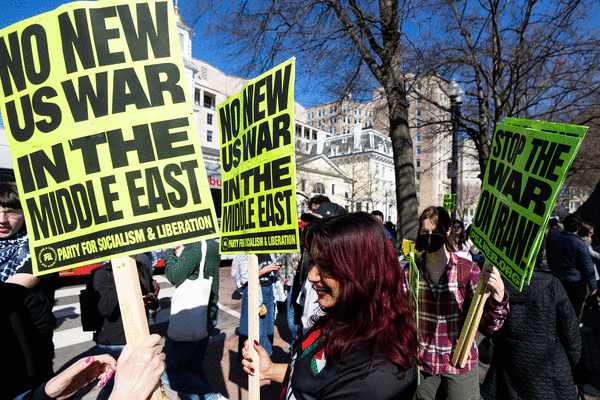
WASHINGTON — House members eagerly hoping for a spot across the Capitol in the Senate are now facing an unexpected variable in their campaign calculus: the conflict in Iran.
If the war drags on, it will become a delicate issue that both Republican and Democratic candidates will need to balance, albeit for different reasons.
Their first test came Thursday, when the House adopted a GOP resolution describing Iran as a state sponsor of terrorism in a bipartisan 372-53 vote. A separate war powers resolution aimed at reining in President Donald Trump fell short, with just a few defectors on either side. It may not be the last time for Congress to weigh in, as talk swirls of sending extra funds to the military or pressing to formally authorize the war.
Votes like those have a way of resurfacing, strategists say — either as points of pride or political liabilities.
After 9/11, for example, former Rep. Barbara Lee was the sole member of Congress to vote against a resolution to authorize war in Afghanistan, citing it as a “blank check” for endless wars. Nearly two decades later, the California Democrat, who is now the mayor of Oakland, Calif., called it “the most difficult vote I’ve cast in my career in Congress.”
And the 2002 vote to authorize the Iraq War followed Hillary Clinton, who voted in favor of it at the time as a Democratic senator from New York, 14 years later into the primary against Sen. Bernie Sanders, I-Vt., to become the party’s presidential nominee.
“Back in 2002, when we both looked at the same evidence about the wisdom of the war in Iraq, one of us voted the right way and one of us didn’t,” Sanders said during a 2016 debate.
As the midterm season begins in earnest and both the United States and Israel continue their strikes on Iran, this wasn’t the conversation many wanted to be having.
“When you’re seeing servicemembers dying in a war (and) there’s no real explanation of why we, the United States, decided to go to war with Iran, I think that it could impact not only Republicans, but it could also impact Democrats,” said former Rep. Debbie Mucarsel-Powell, D-Fla., who now leads George Washington University’s political management graduate program.
Michigan mayhem
Questions over why the White House attacked Iran could complicate things for pro-Israel Democrats.
That’s true for Democratic Rep. Haley Stevens, who is running neck-and-neck for Michigan’s open Senate seat against state Sen. Mallory McMorrow and former Wayne County health director Abdul El-Sayed.
A vote like the one on Thursday “puts her between a rock and a hard place,” said David Dulio, a professor of political science who is the director of the Center for Civic Engagement at Oakland University.
“She is on record as a strong supporter of Israel, and it goes beyond her AIPAC support,” Dulio said. “Part of her issue is that you’ve got El-Sayed (just) condemning this military action in Iran. You know who’s on the other side of that? Well, it’s Donald Trump. It’s really hard for Haley Stevens to agree in a Democratic primary with Donald Trump.”
Stevens voted in favor of both the Democrat-led war powers resolution and the GOP-led terrorism designation resolution. Asked whether she’d vote to authorize the war if such a resolution ever came to the floor, Stevens said she wouldn’t speculate.
“I am deeply frustrated and disappointed that this president has gone rogue, has gone outside the bounds of the Constitution,” Stevens said. “In terms of the future, I will just say that this administration needs to come to the table for anything they need from Congress.”
Reps. Angie Craig of Minnesota and Chris Pappas of New Hampshire, moderate Democrats who are also vying for Senate seats, could also face the same issue. Like Stevens, both are supported by the American Israel Public Affairs Committee and endorsed by the Democratic Majority for Israel.
Rep. Robin Kelly, D-Ill., who is running to replace retiring Sen. Richard J. Durbin, has taken a different route from Stevens. In January she said she wouldn’t take AIPAC money, although she accepted their donations last year. Kelly and Rep. Raja Krishnamoorthi, D-Ill., were the only two House Democrats running for the Senate to vote against the terrorism designation.
“I think that that’s why you’re seeing some of these Democrats try to thread this needle of, you know, the supreme leader and the regime in Iran is terrible, and they’re terrorists and they’re killers, but do we really want to be doing it this way?” Dulio said.
Length of conflict
It would be unusual for foreign affairs to top the list of issues that voters prioritize at the polling booth. But experts say the length of this conflict could be the trickiest part for Republican candidates as November inches closer, coupled with the fact that Trump campaigned on no new international conflicts.
So far, Republican lawmakers have mostly lined up to support Trump as he declines to put a firm timeline on the war, including the House members seeking Senate seats.
“This is an imminent threat that the president is addressing. When you’ve got missiles and bombs aimed at American bases, that’s an imminent threat,” said Rep. Earl L. “Buddy” Carter, R-Ga., who’s running to unseat Democratic Sen. Jon Ossoff. “Let’s face it, Iran’s got American blood on their hands.”
“I will continue to support what the president has done,” said Rep. Harriet M. Hageman, R-Wyo., who’s running to succeed retiring Republican Sen. Cynthia Lummis.
All seven House Republicans running for the Senate voted to reaffirm Iran as a state sponsor of terrorism and against the war powers resolution.
Mucarsel-Powell said if the conflict is short and domestic policy “is not truly affected,” it could help Republicans make the case that they’re going to be able to protect national security, “which is always an issue that comes up for voters.”
But polling since the war began last weekend indicates the American public is not exactly on board. An NBC News survey found 54 percent disapproved of Trump’s handling of the conflict, and nearly the same number said the U.S. should not have taken military action. Similarly, a CNN poll found nearly 60% disapproved.
“I think that that really will drive home to voters that are truly exhausted … of not seeing any sort of economic relief, exhausted that their wages are not going up, but prices continue to go up, exhausted of the chaos,” Mucarsel-Powell said of the length of the conflict. “They don’t want another war.”
Sen. Andy Kim, D-N.J., a former member of the House, said while Democrats should still focus their messaging on affordability and domestic issues, the war in Iran plays into that. The conflict is already estimated to cost $891 million a day.
“What I will say is that the American people are livid. They do not want this,” said Kim, who added that the money spent funding the war “could have gone toward lowering our health care costs, lowering our grocery costs.”
The resolution votes taking place this week were fraught enough, but any vote to authorize a war in Iran would come with much higher stakes.
Those authorizations can last for years if they aren’t repealed. For example, while a few decades-old AUMFs were repealed last year through the fiscal 2026 National Defense Authorization Act, the 2001 AUMF that laid the foundation for U.S. counterterrorism operations since the Sept. 11 terrorist attacks is still in effect.
Lawmakers are questioning whether that AUMF is broad enough to constitute further Iranian intervention. The White House has refused to rule out that possibility of calling for a new authorization this week, both publicly and well as in private briefings to lawmakers on Capitol Hill.
If such a vote happens, Michael Traugott, interim director of the Center for Political Studies at the University of Michigan, said voters will be watching — and so will their midterm election opponents.
“Some people want to support the president, some people want to oppose the president. Some people think this is right, some people think this is wrong,” Traugott said. “And some people are thinking about the video for advertisements in the fall campaign.”
_____
Ariel Cohen and Mark Satter contributed to this report.
_____
©2026 CQ-Roll Call, Inc., All Rights Reserved. Visit cqrollcall.com. Distributed by Tribune Content Agency, LLC.





Comments