Deadly LaGuardia crash raises worries about close calls at Sea-Tac, elsewhere
Published in News & Features
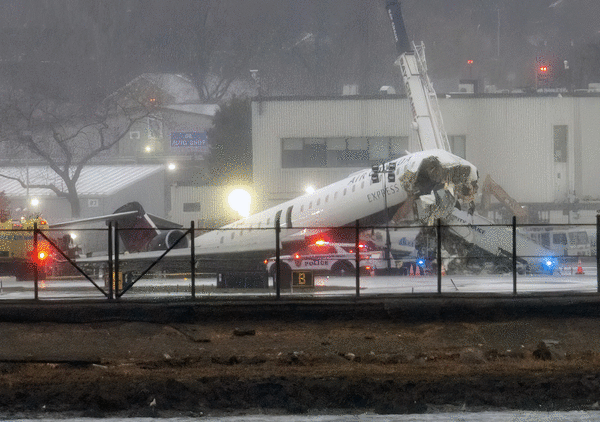
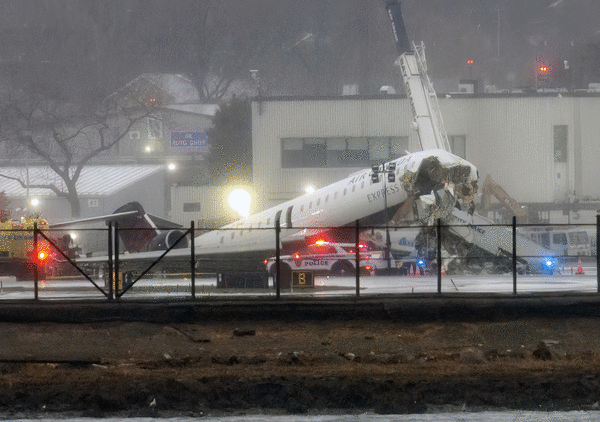
SEATTLE — The deadly collision between an Air Canada plane and a fire truck at LaGuardia Airport in New York City has raised alarm about the possibility of a plane speeding into another aircraft or vehicle on the jetway.
It’s too soon to know what caused Sunday's accident, which saw an Air Canada jet collide with an airport fire engine, and it will be some time before the National Transportation Safety Board determines a likely cause.
The tragic collision highlights the risk of such incidents at other major airport hubs, including Seattle-Tacoma International Airport. While the number of collisions and close calls has held steady nationally, the number of incidents at Sea-Tac remains below prepandemic levels.
But just last week the NTSB said it was investigating a close call between an Alaska Airlines plane and a FedEx cargo jet at Newark Liberty Airport in New Jersey. Both planes landed safely but the Alaska jet flew over the FedEx aircraft while both jets were attempting to land on crossing runways.
In the immediate aftermath of the collision Sunday, it appeared that air traffic control at LaGuardia had cleared the Air Canada plane to land and granted the firetruck permission to cross the runway.
Shortly after clearing the firetruck to cross the runway, an air traffic controller attempted to tell the truck to stop, according to a recording of control tower communications circulating on Monday.
The pilot and first officer flying the Air Canada plane died and more than 40 people went to the hospital, including the two firefighters in the vehicle that collided with the plane.
New York Gov. Kathy Hochul called the collision an aviation disaster, the likes of which we have not seen here in over three decades."
Transportation Secretary Sean Duffy said the incident was "incredibly sad" and "troubling."
"We are working our hearts out to make sure that when people travel, whether by rail or by car or by air, that they travel safely," he said at a news conference Monday.
The Federal Aviation Administration broadly defines these types of incidents as “runway incursions,” a catchall term it uses to describe any incident where an aircraft, vehicle or pedestrian is somewhere on a runway where it shouldn’t be.
The regulator has worked for decades to decrease the risk of runway incursions, after a peak in the early 2000s, said Robert Joslin, a professor at Embry-Riddle Aeronautical University and a former FAA technical adviser and flight test pilot. Those efforts had a range of focuses, from adding lights and signs to the physical runways to changing the verbiage operators use to communicate with air traffic control to incorporating high-tech warning systems.
Those efforts have been successful, Joslin said. The number of runway incursions has remained about the same over the last 10 years, even as the number of flights taking off and landing has continued to climb. The number of incidents dipped in 2020 and 2021, when the COVID-19 pandemic decreased air travel, and then climbed back to prepandemic norms, around 1,600-1,700 incidents per year.
The FAA records every runway incursion, even those that do not result in a collision or pose a safety risk. The majority of those incidents are labeled as category C or D, meaning there were no immediate safety consequences or there was enough time or distance to avoid a collision.
Still, the FAA hasn’t gotten the rate of serious runway incursions down to zero, Joslin said.
“It’s a lot of different things that have gone into that to try to mitigate it, and it still happens,” Joslin said. “In this case, another 30 seconds here and there, and it would have been a nonevent.”
In a March 2025 report, the Office of the Inspector General for the Department of Transportation similarly said the FAA had taken steps to prevent and mitigate runway incursions, but "work remains to be done.
How does Sea-Tac compare?
Seattle-Tacoma International Airport has the second-lowest rate of runway incursions among the nation’s 30 busiest airports, according to Joslin’s analysis of FAA data.
From 2021 to 2024, Sea-Tac saw about 10.4 runway incursions per 1 million flight operations.
LaGuardia, comparatively, saw 15 runway incursions per 1 million flight operations.
Sea-Tac’s lower rate is likely a function of lower volume, Joslin said. “More volume, more confusion,” he said. “When you have a lot of runways and taxiways, it compounds the problem.”
U.S. Sen. Maria Cantwell, D-Wash. and ranking member of the Senate committee on commerce, science and transportation, said Monday she was in touch with the FAA and NTSB as they began their investigation.
“Our hearts break for the families of the pilot and first officer of Air Canada Express flight 8646 who lost their lives in this accident, and we hope and pray for a swift recovery for the firefighters and the passengers who were injured.”
Determining what went wrong
Investigators from the NTSB are starting to collect evidence to understand what went wrong Sunday, but there are still very few verified facts, Chair Jennifer Homendy said at a news conference Monday.
The NTSB will look for information on air traffic controller staffing during the incident, including how many controllers were working, how long they had been on shift, and what roles they were performing.
The safety board will also examine data from the cockpit voice recorder and flight data recorder, which should provide information about the final moments of the flight. Because the plane was so mangled,the Port Authority of New York and emergency responders had to cut a hole in the roof of the plane and drop into the aircraft to obtain the recorders, Homendy said.
The NTSB will also rely on data from a surveillance system that can capture a “replay of the event,” Homendy said. That system — known as Airport Surface Detection System Model X, or ASDE-X — uses radar and satellite technology to let air traffic controllers track surface movement of aircraft and vehicles.
Because of the sheer volume of debris from the collision, Homendy expects the runway at LaGuardia will remain closed for days.
Parts of the investigation were slowed down on Monday as NTSB experts struggled to navigate crowded security lines at airports amid a partial government shutdown that has left Transportation Security Administration agents working without pay. The NTSB had to call the Houston airport after one of their experts waited in a security line for three hours, Homendy said.
Sea-Tac is operating as normal, the Port of Seattle said Monday.
©2026 The Seattle Times. Visit seattletimes.com. Distributed by Tribune Content Agency, LLC.




Comments