At Miami forum, Delcy Rodríguez makes once-unthinkable appeal for US investment
Published in News & Features
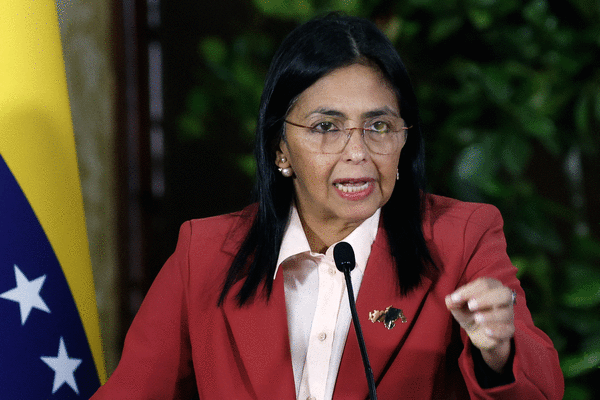
MIAMI — Venezuela’s interim president, Delcy Rodríguez, made a pitch Wednesday for foreign investment in Miami — a city long vilified by her socialist movement — as sweeping political changes following Nicolás Maduro’s capture drive a rapid reopening of the country’s oil sector to U.S. companies.
Rodríguez spoke on video from Venezuela as her country navigates a dramatically altered political landscape after the Jan. 3 capture of Maduro and his wife, Cilia Flores, in a predawn U.S. raid in Caracas — an operation that triggered a fragile transition now being shaped by the Trump administration.
That shift has opened the door to a new phase of cooperation between Washington and Venezuela’s remaining socialist leadership, with the oil and mining sectors increasingly opening to U.S. firms as part of a broader economic realignment. After years of sanctions, confrontation and mutual distrust, the relationship is being recalibrated around energy security, investment and political stabilization.
Speaking to the FII Priority forum — a global gathering in Miami Beach of more than 1,000 business leaders, policymakers and investors — Rodríguez cast Venezuela as an economy in recovery and newly open to private capital, particularly in the energy sector.
A dramatic turn in rhetoric
Her appearance — even virtually — underscored the scale of the political shift. For years, Venezuela’s ruling movement portrayed global capitalism as a driver of inequality and dismissed Miami — home to the larges Venezuelan exile community in the U.S. — as a bastion of the “extreme right” and anti-Chavista opposition.
Over the past two decades, officials in Caracas have also repeatedly accused exiles in the city of orchestrating dozens of plots to overthrow the socialist revolution. Against that backdrop, her participation in an investor forum in Miami would have been unthinkable just months ago.
The moment reflects a pragmatic pivot driven by economic necessity and geopolitical change. By addressing financiers and corporate executives in Miami, Rodríguez signaled a willingness to engage directly with people her movement once vilified — an acknowledgment that foreign capital, particularly from the United States, will be central to Venezuela’s recovery.
“Venezuela leads economic growth in Latin America,” Rodríguez said, citing data from the U.N.’s Economic Commission for Latin America and the Caribbean. She pointed to 19 consecutive quarters of growth and described a five-year recovery despite what she called “unilateral coercive measures” imposed by Washington and its allies.
Her remarks aimed to recast Venezuela’s image from a country long associated with economic collapse to one positioning itself as a fast-growing market driven by reforms and renewed access to global capital.
Oil at the center
At the core of Rodríguez’s pitch is Venezuela’s vast energy potential and a newly enacted hydrocarbons law that expands the role of private investors.
The legislation allows companies to participate directly in exploration, production and commercialization, while introducing more flexible tax and royalty structures and allowing for international arbitration — provisions designed to ease long-standing concerns over legal uncertainty.
Rodríguez said Venezuela holds the world’s largest proven oil reserves — about 303 billion barrels — and production costs comparable to Saudi Arabia, among the lowest globally.
She added that the new framework allows investors to negotiate terms on up to 64% of a barrel’s value, including reductions in royalties and income taxes — a level of flexibility rarely seen under previous state-dominated models.
Analysts say the reform marks one of the most significant shifts in Venezuela’s oil policy in decades, moving away from rigid state control toward a more hybrid system aimed at attracting foreign capital.
The government is also seeking to revive its historic energy relationship with the United States, which once accounted for roughly 40% of Venezuela’s oil exports. Rodríguez described the U.S. as a “natural market” and said commercial ties are beginning to be restored.
That reopening comes as U.S. policymakers weigh how to balance energy interests with the political risks of engaging a transitional government still rooted in Venezuela’s socialist system.
Broader economic pitch
Beyond oil, Rodríguez pointed to growth in construction, finance, mining and manufacturing, framing Venezuela as a broader investment destination.
She said the country reached zero fuel imports in 2025 for the first time in a decade, with domestic production now meeting internal demand — a milestone she presented as evidence of the oil sector’s recovery.
She also highlighted Venezuela’s vast natural gas reserves — among the largest in the hemisphere — along with gold and other mineral resources, positioning the country as a potential supplier of both energy and critical materials.
In an effort to counter security concerns, Rodríguez said Venezuela now has one of the lowest homicide rates in the region, at three per 100,000 inhabitants, below the Latin American average.
At the same time, she acknowledged lingering challenges, including poverty, infrastructure decay and what she described as “social debts” after years of economic crisis.
Call for investment and diplomacy
Rodríguez framed the reforms as part of a broader push to reintegrate Venezuela into the global economy.
She called for the “de-ideologization” of investment decisions and urged companies to engage directly with Caracas rather than rely on outside narratives.
“We are creating conditions where investors can be assured that, regardless of political changes, there is legal security,” she said.
She also signaled improving ties with Washington, backing a “constructive bilateral agenda” and confirming that Venezuelan officials are heading to Washington for talks aimed at restoring formal diplomatic channels.
Those discussions are expected to focus on energy cooperation, sanctions relief and coordination during Venezuela’s transition.
At the regional level, Rodríguez argued that Latin America remains fragmented and insufficiently integrated, calling for closer cooperation in trade, infrastructure and finance.
She cited data showing that remittances of money from abroad to the region — $161 billion in 2024 — exceeded foreign direct investment, which totaled $139 billion, as evidence of structural imbalances.
Rodríguez said her administration has held more than 230 meetings with potential investors and engaged over 120 energy companies from the United States, Europe, Asia and the Middle East.
She ended with a direct appeal: “I invite you to Venezuela ... to see the country’s reality firsthand.”
_____
©2026 Miami Herald. Visit miamiherald.com. Distributed by Tribune Content Agency, LLC.





Comments