Iran rejects ceasefire, Trump amps threats as deadline looms
Published in News & Features
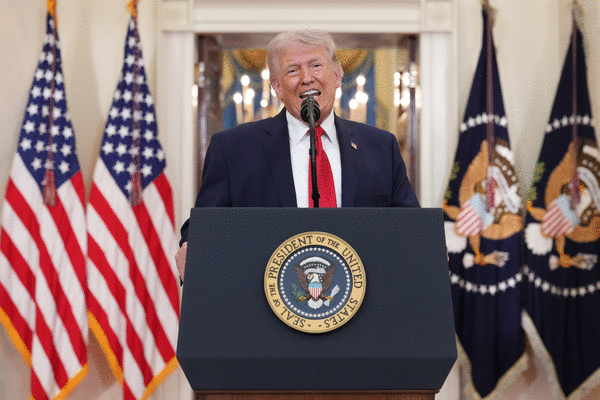
Iran rejected a proposed ceasefire as Donald Trump ramped up his threats less than two days before the U.S. president’s ultimatum to reopen the Strait of Hormuz or face further attacks on civilian infrastructure.
“They don’t want to cry, as the expression goes, ‘uncle,’ but they will, and if they don’t, they’ll have no bridges,” Trump told reporters Monday at the White House. He added that it was “highly unlikely” that he’d move the deadline again.
The president was scheduled to address reporters at a press conference at the White House.
Iran demanded a permanent end to the war, lifting of sanctions, and reconstruction efforts, in addition to protocol for safe passage through Hormuz, according to Iran’s state-run IRNA. The rejection, delivered through Pakistani mediators, is the latest blow to efforts to end the month-long war that has triggered a global energy crisis.
Trump cast Iran’s recent proposals as a “very significant step” but not enough to end the fighting.
U.S. allies are reportedly pressing for a last-minute deal with Iran, as Trump extended his deadline to Tuesday for Tehran to reopen the vital waterway, keeping markets on edge over whether a breakthrough can be reached.
Oil prices swung between losses and gains as traders remain focused on real-world movement of oil barrels amid mixed messaging on peace talks. Brent crude traded near $109 a barrel while U.S. crude hovered near $112 a barrel.
Axios reported that Pakistan, Egypt and Turkey are pushing to secure a potential ceasefire — lasting about 45 days — to head off threatened U.S. strikes on Iran’s energy infrastructure and retaliation by the Islamic Republic against countries in the region.
Trump also pushed back on charges that destroying Iranian bridges and power plants would constitute a war crime — as outlined under the Geneva Conventions.
“I’m not worried about it,” Trump said. “You know what’s a war crime? Having a nuclear weapon, allowing a sick country with demented leadership to have a nuclear weapon — that’s a war crime.”
In an expletive-laced post Sunday, Trump threatened to destroy Iran’s power plants and blow up “everything over there,” before announcing what appeared to be a new Tuesday 8 p.m. deadline, without offering details. The move adds to a series of extensions since he began issuing similar ultimatums on March 21 to force Iran to reopen the strategic waterway.
Fighting continued, with Israel, Kuwait and the United Arab Emirates reporting Iranian attacks overnight into Monday. Israel struck Iran’s biggest petrochemical facility, which is responsible for 50% of the petrochemical production in the country, Defense Minister Israel Katz said.
Even amid repeated delays, Trump has pointed to ongoing negotiations between his envoys and Iran’s leadership, which he has yet to identify, aimed at ending the war triggered by U.S. and Israeli attacks in late February.
Iran’s Foreign Ministry Spokesman Esmail Baghaei acknowledged the exchange of messages with the U.S., but reiterated Tehran is seeking a definitive end to the war instead of a mere pause, according to Shargh newspaper. Baghaei was cited by state TV as saying a short-term detente without no guarantees that the cycle won’t be repeated is something “no rational person would do.”
The fighting has left thousands dead, most of them in Iran and Lebanon, and brought vessel traffic through Hormuz — through which about a fifth of the world’s oil and liquefied natural gas exports normally flow — to a near standstill.
Tehran continued striking energy targets in Persian Gulf neighbors, including Kuwait’s oil headquarters and a major petrochemicals plant in Abu Dhabi over the weekend. The UAE issued multiple alerts overnight, while Kuwait said its air defenses intercepted missile and drone attacks.
The Israel Defense Forces said Iran launched four waves of missiles since midnight, with emergency services saying they recovered two bodies from a home struck earlier in Haifa.
Majid Khademi, the head of the Islamic Revolutionary Guard Corps’ Intelligence Organization, was killed in a U.S.-Israeli strike, Iran’s semi-official Fars news agency said.
Fifteen ships passed through the Strait of Hormuz with Iran’s permission over the course of 24 hours, the semi-official Fars news agency reported, adding that’s still about 90% lower than before the start of the conflict. It didn’t elaborate on the ownership or destination of the vessels.
Two tankers carrying Qatari liquefied natural gas appear to have abandoned an effort to exit the Persian Gulf through the Strait of Hormuz — delaying what would have been the first exports to buyers outside of the region since the war started.
In the U.S., average national retail gasoline prices have topped $4 a gallon for the first time since 2022. Crossing that critical psychological threshold brings political risk to the Trump administration and Republicans, as consumers grow increasingly concerned over the cost of living ahead of November’s midterms.
Israel has made clear that it wants to inflict further damage on Tehran’s military capabilities, assessing that Iran still has more than 1,000 missiles that can reach its territory, while Hezbollah’s arsenal in Lebanon includes as many as 10,000 shorter-range rockets, according to military briefings cited by Israeli media over the weekend. The Israeli military is waging a parallel war in Lebanon against Iran-aligned Hezbollah.
More than 5,000 people have been killed in the conflict, almost three-quarters of them in Iran, according to government organizations and the U.S.-based Human Rights Activists News Agency. More than 1,400 people have been killed in Lebanon, and dozens of others died across Gulf Arab states and in Israel.
The U.S. over the weekend rescued an airman from Iran in an operation that involved dozens of aircraft over a mountainous area in the Islamic Republic.
The mission followed the downing of a U.S. military aircraft and spanned two days, involving hundreds of special operations troops, with U.S. aircraft dropping bombs and firing on Iranian convoys to keep them away from the aviator’s hiding area, The New York Times reported.
The downing of U.S. aircraft pierced the aura of invincibility Trump has sought to project.
Oil prices have been disrupted by the conflict and soaring costs for products such as jet fuel and diesel are threatening a renewed wave of inflation. OPEC+ members increased their production quotas for May, in a symbolic move as the war constrains output and shipments from several of the alliance’s largest members.
Saudi Arabia raised the price of its main oil grade to Asia to a record high premium, seeking a spread of $19.50 over regional benchmarks for refiners in Asia.
_____
(With assistance from Onur Ant, Carla Canivete, Devika Krishna Kumar and Meghashyam Mali.)
©2026 Bloomberg L.P. Visit bloomberg.com. Distributed by Tribune Content Agency, LLC.




Comments