Trump hails 2-week ceasefire, backing off threat to level Iran
Published in News & Features
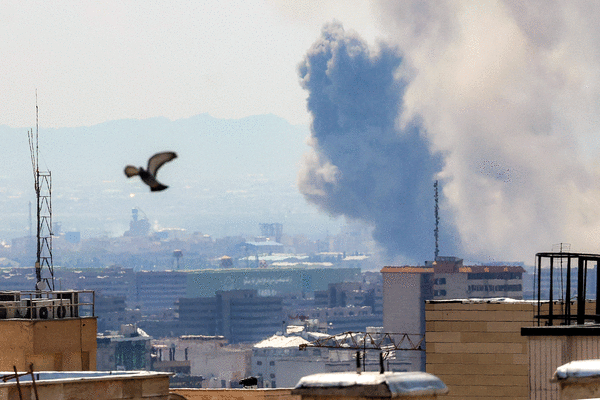
WASHINGTON — The United States and Iran agreed to a two-week ceasefire that is expected to halt the American-Israeli military campaign in exchange for Tehran reopening the Strait of Hormuz.
President Donald Trump announced the agreement Tuesday on social media hours after Pakistan, a mediator in talks, implored the U.S. leader to back off his deadline to unleash massive devastation on Iran if it did not meet his demands. The deal buys time for the two sides to reach a longer agreement to end the six-week-old war, which has killed thousands of people and sparked a global energy crisis.
Trump said he had agreed “to suspend the bombing and attack of Iran for a period of two weeks” as long as Iran agrees to “the COMPLETE, IMMEDIATE, and SAFE OPENING of the Strait of Hormuz.”
Iranian Foreign Minister Abbas Araghchi said in a statement that “for a period of two weeks, safe passage through the Strait of Hormuz will be possible via coordination with Iran’s Armed Forces” and that if attacks against Iran are halted, “our Powerful Armed Forces will cease their defensive operations.”
Israel has also agreed to the ceasefire, according to a White House official.
Oil slumped after Trump announced his decision, which came 90 minutes before his 8 p.m. EDT deadline for Iran to reopen the strait or face a massive military bombardment.
Trump’s decision represents a dramatic climb-down from a bellicose social media post earlier Tuesday, in which he warned “a whole civilization will die tonight, never to be brought back again” if Iran didn’t give in.
After that, it was unclear if a path toward deescalation would be found. U.S. forces in the early hours of Tuesday hit military targets on Iran’s major oil export hub of Kharg Island.
Trump’s threat to strike Iran’s civilian infrastructure, which would violate the Geneva Conventions, prompted Iranian negotiators to cut off diplomatic talks with the U.S., according to a person familiar with the matter.
That set off an eleventh-hour rush by mediators to resume the indirect negotiations. Pakistan Prime Minister Shehbaz Sharif earlier posted on social media that talks were “progressing steadily, strongly and powerfully” and that his country had asked Iran “to open Strait of Hormuz for a corresponding period of two weeks as a goodwill gesture.”
Finalizing the agreement may also prove difficult.
The complete terms of a possible pact weren’t disclosed. Trump only said the U.S. had received a 10-point proposal from Iran, describing it as “a workable basis on which to negotiate.”
“Almost all of the various points of past contention have been agreed to between the United States and Iran, but a two week period will allow the Agreement to be finalized and consummated,” he said.
Much remains unclear about the ceasefire agreement or whether it will hold.
Still, the decision to stand down — at least for now — marked the latest case of the president backing off a threat to broaden the list of military targets in Iran to include civilian infrastructure such as power plants and desalination facilities. In March, he had given Iran five days to reopen the strait or face such attacks, and then extended the deadline another 10 days.
The pattern has become so well-known that it even has its own acronym — TACO, or Trump Always Chickens Out.
Focus will now return to Hormuz and whether ships can pass safely through the vital waterway. While some vessels have made it through the strait in recent weeks, they’ve generally not been from countries Iran views as hostile or having at least tacitly supported the U.S. and Israeli strikes.
“That is the real litmus test — whether operators in the field — ship owners, ship operators — change their behaviors, following the announcement of the ceasefire and maybe some type of reassurance that ships beyond just the already flagged Iraqis are safe,” said Clayton Seigle, a senior fellow at the Center for Strategic and International Studies in Washington.
Before Trump’s post, dated Brent crude, the price valuing most of the world’s real-world oil transactions, had shattered all previous records, hitting $144.42 per barrel, while Brent futures, an international benchmark, traded near $109.
A two-week deadline delay is likely to reset oil prices down to about $100 per barrel. That has emerged as something of a new baseline during the conflict. “That delay by itself would be enough probably to take us down to our new resting level, which is not all the way back by any means,” said Kevin Book, managing director of Washington-based ClearView Energy Partners.
_____
(With assistance from Josh Wingrove, Magdalena Del Valle and Jennifer A. Dlouhy.)
_____
©2026 Bloomberg L.P. Visit bloomberg.com. Distributed by Tribune Content Agency, LLC.






Comments