Retracing the fateful journey of the Tahoe avalanche victims
Published in News & Features
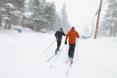

DONNER PASS, Calif. — After 5½ hours on backcountry skis, traversing the Sierra Nevada’s rapidly melting snowpack beneath a scorching spring sun, the guide at the front of our group stopped and went silent.
He dropped to his knees, bowed his head and folded his hands in prayer.
Out of breath, with my thighs burning from a long, steep descent, I was too tired to grasp what he was doing.
Then I noticed the flowers lying in a shallow depression in the snow.
We had arrived.
At this remote spot in February, exactly one month earlier, 13 members of a guided backcountry ski trip were buried by an avalanche during a ferocious blizzard.
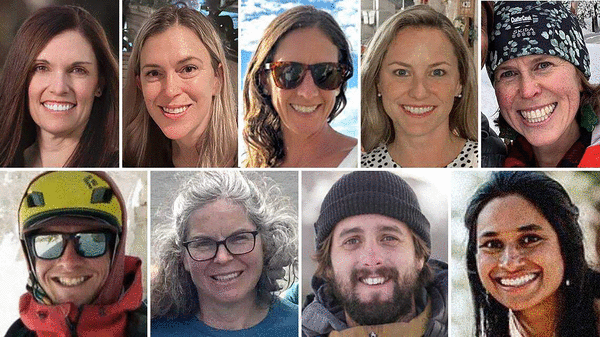
Nine died, including three guides and six of their clients — local women, wives and working moms who had been friends for years — making it the deadliest avalanche in California history.
In mid-March, I joined a professional guide and an experienced backcountry photographer for the difficult trek to the site of the avalanche.
We followed, as closely as we could, the route the skiers took, starting at the trailhead near the summit of Donner Pass, named for the 19th century pioneers who got trapped in a blizzard there and, infamously, resorted to cannibalism.
We covered 10 miles, climbing and descending nearly 5,000 vertical feet — a 9½-hour round trip.
We were searching for something that inevitably eludes social media commentators and online experts dissecting the tragedy from afar, information digital maps and sophisticated satellite imagery can never convey: the feel of the place.
Was the route so intimidating, or exhausting, that it would have clouded their judgment?
What we found shocked us — and made the tragedy seem even sadder and more unfair. The spot where the nine met their fate was postcard peaceful.
Deep in a wooded ravine, bathed in warm sunlight, we knelt behind the makeshift memorial of flowers and looked up the slope that sent tons of snow barreling down. All we could see was a slight rise and a healthy forest of full-grown pine trees.
Big trees are no guarantee of safety in avalanche country, but they’re a good sign because saplings struggle to grow on slopes frequently raked by tons of sliding snow.
It’s clear from maps that the hill above, Perry’s Peak, is steep enough to slide in a very heavy storm. But it’s also clear, as those pines showed, that it doesn’t happen often.
“This is not the spot I would have been most worried about,” said the guide, who asked not to be named for fear that others in the industry would accuse him of seeking publicity by leading a reporter to the spot.
“It’s just crazy. There’s very little damage, and so many people,” said Danny Kern, the backcountry photographer, before his voice trailed off.
‘Are we still going?’
The plan was for the group to spend three days on a trip to Frog Lake, a natural bowl just north of Lake Tahoe and a bucket list destination for backcountry skiers.
Four professionals from Blackbird Mountain Guides and 11 clients — 15 in all — set off on Sunday, Feb. 15.
Among the clients were eight women from the Bay Area, friends in their 40s and early 50s, who seemed to be living the Northern California dream: fit, successful and very outdoorsy. Some had careers in tech and bioscience, and several were connected through the nearby Sugar Bowl Academy, a private boarding school that trains young ski racers.
There were three male clients, including an electrician from the Bay Area and a software engineer originally from Massachusetts. They didn’t know one another and were relatively new to backcountry skiing, relying on the guides for good judgment.
The first big decision arrived before the trip even began. Weather forecasts showed an enormous atmospheric river storm due to slam into the Sierra Nevada on Monday — the second day of the planned outing.
“I know some people actually called the day before and said, ‘There’s a big storm coming. Are we still going?’” said Jim Hamilton, 65, the software engineer. “The guides were like, ‘Yeah, we’re definitely going.’”
For reasons that are unclear, at least one client backed out, according to Nevada County Sheriff Shannan Moon, whose department led the massive effort to rescue survivors and retrieve the bodies.
For others, the looming storm was a feature, not a bug. An undated five-star review on Blackbird’s website for a previous trip to Frog Lake read: “Despite the tough weather and significant avalanche conditions, they kept the tour safe, fun and exhilarating. I now believe storm skiing may be the best way to go.” The reviewer praised at least one of the guides who later died in the Feb. 17 avalanche.
Blackbird representatives did not respond to requests for comment.
When the storm arrived on Monday, as scheduled, Hamilton said it made for the best powder skiing day of his life. Waking up in a Frog Lake hut reminded him of “Christmas morning.”
By Tuesday morning, the storm was outpacing the forecast, on its way to becoming the biggest to hit that section of the Sierra Nevada since 1982. It would dump more than 10 feet of snow over the next few days.
Leave early or hunker down
The guides held a closed-door meeting, emerging to say that they were scrapping the original plan to spend a few hours skiing in the fresh powder near the huts. Instead, they wanted to leave immediately.
According to Hamilton, the guides didn’t raise the possibility of riding out the storm where they were. The huts are in a flat spot near the lake, safe from avalanches. And they’re quite plush by backcountry standards, with beds, leather chairs, a fireplace and a generously stocked kitchen.
But if the group had stayed put, they could have been stuck there for several days, Hamilton said. “I imagine that would have cost money and messed up everyone’s schedules. ... That probably wouldn’t have been a popular option.”
If anyone had believed the storm was life-threatening, they would have snuggled up beside the fire and waited for it to pass, cost and inconvenience be damned. But none of the guides gave any indication they were worried about safety, Hamilton said.
Certainly not Andrew Alissandratos, 34, the leader. He told Hamilton he had once been there in a storm so bad he had to dig down, through the snow, to open the door of a completely buried hut.
He was familiar with the place “in every condition you can imagine,” Hamilton said. “This was just another day at the office for him.”
The way out
Standing on the snowy edge of Frog Lake Cliff, we had an almost perfect bird’s eye view of the accident scene.
From that vantage point, about 1,000 feet above the huts, the escape option the guides didn’t choose was impossible to miss. Johnson Canyon skirts beneath some slopes with avalanche potential but mostly winds downhill along a flat and inviting creek bed.
Taking it, though, would have deposited them on the edge of Interstate 80, miles from their cars.
They would have needed to find a ride up the hill, or maybe into Truckee, the nearest town. Both options would have been complicated with I-80 closed due to the storm.
The guides never discussed taking the easier way out, at least not in front of their clients, as far as Hamilton remembers.
“I guess the logistics of getting us up to our cars was a ‘no go’ for them,” he said.
So the remaining options were to retrace their route in or improvise.
The direct route back to their cars, which they had taken on the way in, would have led them straight to “the notch,” a beautiful gap through the cliffs behind the lake.
On topographical maps published by Truckee and Donner Land Trust, which owns the huts, that route is shaded in bright red and purple, practically screaming, “Avalanche!”
So the guides improvised a slightly longer route that circled behind the towering cliffs and led them to the more gently sloped, forested ravine beneath Perry’s Peak.
It wasn’t perfect. The Sierra Avalanche Center’s update that morning warned that “large avalanches may run through treed areas” and that travelers should be certain “there are no steeper slopes connected to the terrain.”
Still, the route could have been done safely, said another professional guide with years of experience in the Sierra who also asked that his name not be used. “But it’s a bit like threading the needle.”
The key would have been to stay near the middle of the ravine and not stray too far left, directly beneath Perry’s Peak.
“Even in white-out conditions, it can be done,” he said. Guides have GPS on their phones, “like pilots flying by instruments” at night or in bad weather.
“I wouldn’t have been afraid to do it, but my head would have been buried in my phone the whole time,” he said.
Even getting to the ravine turned out to be fraught during the storm, recalled Hamilton and the electrician, Anton Auzans.
First, they had to go up and over a ridge. When they crossed areas that were obviously risky, the guides made them spread out and proceed one at a time — standard procedure in avalanche conditions — so one slide wouldn’t take them all out.
Once they were in the ravine, the snow started coming down harder, and the guides leading the way at times battled through snow up to their waists. The clients started bunching up behind, like traffic on the 405.
What happened next wasn’t just an avalanche — it was more like an ambush.
15 minutes to survive
Auzans remembers hearing someone scream, “Avalanche!” before a wall of white swept down from the hillside to their left. He only had time to look up, see what was coming and dive behind a dead tree. He got swept away like everyone else.
He didn’t panic. He recalled his training and tried to swim toward the surface, using his hands to create an air pocket around his nose and mouth when the sliding stopped. Then, thinking he might never see his 3-year-old son again, Auzans found the strength to punch his way out.
He emerged into a lonely silence. Everyone ahead of him — 12 people — had disappeared in a sea of white.
Two others — Hamilton and the only guide who survived — had fallen behind because Hamilton had been struggling to get his boot into his binding, which is notoriously tricky with backcountry skis, especially in deep snow.
“That’s probably what saved our lives,” Hamilton said.
He didn’t see or hear the avalanche. When he finally got his boot to click into place, he reached the spot where he expected to find the others. “I came out of the woods and there was nothing,” he said. “I was like, ‘Wait, where is everybody?’”
And then he heard Auzans shouting.
The three men — Auzans, Hamilton and the surviving guide — immediately got to work trying to free the others.
They had collapsible shovels to dig and probes, which unfold like tent poles to poke through the debris. They also had beacons, electric devices everyone wears that transmit and receive signals to help find people buried in snow.
But their beacons were so overwhelmed by the number of signals that the arrows on their digital screens kept pointing, wildly, in every direction.
“The thing was just going nuts,” Hamilton said. “It wasn’t homing in on anyone.”
Someone who isn’t killed by the initial trauma of an avalanche — getting swept into a tree or over a cliff, for example — has a 90% chance of survival if they can be freed in 15 minutes.
After that, whatever air is surrounding them inside the snow gets used up.
Working quickly but methodically, the three men had remarkable success, at first. They dug out three people who were still breathing, and all survived.
Then, they reached Alissandratos.
“I saw his face. It was peaceful but just … completely white,” Hamilton said. “He wasn’t even buried that deep.”
The next two skiers they uncovered were also dead.
At some point during the frantic fight to save his comrades, Auzans made the 911 call that triggered a massive search and rescue effort.
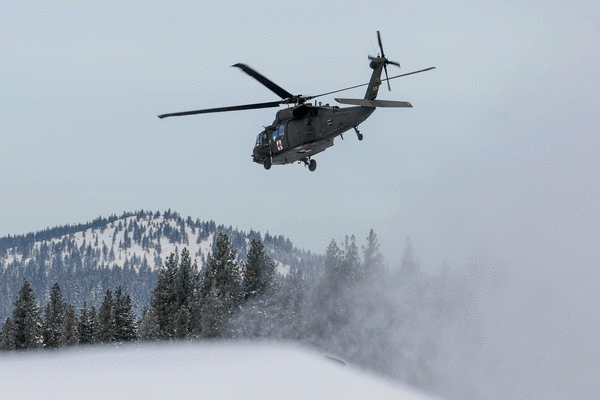
Since there was no chance of flying helicopters, dozens of rescuers from multiple agencies began the arduous, and still very dangerous, journey to the back of Perry’s Peak.
They came up from below Frog Lake — the easier way — and split into two groups: a rescue team and a backup, in case the main team got buried, Hamilton said.
They made it to the huts, but there was so much fresh powder that even the expertly driven snowmobiles kept sinking, Hamilton said. The rescuers had to cover the last mile or so on skis.
They finally reached the six survivors — five clients and a guide — around 5:30 p.m. Even then, the ordeal wasn’t over. After an indescribably stressful and traumatic day, Hamilton said, he was fantasizing about riding down the mountain in a snowcat with the heater going full blast.
Instead, he and the other survivors had to strap on their headlamps and ski back to the huts with their rescuers.
In dicey sections, the rescuers followed protocol and made everyone spread out in single file. Hamilton remembers 10 minutes alone in the dark, shakily trying to follow the tracks in front of him, praying he wouldn’t just disappear into the void.
::::
A month later, I knelt in the fateful spot at the bottom of Perry’s Peak beside my own guide.
The bouquets someone had left were still carefully arranged in the snow. The sun shone down from a brilliant blue sky. The undisturbed trees offered silence and shade.
When I got home, I shared photos and video of the spot with Auzans and Hamilton.
Hamilton said he had spent the first few weeks after the avalanche convinced he would never go near snow again. But he was slowly getting back to himself. He had even gone skiing in the relative safety of a resort the week before.
After seeing the photos, he said, “I definitely want to go back to the spot.” Certainly in the summer as a hike, but maybe even in the winter.
“There’s different types of people, obviously, but everyone on that trip was an adventure person,” Hamilton said. “This is what makes them feel alive.”
He was in no mood to fault the decision-making of his dead companions. But if he had to identify one thing, he would point to overconfidence.
The guides were just “so used to going in and out of there and taking risks and living on the edge,” he said.
Auzans nearly erupted when I described the spot as “peaceful.” But he softened when he saw the images.
“You have to understand the intensity of the storm, the 50-mile-per-hour wind, the environment was alive,” he said. “I suppose if you go to New Orleans on a nice day, you think it’s a great place. If you were there during [Hurricane] Katrina, you’d see it differently.”
While we spoke on the phone, he was driving to pick his son up from school, something he was terrified he’d never get to do again.
The only thing he knew for sure was that they never should have been anywhere near Perry’s Peak in such dangerous avalanche conditions.
For the rest of the questions, he said, “There are no definitive answers. It just happened.”
©2026 Los Angeles Times. Visit at latimes.com. Distributed by Tribune Content Agency, LLC.






Comments