Israel talks, US reassurance indicate deescalation in Lebanon
Published in News & Features
Israel’s Prime Minister Benjamin Netanyahu agreed to hold talks with Lebanon as U.S. President Donald Trump said the Israeli leader is “going to low-key it” with strikes on the war-weary country, signaling some hope for deescalation.
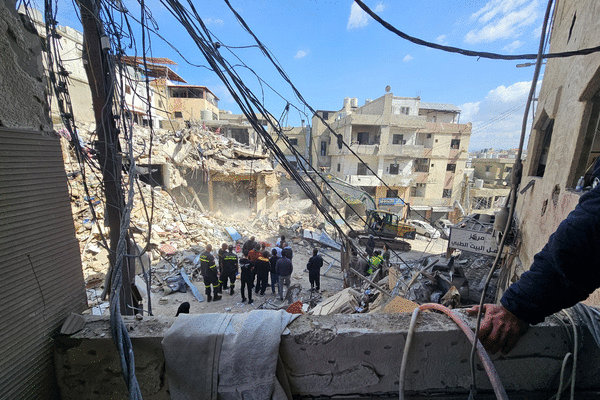
Still, Netanyahu vowed to keep fighting Iran-backed Hezbollah in Lebanon, which on Wednesday suffered the deadliest single-day attacks since the war erupted more than a month ago. The death toll from the offensive left at least 303 people killed and 1,150 wounded, according to the Lebanese Health Ministry.
The strikes, which targeted central Beirut and different parts of the country, came hours after Trump announced a ceasefire with Iran. Pakistani Prime Minister Shehbaz Sharif, a key mediator, initially said the truce included Lebanon, before U.S. and Israeli officials stated the opposite.
Trump, who spoke with Netanyahu on Wednesday, told NBC News that the Israelis were “scaling back” operations in Lebanon, and U.S. Vice President JD Vance said Wednesday that Israel had agreed to “check themselves a little bit in Lebanon” to support the talks.
Israel Defense Forces carried out fewer strikes in the country on Thursday. It will continue to strike Hezbollah until the security of communities in northern Israel is ensured, Netanyahu said. “There is no ceasefire in Lebanon,” he said in a video statement.
The talks, which Lebanon has called for, will focus on disarming Hezbollah and reaching a sustainable peace agreement with the country, he added. The U.S. State Department is expected to host a meeting with Israel and Lebanon next week to discuss ongoing ceasefire negotiations, according to a State Department official.
Lebanon President Joseph Aoun has said the only solution to the situation in Lebanon is to achieve a ceasefire, followed by direct negotiations with Israel. Lebanon has for months been seeking to disarm the militant group, which adamantly refuses to give up its arsenal.
Hezbollah attacked Israel in early March to, it said, avenge the killing of the Iranian Supreme leader Ayatollah Ali Khamenei, who was assassinated in the war that the Jewish state and the U.S. launched against Iran on Feb. 28.
This prompted the Israeli army to invade swaths of Lebanon, ending a ceasefire that followed a war with Hezbollah in 2024, during which the group’s military might was largely diminished. At least 1,888 have been killed in the country since the new war broke out, according the Lebanese Health Ministry.
The ongoing fighting has displaced more than 1 million people across the country, nearly a fifth of the population, as Israel aims to establish a security buffer zone up to the Litani River, located roughly 30 kilometers (19 miles) from the Israeli border.
Iran said it could withdraw from the ceasefire agreement with the U.S. if Israel keeps up its Lebanon campaign. The passage of oil tankers through the Strait of Hormuz, through which about a fifth of the world’s oil and liquefied natural gas is shipped, was halted in response to the attacks.
Trump said he was “optimistic” about a deal with Iran but later threatened Tehran over charging fees in the Strait of Hormuz. Vance is expected to lead the U.S. delegation in discussions scheduled for Saturday in Islamabad over a possible peace agreement with the Islamic Republic.
©2026 Bloomberg L.P. Visit bloomberg.com. Distributed by Tribune Content Agency, LLC.






Comments