Alligator Alcatraz phones were cut off. Then the beatings began, court docs say
Published in News & Features
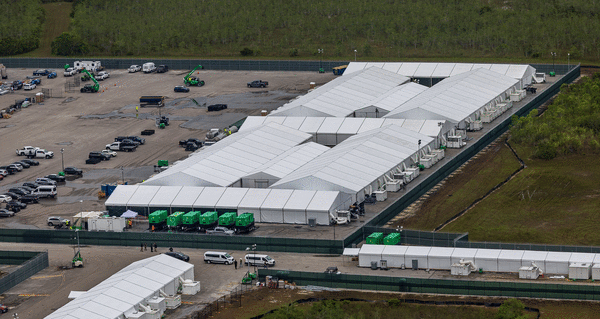
MIAMI — Attorneys representing immigrants held at the “Alligator Alcatraz” detention site alleged Friday in federal court that guards beat and pepper-sprayed detainees after a protest over lost phone access — allegations they argue show state and federal officials defying a recent court order protecting detainees’ civil rights.
In a court filing in Fort Myers, lawyers with the American Civil Liberties Union Foundation and civil rights groups said officers at the controversial Everglades facility entered a unit earlier this month and physically assaulted detainees. One man was thrown to the ground and “severely beat,” according to his attorney, who submitted photographs to the court showing her client with a black eye.
The attorney, Katie Blankenship of the legal-services organization Sanctuary of the South, wrote in a sworn declaration that officers broke another detainee’s wrist and “pepper sprayed everyone in the cage.”
The violence, the attorneys say, erupted after site employees abruptly cut off detainees’ access to phones on April 2 — eliminating what they described as their clients’ only connection to legal counsel and their families.
The day-long prohibition came less than a week after Middle District Judge Sheri Polster Chappell issued an order expanding Alligator Alcatraz detainees’ access to their lawyers and their ability to use phones at the remote pop-up facility.
In the court filing, the ACLU Foundation and partner organizations accused the state and federal government of disregarding Polster Chapell’s March 27 order.
The Florida Division of Emergency Management manages operations at Alligator Alcatraz and must adhere to federal standards set by the U.S. Department of Homeland Security. Spokespeople for FDEM and DHS did not immediately respond to a request for comment late Friday.
According to Blankenship’s declaration, based on first-hand accounts from two detainees, Alligator Alcatraz staff “turned off all the phones in the housing units on” April 2 for the entire day. “The facility did not give them any advanced warning of the phones being cut off, nor did they explain why the phones were cut off,” she wrote.
Detainees grew frustrated. “These phone calls are the only way people can contact loved ones or speak with and secure an attorney,” Blankenship stated.
Blankenship said her clients, Lazaro Hernandez Galban and Raiko Lopez Morffi, complained loudly about the phones not working. Then, guards who worked for the contractor Critical Response Strategies began taunting detainees, threatening to enter the cage where immigrants were held. The situation escalated when a guard punched a detainee.
Critical Response Strategies did not immediately respond to a request for comment late Friday.
Galban and Morffi had tried to deescalate the conflict but instead were targeted by the guards, the declaration states.
“An officer came in and punched Mr. Morffi in his right eye and began to beat him. He was taken out of the cage and thrown to the ground and beaten by multiple guards. He suffered injuries to his shoulder and arm and was kicked in the head. A guard placed their knee on his neck when the guard was trying to restrain him,” the court filing stated.
Blankenship met with Morffi six days later on a video call and took a picture of her screen that she entered into the court record, showing her client’s right eye a dark shade of purple.
The filing alleges other detainees were also beaten and the guards broke a man’s wrist.
Blankenship said the officers pepper-sprayed everyone in the cages, which each house about 32 men.
“A detained older gentleman passed out, as he could not breathe,” the filing stated.
Detainees were so afraid guards would come back to beat them some more, they barricaded the door, eventually allowing staff in to render medical care to injured men, Blankenship wrote.
The phones were eventually turned back on after detainees allowed guards back in their cage, she said. “Staff never provided an explanation to the detainees for why the phones were cut off that whole day. “
The filings late Friday were filed in advance of a Monday hearing before Judge Polster Chappell, whose preliminary injunction mandated several changes: attorneys must be allowed to visit their clients at the facility without previous appointments; more phones must be installed at the facility; and the protocol for visits between lawyers and detainees must be made available in multiple languages and published on an accessible website for lawyers.
The civil rights groups say that has not happened.
©2026 Miami Herald. Visit miamiherald.com. Distributed by Tribune Content Agency, LLC.






Comments