Trump isolation deepens on world stage as allies rebuff, condemn
Published in News & Features
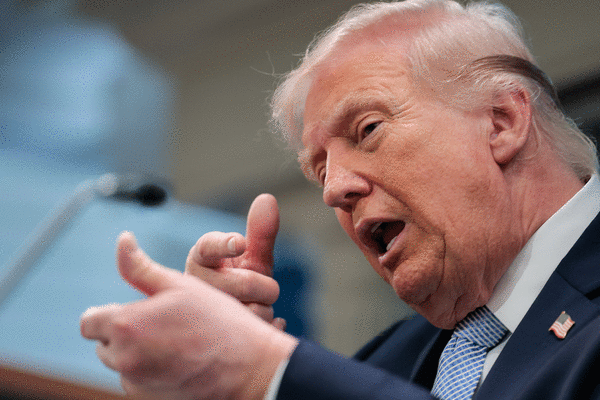
The war in Iran and President Donald Trump’s rhetoric have driven U.S. alliances with Europe near the breaking point.
The U.S. has offered a diplomatic version of the silent treatment to many European partners, refusing to loop them in about its plans for the conflict and progress in peace negotiations, officials on the continent say. That’s included freezing much of Europe out of consultations on his recent move to impose a blockade against the few ships Iran has allowed to navigate the Strait of Hormuz, and Washington’s decision to let a waiver on Russian oil expire.
The U.S. isn’t the only one increasingly going at it alone. The U.K. and France – which have drawn Trump’s ire over their criticism of the war – are expected to host their own conference on Friday to discuss peaceful means to restore free transit through the strait. Meanwhile, many allies have so far refused to participate in the U.S. blockade.
And while the U.S. and European leaders may not be speaking privately, they are quite publicly trading barbs. Following Pope Leo XIV’s criticism of the war in Iran, Trump launched a broadside against the pontiff, calling him “terrible for foreign policy.”
Giorgia Meloni, the Italian prime minister who fostered a friendly relationship with the U.S. president, called Trump’s tirade against the pope “unacceptable” and suspended Italy’s two-decade-old defense pact with Israel, the U.S.’s partner in the war, citing only “the current situation.”
The fissures have emerged against the backdrop of Hungarians over the weekend voting to end the 16-year tenure of Prime Minister Viktor Orban, despite a last-minute campaign visit by U.S. Vice President JD Vance. The defeat was seen as a blow to Trump, who has long hailed Orban — a close ally of Russia’s Vladimir Putin and frequent irritant to the European Union — as among his closest partners on the continent.
Taken in total, the shift has laid bare the limits of Trump’s singular brand of leadership, which has disregarded the coalitions previous presidents built to counter adversaries and foster American soft power abroad.
European officials privately concede that the break is unlikely to prove permanent. Security and energy concerns mean they cannot countenance a full split with Washington, and some even agree Trump’s blockade may provide the necessary pressure to encourage a deal to end the war, according to the officials, who spoke on the condition of anonymity.
Still, it will be up to Trump to unwind the crisis he helped create in the Middle East — and for the U.S. Navy to potentially get involved in reopening the strait, at risk to American servicemembers. That has significant implications for a conflict that has set off a global energy crisis and driven economic uncertainty.
“President Trump and the people around him seem not to understand that American power floats on other countries’ voluntary cooperation to drive down the costs and difficulty of anything we try and do in the world,” said Kori Schake, a former George W. Bush administration official now at the right-leaning American Enterprise Institute.
Instead of pursuing goals that are in the collective interest, “he’s imposing the cost of what is in America’s and Israel’s interests on everybody else in the world — and without even consulting others,” she said.
White House spokeswoman Anna Kelly said Trump is disappointed with European allies for barring U.S. forces from using their bases for the Iran campaign.
“The President has effectively restored America’s standing on the world stage and strengthened relationships abroad – but he simultaneously will never allow the United States to be treated unfairly and taken advantage of by so-called ‘allies,’” Kelly said in an emailed statement.
The speedy deterioration of Trump’s relationships has been remarkable, even for a president known for his volatile temperament and quick disposal of allies.
Trump told Italian daily Corriere della Sera that he was “shocked” by Meloni and no longer saw her as “brave.” It’s a sharp reversal from his previous praise for the leader he once described as a “beautiful young woman” who had taken Europe “by storm.”
There are signs Trump’s gambit is also causing anxiety for U.S. partners in the Persian Gulf. Saudi Arabia is pressing the U.S. to abandon its blockade out of concern Iran could target a Red Sea strait critical for its own crude exports, according to the Wall Street Journal.
To be sure, Gulf countries that have grown closer to the Trump administration say that the military relationship with the U.S. is likely to deepen after the war, according to officials in Europe and the region. But those countries that rely heavily on the U.S. for security will also need to ramp up their defense in the aftermath of the conflict.
The latest developments have deepened already gaping divisions between the U.S. and its partners on trade and security that have built up since his return to office. He antagonized other nations by imposing widespread tariffs on goods from allies and adversaries alike, pulling out of international institutions and chiding leaders for treating the U.S. unfairly.
He also threatened to kneecap NATO, describing the 77-year-old institution as “obsolete,” and targeted the alliance with threats of military action to acquire Greenland, the semi-autonomous Danish territory. Even Trump’s decision to launch strikes with Israel on Iran in February was done without recruiting European countries to join the mission.
The Greenland episode pushed some European officials to be more forceful with Trump after first embracing a more cautious approach during the early months of his second term, according to a person familiar with their thinking.
Trump is driving an “isolationist, interventionist approach,” that’s out of sync with the post-World War II global order, said former Republican Representative Carlos Curbelo. Countries that have chosen not to help the U.S. police Hormuz represent a casualty of that strategy, he said.
“It does appear that we’re finally paying a price for all of that,” he said. “I think he’s isolated, and I think the country is isolated.”
Some Asian allies have stayed quieter about the lack of consultation from Washington, but the situation has still proved challenging. Japanese Prime Minister Sanae Takaichi has been unable to secure a call with Trump since the Iran ceasefire, but did speak by phone with Iranian President Masoud Pezeshkian on April 8.
Trump’s actions have emboldened China, according to some analysts who say they have handed the country potent fodder to strengthen its own ties with Western nations, such as Canada and France. Beijing has warned the U.S. blockade threatens global trade and called for “calm and restraint.”
“The Chinese believe that they are benefiting from being a beacon of stability in a very volatile world,” said Ryan Hass, a former National Security Council official now at the Brookings Institution. “They sort of feel that trends are working in their favor right now so they don’t need to give much or do much to benefit from the windfall of President Trump’s actions on the world stage.”
Meanwhile, the energy supply disruption caused by the war is squeezing American allies. The weeks-long freeze of most oil and liquefied natural gas cargoes through Hormuz has caused cooking fuel shortages for Southeast Asian nations, prompted emergency closures and spurred at least one refinery to shut down.
Now, Trump’s decision to enforce a blockade threatens to further worsen the supply crunch for Japan, the Philippines, South Korea and India. Jet fuel supplies for both civil and military aircraft are of particular concern, the European officials said.
“If I were an Asian country that had worked out a deal with Iran to pay a toll in exchange for getting deliveries of oil or anything else, I would be pretty annoyed that Trump has now rendered that moot,” said Rosemary Kelanic of Defense Priorities, a non-interventionist Washington organization. “That makes the U.S. even more squarely responsible for these oil price spikes.”
_____
(With assistance from Jeff Mason, Catherine Lucey, Daniel Carvalho, Sakura Murakami and Yoshiaki Nohara.)
©2026 Bloomberg L.P. Visit bloomberg.com. Distributed by Tribune Content Agency, LLC.



Comments