'Miami can overcome hate': Unity march brings people together amid growing division
Published in News & Features
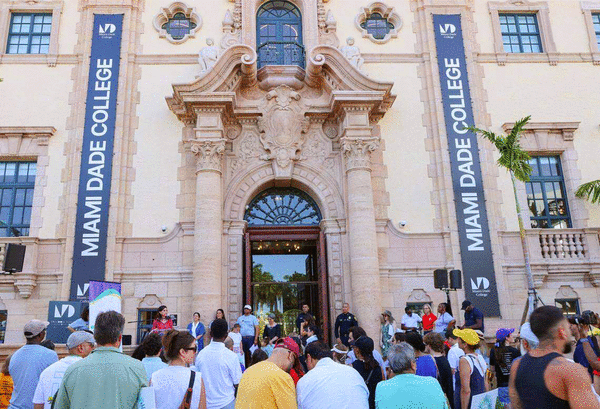
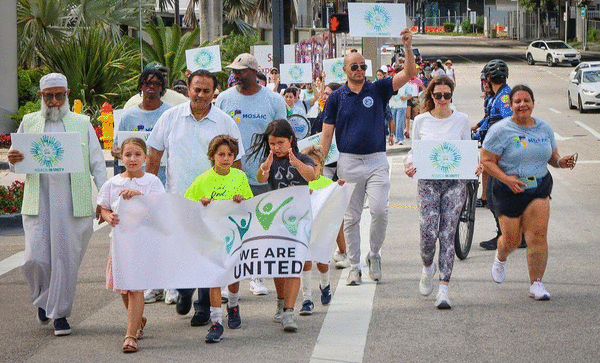
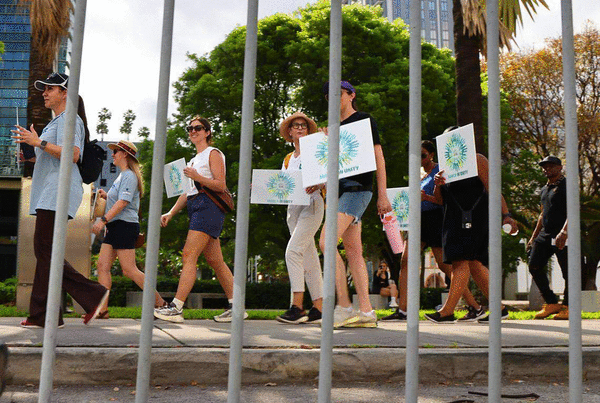


MIAMI —More than 100 Miami residents flooded the streets of downtown Sunday to participate in a march that was far from your typical protest.
The family-friendly, non-political march from the Freedom Tower at Miami-Dade College to the Underline park was meant to be a call for unity and peace amid societal divisions.
“It’s not up to us to have all the answers, but we’re not going to look away,” said Matthew S. Anderson, Executive Director of Mosaic Miami, a civic organization that promotes cross-cultural understanding and the lead organizer of the “We are United: March for Unity.”
“We have to believe that Miami can overcome hate and more importantly that it’s up to us to make that real,” Anderson said.
In its third year, the event has become an annual tradition, drawing a cross-section of Miami’s religious, cultural, civic and nonprofit communities. Over two dozen local groups sponsored the event, including the Office of Mayor Daniella Levine Cava, Office of Mayor Eileen Higgins, The Miami Foundation and The Underline.
The event was designed to be a peaceful, shared moment of action to celebrate Miami’s diverse roots and to “recommit to the values that define us: dignity, respect, and belonging” Anderson said.
As the group crossed the Brickell Avenue Bridge marching to the steady beats of musicians from the nonprofit Guitars Over Guns, Miami-Dade College student Arabella Guglielmi said she showed up to the event in hopes of finding a kind, tolerant community.
“It’s nice to gather with a group of like-minded people,” said Guglielmi, who is originally from Italy. The Italian-exchange student said she prefers attending an event meant to unify people over a more political protest, but wished more students were present.
“I don’t like that confrontation. I like unity more, that’s why I’m here,” Guglielmi said.
Judith Echeverria showed up to the march with a group of congregants from the Unitarian Universalist Congregation of Miami, a church that she says is “very much in alignment with what this group is totally about, which is taking away the hate ... finding the commonality and not dismissing difference,” she said.
Echeverria, who is a part of the social justice committee at the Universalist church, said the church — a relatively new denomination that focuses on social justice issues — teaches about humanity and showing up for society’s most vulnerable.
“When we look at our government right now, it feels like it is not helping. Our government has this tone of fearmongering and hate,” she said.
The Underline park, a 10-mile stretch of public land situated underneath the Metrorail, was intentionally chosen as a meeting point for participants. The park was designed to transform an underutilized space into a vibrant network of public paths where people can walk, run or enjoy outdoor activities.
“This space was truly exemplary of not only unity, but the power of community, getting together and delivering on a vision that started with one person,” said Eulois Cleckley, CEO of Friends of The Underline.
Other faith groups, including the Greater Miami Jewish Federation, the Coalition of South Florida Muslim Organizations and Coral Gables Congregational Church of Christ, were also in attendance.
After hearing from faith leaders and nonprofit partners, attendees played a game meant to inspire connection across different backgrounds, called Connection Bingo.
“When you invite people to connect in a deeper way, at the end of the day, most of all of us are looking for the same values: love, connection, honesty,” said Victoria Santamarina, the Director of Coalitions at Radical Partners and organizer of the activity. “All of that is what brings Miami together.”
________
©2026 Miami Herald. Visit at miamiherald.com. Distributed by Tribune Content Agency, LLC.





Comments