Connecticut House passes vaccine bill in all-day marathon as 98% of state's kindergartners vaccinated
Published in News & Features
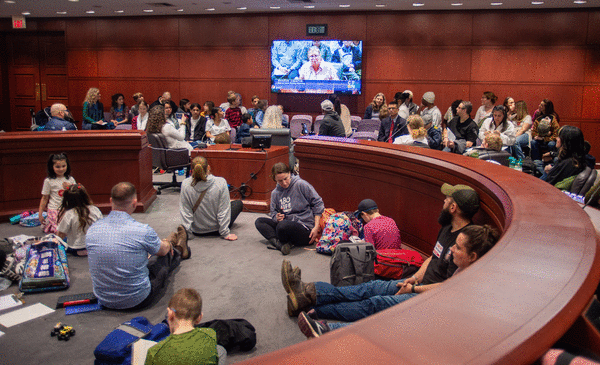
HARTFORD, Conn.— After months of clashes and hours of debate, the state House of Representatives passed a controversial bill Tuesday to ensure the status quo in a state that already has one of the highest vaccination rates in the nation.
Democrats who favored the bill said they were trying to reinforce the status quo at a time when the federal government has raised skepticism about vaccines under President Donald Trump and the nation’s chief health official, Robert F. Kennedy, Jr. But Republicans said they were highly concerned about religious liberty and parents’ rights to make decisions for their children.
After six hours of debate the final vote was 89-60 with two absent. Twelve House Democrats joined with Republicans in voting against the bill.
The bill relates to a long-running battle that dates back to 2021, when the legislature eliminated the religious exemption for all new school students. Students who already had a religious exemption in kindergarten through grade 12 were “grandfathered in” and could maintain their exemption of not being vaccinated, but no new exemptions would be granted.
Since then, the issue has been subject to long-running court challenges that will continue Wednesday in a federal appeals court in New York City.
“We are clarifying for the court that we meant what we said in 2021, that there is no religious exemption,” said House Speaker Matt Ritter, a Hartford Democrat who strongly supports vaccines. “We are not looking to change that law from 2021. … This really is a status quo piece of legislation.”
But Republicans and many families who testified this year at the state Capitol complex were highly concerned about religious liberty and the government’s authority. House Republican leader Vincent Candelora of North Branford said he believes that state officials are concerned that they might lose a pending lawsuit regarding the religious exemption, and thus placed language in the bill that would block parents from exercising their religious rights.
“We’re going to retroactively repeal a substantive right in the Religious Freedom Restoration Act,” Candelora said, referring to state and federal laws that were both passed in 1993. “We think that is highly unusual to do. It’s not something that should be taken lightly, and it’s not something we should be setting precedent for. A lot of the controversy has less to do about the bill and more to do about the fact that we have a population of children that, around 2021, were blocked from being able to attend public school.”
Candelora added, “Those parents are still very vocal. They’re concerned about the impacts that this bill will have. But what we’re doing today is attempting to block a lawsuit to allow for people to have appropriate redress for legislation that they believe was unconstitutionally passed. The legislature is going to come in and try to interfere with that judicial branch and change the outcome of the lawsuit through legislation.”
Based on the controversy of the issue, there was an obvious increased presence of the state Capitol police with multiple officers on the second floor outside the state House of Representatives chamber. Two officers also came to the House Speaker’s traditional pre-session news conference before the debate started in a rare display of police presence.
Connecticut track record
The state, lawmakers said, has made major strides in vaccinations since the religious exemption was removed in 2021.
Connecticut has reached a vaccination rate of 98.2% for enrolled kindergartners, which rates as the nation’s highest and exceeds the 95% threshold needed for herd immunity, legislators said.
The vaccination rates vary sharply, according to public records for the 2024-25 school year, including 100% fully vaccinated at the Tootin’ Hills elementary school in West Simsbury and 98% at the Noah Wallace and East Farms elementary schools in Farmington. The Bugbee, Duffy, Smith Stern, and Webster Hill elementary schools in West Hartford all have 100% rates. At the lowest end, only 58% are fully vaccinated at the Beardsley School in Bridgeport.
Lawmakers said there is a large amount of misinformation and disinformation on the often-emotionally charged issue.
“The biggest misunderstanding is that we’re adding mandates. We are not,” said Rep. Cristin McCarthy Vahey, a Fairfield Democrat who co-chairs the public health committee. “There are no new mandates being put into this bill. … We’re trying to be proactive in the face of uncertainty.”
She added, “We know that vaccines save lives. … This bill does not mandate any new vaccines for adults.”
Court hearing Wednesday
On Wednesday, oral arguments were scheduled to be held in lower Manhattan in a case known as Milford Christian Church v. Beth Bye, which is a Connecticut case regarding the religious exemption. Bye is a former state commissioner and former state senator.
The case involves an appeal by the church to the appeals court “after the state threatened to shut down MCC’s Little Eagles daycare and preschool in 2023 because Little Eagles continues to permit families to utilize religious exemptions to vaccinations required for preschool attendance,” an attorney for We The Patriots USA, Inc. said. “At issue in this case is whether the state violated MCC’s free exercise of religion, and whether the repeal of the state’s religious exemption was unconstitutional.”
On a day when lawmakers were concerned about the legal implications, Ritter said, “Supreme Court case law for 120 years says the right to practice religion freely does not include liberty to expose the community or the child to communicable disease or the latter to ill health or death. It’s been the law of this country for a very long time. Connecticut actually had the mandate to vaccine prior to 1900. That’s the long tradition of this state of believing in vaccines and their efficacy and their safety.”
A nonpartisan summary states that the bill “expressly provides that the state’s Religious Freedom Restoration Act does not apply to school immunization requirements for public and private schools, including higher education institutions, and child care centers and group and family day care homes.”
Rep. Nicole Klarides-Ditria, the ranking House Republican on the public health committee, said the government has to reach “a very high bar” before interfering with a person’s religious beliefs. She asked whether the piece of the bill on religion – Section 14 – was placed in the legislation because the state is worried about losing a lawsuit.
“This legislation is clearly being done because of this pending litigation … and that’s concerning to me,” Klarides-Ditria said. “That should alarm everybody in this chamber, regardless of where you stand on vaccines. I’m not asking you to vote against vaccines. I’m asking you to vote for accountability.”
In a back-and-forth on the House floor Tuesday, lawmakers talked about the pending court case.
“Yes, there is litigation that is occurring right now in our state,” McCarthy Vahey said. “There is litigation related specifically to this part of the statute. … The pending court case remains on one count.”
When asked if the bill was designed in reaction to the skepticism of vaccines by the federal government, McCarthy-Vahey said, “That is the case. … We want to make sure that we can still purchase the vaccines for children.”
She added, “Yes, unfortunately, the changes at the federal level have necessitated parts of this. … We are trying to take the step to assure continuity in our state.”
Unlike some school-aged children, the bill states clearly that nursing home residents retain both the medical and religious exemption, lawmakers said.
While lawmakers repeatedly talked about a “religious exemption,” they said it is actually a philosophical or conscience exemption because no major religion is opposed to vaccines.
Strong opposition
State Rep. Anne Dauphinais, a conservative Republican from Danielson, spoke sharply on the House floor Tuesday against the measure.
“This bill is about control,” Dauphinais said before referring to the major protests at the state Capitol in 2021. “Thousands of people came out. Not a handful. Thousands and thousands of families came out. … Every single vaccine has side effects, and the risk of death. … Now, in order to send them to public school we have to expose them to the risk of injury or death. … When you hear they’re safe and effective, I challenge that.”
She added, “Choose vaccines or public education. Which one am I going to pick?”
Dauphinais said that many families have been unable to obtain a medical exemption.
“Testimony after testimony after testimony,” said Dauphinais, who is a nurse. “People coming in and saying we can’t get a medical exemption. Many doctors are feeling pressure about giving a medical exemption. … Science is never, ever, ever settled, and I will debate any of you all day long.”
Based on statistics from the state public health department, the number of medical exemptions has skyrocketed from 71 in the 2023-24 year to 245 the following year and then 466 in 2025-26.
“You could die if you get the MMR,” Dauphinais said, referring to the measles, mumps and rubella vaccine. “We have a bunch of kings and queens in this room who want to dictate to you. … I personally think we should respect others’ religious views, even if they are different from mine. … I’m ashamed that this may pass today and have such huge ramifications going forward.”
_____
©2026 Hartford Courant. Visit courant.com. Distributed by Tribune Content Agency, LLC.






Comments