Ex-Israeli prime ministers unite parties to take on Netanyahu
Published in News & Features
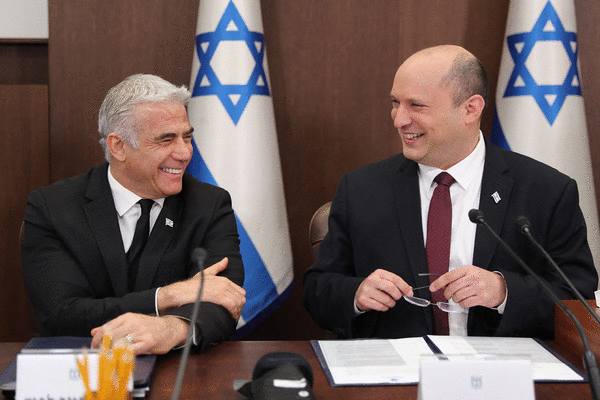
Naftali Bennett and Yair Lapid, two former prime ministers of Israel, announced the merging of their parties, creating a new political entity that could outpoll that of Benjamin Netanyahu’s Likud in the upcoming election.
The party, named Together, will be led by Bennett, a hawk and one-time settler advocate who has edged closer to the center, especially on domestic issues. Although he left politics after losing to Netanyahu in 2022, he is the strongest challenger to the prime minister, according to weekly voter surveys.
Lapid, a centrist whose base is in secular Tel Aviv, currently leads the opposition through his Yesh Atid party. The two co-led a previous big tent government that unseated Netanyahu but lasted barely more than a year before losing to him in 2022.
Netanyahu then formed the most right-wing and religious government in the country’s history. It’s been pursuing populist policies that opponents label divisive and anti-democratic.
A statement from both Bennett and Lapid said the men were announcing “the first step in the process of healing the State of Israel: the merger of the Yesh Atid party and the Bennett 2026 party into a unified party led by former Prime Minister Naftali Bennett.”
“This move unites the ‘reform bloc,’ puts an end to internal infighting, and allows for all efforts to be invested toward a decisive victory in the upcoming elections and to lead Israel toward the necessary reform,” according to the statement.
In their previous arrangement, the two rotated as prime minister. The new deal has no such provision.
Polls this past weekend showed Bennett neck-and-neck with Netanyahu. If he adds Lapid’s projected seats, they could constitute the largest party, giving them the nod to form the next government. Weekend polls showed the opposition bloc, excluding Israeli Arabs, with 60 or 61 seats out of 120, just enough to form a coalition.
Netanyahu, 76, the country’s longest-serving premier, has been biding his time on when to hold the election, which must occur by the end of October.
Major challenges — both foreign and domestic — still face the nation. After Iran-backed Hamas attacked Israel in October 2023, killing and abducting hundreds, Israel launched a long, brutal war in Gaza, killing tens of thousands. It’s also been at war with Iran and Hezbollah in Lebanon. The question is when to turn from war to diplomacy.
Netanyahu is also grappling with the question of whether ultra-Orthodox men should be required to perform military duty. The Supreme Court says they must, but his religious coalition members say they won’t serve in any government that passes such a law.
The recent conflicts have forced other Israelis into hundreds of days of reserve duty, a major social and economic burden, with most Israelis saying the ultra-Orthodox must serve and help defend the country.
Bennett and Lapid favor such conscription and wouldn’t need the ultra-Orthodox parties to form a government, polls suggest. Carrying out such a law, however, will prove challenging, with hundreds of thousands of religious Israelis vowing to fight it.
Netanyahu, who’s on trial for graft, is expected to campaign on his long experience as well as deep friendship and collaboration with U.S. President Donald Trump, as is evidenced by their joint war against Iran.
But that war, while broadly supported at first, hasn’t gone as well as they’d hoped and Israeli public opinion is showing fatigue and disillusion with it.
According to a new poll, about half of Israelis believe Iran has been weakened by the recent campaign, while nearly one-third see no change, and 15% believe Iran has strengthened. Assessments of Israel’s own position are similarly split: 38% believe Israel has grown stronger, while roughly one-third think it has weakened.
_____
©2026 Bloomberg L.P. Visit bloomberg.com. Distributed by Tribune Content Agency, LLC.






Comments