Regulating prediction markets pursued by US senator as Army soldier busted. 'Simply out of control'
Published in News & Features
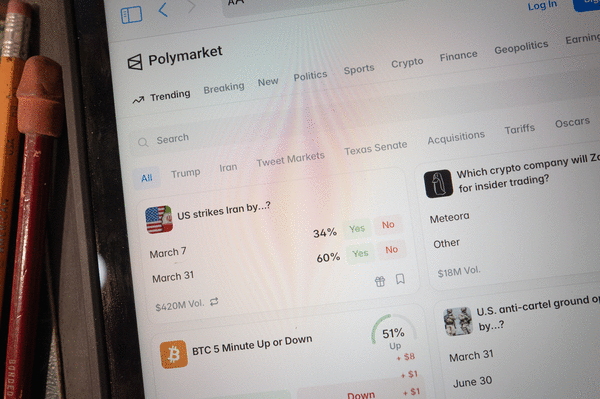
Few Americans knew the exact timing of the ouster of Venezuela’s leader, but for one military insider it was a sure bet.
In the new world of prediction markets, a U.S. Special Forces operative was recently arrested and accused of using secret, classified military information to bet that Nicolas Maduro would be removed from office by a certain date. The soldier received more than $400,000 after betting $33,000 as U.S. forces captured Maduro on Jan. 3, which was 28 days before the betting deadline, according to a federal indictment.
Now, U.S. Sen. Richard Blumenthal and state Attorney General William Tong say the country needs legislation to oversee the betting markets that are led by companies like Polymarket. Blumenthal already proposed federal legislation last month because the fast-growing markets have little oversight and are subject to market manipulation while they do not follow consumer protections and state gambling laws.
“The arrest shows how prediction markets have become a cesspool of insider trading that threatens our national security,” Blumenthal told The Hartford Courant in an interview. “This breach of trust is absolutely unconscionable and unfathomable for a member of our military entrusted with this secret, sensitive information. But it also shows how Polymarket, in effect, breeds this kind of misuse of insider information. It presents an easy source of profiteering because it’s anonymous and it can be done using cryptocurrency and other means of disguising the identity and other factors surrounding the bets.”
Blumenthal added, “It shows these prediction markets are simply out of control.”
The soldier, identified in the indictment as Gannon Ken Van Dyke, is a U.S. Army communications specialist based at Fort Bragg in North Carolina who had signed nondisclosure agreements to “never divulge, publish, or reveal by writing, words, conduct, or otherwise ... any classified or sensitive information,” according to the federal indictment in the Southern District of New York.
Blumenthal, though, said the soldier got caught because he made some mistakes.
“He established an account in his own name,” Blumenthal said. “To be really blunt, he was pretty clumsy in the way he established his account and then collected on his winning contract. He tried to cover his tracks by eliminating the account, but he was pretty unartful overall. He’s a Special Forces guy. He’s not a financial type. ... Someone using a false name and quickly erasing any identifying information much more likely could have avoided apprehension.”
The 38-year-old soldier has been charged with commodities fraud, wire fraud, unlawful use of confidential government information for personal gain, theft of nonpublic government information, and engaging in monetary transactions from unlawful activity. He worked in conjunction with the Joint Special Operations Command, which works with elite teams like SEAL Team Six from the U.S. Navy and Delta Force of the U.S. Army.
New York-based Polymarket cooperated in the investigation and helped federal authorities to make their case.
“When we identified a user trading on classified government information, we referred the matter to the DOJ & cooperated with their investigation,” Polymarket said on X, adding that the arrest shows that “the system works.”
After the arrest, President Donald J. Trump told reporters at the White House that he was “not happy” about the gambling incident. He described the matter as “like Pete Rose betting on his own team,” referring to the famous player who was banned from baseball and blocked from the Hall of Fame in Cooperstown because of his betting.
“The whole world, unfortunately, has become somewhat of a casino, and you look at what’s going on all over the world, in Europe and every place, they’re doing these betting things,” Trump said in remarks that were televised. “I was never much in favor of it. I like it conceptually, but it is what it is.”
Beyond the military case, officials say there have been suspicious trades in the oil futures markets as traders have placed bets that the price of oil would drop — and it did. Last month, U.S. Sen. Chris Murphy said on X that it was corruption when a bet was made immediately before Trump’s announcement that the attacks on Iran would be halted.
“$1.5 BILLION. Let me say it again — a $1.5 BILLION BET,” Murphy wrote. “Bigger than any futures purchases made at the time. 5 minutes before Trump’s post.”
Even before last week’s arrest, Murphy was talking three weeks ago about how the military could be involved in betting related to the Iran War — rather than Maduro’s capture in Venezuela.
“(Prediction) markets are, of course, wildly corrupt and dangerous for our political process,” Murphy said in a Substack column on April 1. “Imagine a high-ranking U.S. military leader, who has wagered $50,000 on a U.S. invasion, pushing for war at the Situation Room table not because it is necessary for our national security, but because he stands to get rich quick from his bet. Imagine the powerful people close to President Trump using classified and highly sensitive inside information about the war to place highly lucrative, successful wagers based on their proximity to power. Of course, you don’t have to imagine these scenarios because they are already happening in real life.”
Murphy added, “What does it do to our soul, as human beings and as American citizens, when questions of life and death, misery and famine, war and peace, stop being matters of morality and become ways to cash in and make money? … I think the transformation of moral questions into financial questions hardens us to suffering, or at the very least, excuses us from grappling with the complicated questions of right and wrong in public decision making.”
With co-sponsors from around the nation in the House and Senate, Murphy has introduced the BETS OFF Act, which stands for Banning Event Trading on Sensitive Operations and Federal Functions. It is designed to stop betting on war, assassinations, government actions, and specific events where an individual either controls or knows about the outcome, such as military actions.
In a related matter, the federal Commodity Futures Trading Commission, which oversees the prediction markets, recently filed lawsuits against Connecticut and other states, saying that the states had tried to “outlaw, regulate and otherwise restrain” the prediction markets.
“The Trump administration is recycling industry arguments that have been rejected in district courts across the country,” Tong said in response. “These contracts are plainly unlicensed illegal gambling under time-worn state law, and we will aggressively defend Connecticut’s commonsense consumer protection laws.”
Multiple federal prosecutors and the FBI investigated the military case regarding Venezuela.
“Prediction markets are not a haven for using misappropriated confidential or classified information for personal gain,” U.S. Attorney Jay Clayton in Manhattan said in a statement. “The defendant allegedly violated the trust placed in him by the United States Government by using classified information about a sensitive military operation to place bets on the timing and outcome of that very operation, all to turn a profit. That is clear insider trading and is illegal under federal law. Those entrusted to safeguard our nation’s secrets have a duty to protect them and our armed service members, and not to use that information for personal financial gain.”
Blumenthal’s bill is called the Prediction Markets Security and Integrity Act, which is designed to prevent fraud in the prediction markets. He has also introduced the Supporting Affordability and Fairness with Every Bet (SAFE Bet) Act that would create safeguards for mobile betting and the Gambling Addiction Recovery, Investment and Treatment (GRIT) Act that would direct money toward the treatment of gambling addiction.
_____
©2026 Hartford Courant. Visit courant.com. Distributed by Tribune Content Agency, LLC.


Comments